Results by title
9 books match the query 'St . Thomas Aquinas'
By knowledge & by love
charity and knowledge in the moral theology of St. Thomas AquinasMichael S. Sherwin
Catholic University of America Press, 2005
By Knowledge and By Love represents a major contribution to Thomistic moral theology and philosophy by providing a thoughtful examination of Aquinas' psychology of action and his theology of charity.
[more]
Christ and Spirituality in St. Thomas Aquinas
Jean-Pierre Torrell
Catholic University of America Press, 2011
The studies in this volume investigate themes of particular spiritual relevance in Aquinas's theology: friendship, charity, prayer, configuration to Christ, priesthood, preaching.
[more]
Perfecting Human Actions
St. Thomas Aquinas on Human Participation in Eternal LawJohn Rziha
Catholic University of America Press, 2009
During the last few centuries, a practical dichotomy between God and humans has developed within moral theory. As a result, moral theory tends to focus only on humans where human autonomy is foundational or only on God where divine commands capriciously rule. However, the moral theology of Thomas Aquinas overcomes this dichotomy. For Thomas, humans reach their perfection by participating in God's wisdom and love.
Perfecting Human Actions explores the ways humans participate in eternal law--God's wisdom that guides and moves all things to their proper action. The book begins with a thoughtful examination of the philosophic recovery of the notion of participation in Thomistic metaphysics. It then explains Thomas's theological understanding of the notion of participation to show how humans are related to God. It is discovered that when performing human actions, humans participate in the eternal law in two ways: as moved and governed by it, and cognitively.
In reference to participation as moved and governed, humans are directed by God to their proper end of eternal happiness. This mode of participation can be increased by perfecting the natural inclinations through virtue, grace, and the gifts of the Holy Spirit. In reference to cognitive participation, humans as rational creatures can know their proper end and how to attain it. Through this knowledge of moral truths, the intellect participates in the eternal law. Cognitive participation is perfected by the intellectual virtues (especially faith) and the gifts of the Holy Spirit (especially wisdom).
The book concludes by showing how the notion of human participation in the eternal law is a much better foundation for moral theory than the contemporary notion of autonomy.
[more]
Reading Job with St. Thomas Aquinas
Matthew Levering
Catholic University of America Press, 2020
Reading Job with St. Thomas Aquinas is a scholarly contribution to Thomistic studies, specifically to the study of Aquinas’s biblical exegesis in relation to his philosophy and theology. Each of the thirteen chapters has a different focus, within the shared concentration of the book on Aquinas’s Literal Exposition on Job. The essays are arranged in three Parts: “Job and Sacra Doctrina”; “Providence and Suffering”; and “Job and the Moral Life”. Boyle’s opening essay argues that Aquinas’s commentary seeks to show what is required in the “Magister” (namely, Job and God) for the effective communication of wisdom. Mansini’s essay argues that by speaking, God reveals the virtue of Job and its value in God’s providence; without the personal revelation or speech of God, Job could not have known the value of his suffering. Vijgen’s essay explores the commentary’s use of Aristotle for reflecting upon divine providence, sorrow and anger, resurrection, and the new heavens and new earth. Levering’s essay explores the commentary’s citations of the Gospel of John and argues that these pertain especially to divine speech and to light/darkness. Bonino’s essay explains why divine incomprehensibility does not mean that Job is wrong to seek to understand God’s ways. Te Velde’s essay explores how Aquinas’s commentary draws upon the reasoning of his Summa contra gentiles with regard to the good order of the universe. Goris’s essay reflects upon how, according to Aquinas’s commentary, sin is and is not related to suffering. Knasas’s essay argues that Aquinas does not hold that the resurrection of the body is a necessary philosophical corollary of the human desire for happiness. Wawrykow’s essay explores merit, in relation to the connection between sin and punishment/affliction as well as to the connection between good actions and flourishing. Spezzano’s essay shows that Job’s hope and filial fear transform his suffering, making him an exemplar of the consolation they provide to the just. Mullady’s essay reflects upon the moral problems and opportunities posed by the passions, along with the ordering of the virtues to the reward of human happiness. Flood’s essay shows how Aquinas defends Job’s possession of the qualities needed for true friendship (including friendship with God), such as patience, delight in the presence of the friend, and compassion. Lastly, Kromholtz’s essay argues that although Aquinas’s Literal Exposition on Job never extensively engages eschatology, Aquinas depends throughout upon the reasonableness of hoping for the resurrection of the body and the final judgment.
[more]
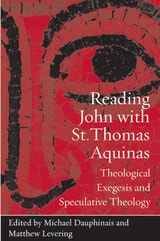
Reading John with St. Thomas Aquinas
Theological Exegesis and Speculative TheologyMichael Dauphinais
Catholic University of America Press, 2005
This volume fits within the contemporary reappropriation of St. Thomas Aquinas, which emphasizes his use of Scripture and the teachings of the church fathers without neglecting his philosophical insight.
[more]
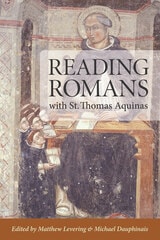
Reading Romans with St. Thomas Aquinas
Matthew Levering
Catholic University of America Press, 2012
This volume fits within the contemporary reappropriation of St. Thomas Aquinas, which emphasizes his use of Scripture and the teachings of the church fathers without neglecting his philosophical insight.
[more]
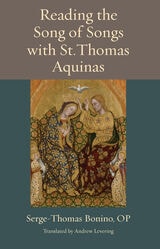
Reading the Song of Songs with St. Thomas Aquinas
Serge-Thomas Bonino
Catholic University of America Press, 2022
St. Thomas Aquinas never commented on the Song of Songs. The purpose of this book is to demonstrate, however, that he meditated on it and absorbed it, so that the words of the Song are for him a familiar repertoire and a theological source. His work contains numerous citations of the Song, not counting his borrowings of vocabulary and images from it. In total, there are 312 citations of the Song in Aquinas’s corpus, along with citations of the Song that are found in citations that Aquinas makes of other authors (as for example in the Catena aurea). Understanding the purpose and placement of these citations significantly enriches our understanding of Aquinas as a theologian, biblical exegete, and spiritual master. The book contains an Appendix listing and contextualizing each citation.
The study of the citations of the Song especially illuminates Aquinas’s spiritual doctrine. By citing the Song, Aquinas emphasizes the spiritual life’s path of dynamic ascent, through an ever increasing participation in the mystery of the nuptial union of Christ and the Church through love. The Song also highlights the eschatological tension or yearning present in the spiritual life, which is ordered to the fullness of beatific vision. Although Aquinas’s theology is highly “intellectual,” by citing the Song he brings out the affective character of the spiritual life and conveys the centrality of love in the soul’s journey toward Christ. He also draws together contemplation and preaching through his use of the Song.
[more]
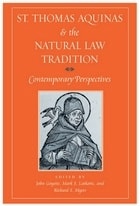
St. Thomas Aquinas and the Natural Law Tradition
Contemporary PerspectivesJohn Goyette
Catholic University of America Press, 2004
To explore and evaluate the current revival, this volume brings together many of the foremost scholars on natural law. They examine the relation between Thomistic natural law and the larger philosophical and theological tradition. Furthermore, they assess the contemporary relevance of St. Thomas's natural law doctrine to current legal and political philosophy.
[more]
The Ethics of St. Thomas Aquinas
Happiness, Natural Law, and the VirtuesLeo Elders
Catholic University of America Press, 2019
"Elders brings to his study an almost encyclopedic knowledge of the history of philosophy. Although he advises his readers not to look for any novel interpretations of Thomas, the book is full of surprises. Time and again, he offers a concise history of the moral issue under consideration...A more authoritative introduction to the moral philosophy of Aquinas is not likely to be found. In fact, it is a delight to read." - Philosophy in Review
[more]