Results by title
3 books match the query 'Stand'

Here I Stand
The Life and Legacy of John BeecherAngela J. Smith
University of Alabama Press, 2017
Biography of a forgotten poet who used his name and influence to speak up for those on the margins of society.
Few surnames resonate in American history more than Beecher. The family’s abolitionist ministers, educators, and writers are central figures in the historical narrative of the United States. The Beechers’ influence was greatest in the nineteenth century, but the family story continued—albeit with less public attention—with a descendant who grew up in Birmingham, Alabama, during the early twentieth century.
John Beecher (1904–1980) never had the public prominence of his famous ancestors, but as a poet, professor, sociologist, New Deal administrator, journalist, and civil rights activist, he spent his life fighting for the voiceless and oppressed with a distinct moral sensibility that reflected his self-identification as the twentieth-century torchbearer for his famous family. While John Beecher had many vocations in his lifetime, he always considered himself a poet and a teacher. Some critics have compared the populist elements of Beecher’s poetry to the work of Walt Whitman and Carl Sandburg, but his writing never gained a broad audience or critical acclaim during his lifetime.
In Here I Stand: The Life and Legacy of John Beecher, Angela J. Smith examines Beecher’s writing and activism and places them in the broader context of American culture at pivotal points in the twentieth century. Employing his extensive letters, articles, unpublished poetry and prose, and audio interviews in addition to his numerous published books, Smith uncovers a record of public concerns in American history ranging from the plight of workers in 1920s steel mills to sharecroppers’ struggles during the Depression to the civil rights movement of the 1960s.
I Stand in My Place With My Own Day Here
Site-Specific Art at The New SchoolEdited by Frances Richard, with a foreword by Lydia Matthews and an introduction by Silvia Rocciolo and Eric Stark
Duke University Press, 2020
Providing a kaleidoscopic view into these works, this richly illustrated volume explores each installation through three to four essays written by critics, poets, and scholars from diverse fields including anthropology, mathematics, art history, media studies, and design. Their texts are complemented by three additional essays reflecting on each piece's art historical significance; the architectural contexts in which the works reside on the university's campus; and The New School's relationship to adventurous art practice. Also included is a roundtable discussion among leading arts educators and artists who reflect on the pedagogical potential of a campus-based contemporary art collection. The book's final section presents a history of each commissioned work, highlighted by archival images never before published.
Published by The New School. Distributed by Duke University Press.
Contributors. Saul Anton, Daniel A. Barber, Stefano Basilico, Carol Becker, Naomi Beckwith, Omar Berrada, Gregg Bordowitz, Tisa Bryant, Holland Cotter, Mónica de la Torre, Aruna D'Souza, Elizabeth Ellsworth, Julia L. Foulkes, Andrea Geyer, Kathleen Goncharov, Jennifer A. González, Michele Greet, Randall Griffey, Victoria Hattam, Pablo Helguera, Jamer Hunt, Anna Indych-López, Luis Jaramillo, Jeffrey Kastner, Robert Kirkbride, Lynda Klich, Carin Kuoni, Sarah E. Lawrence, Tan Lin, Lucy R. Lippard, Laura Y. Liu, Reinhold Martin, Shannon Mattern, Lydia Matthews, Maggie Nelson, Olu Oguibe, G. E. Patterson, Hugh Raffles, Claudia Rankine, Jasmine Rault, Heather Reyes, Frances Richard, Silvia Rocciolo, Carl Hancock Rux, Luc Sante, Mira Schor, Eric Stark, Radhika Subramaniam, Edward J. Sullivan, Roberto Tejada, Otto von Busch, Wendy S. Walters, Jennifer Wilson, Mabel O. Wilson
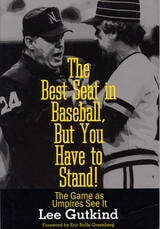
The Best Seat in Baseball, But You Have to Stand
The Game as Umpires See ItLee Gutkind. Foreword by Eric Rolfe Greenburg
Southern Illinois University Press, 1999
To provide this unique—if controversial—look at major league baseball as umpires see it, Lee Gutkind spent the 1974 season traveling with the umpiring crew of Doug Harvey (crew chief), Nick Colosi, Harry Wendelstedt, and Art Williams, the first black umpire in the National League. The result is an honest, realistic, insightful study of the private and professional world of major league umpires: their prejudices and petty biases, their unbending pride in their performance, their inside perspectives on the game, and their bitter criticism of the abuse often directed at their profession and at their conduct. As relevant today as it was in 1974, this illustrated chronicle shows how little has changed in the lives and duties of umpires in the last quarter century.
Guided by his passionate love for the game as he wrote The Best Seat in Baseball, But You Have to Stand!, Gutkind attempted to present the umpires in a positive but realistic light: "I portrayed them as real people, honorable, hard-working and dedicated, but with warts and flaws like the rest of us. But they didn't want to be compared with real people; they wanted to be umpires—on a plateau above most everyone else." Since the publication of this book in 1975, neither Harvey nor Wendelstedt have communicated with Gutkind, with Wendelstedt even denying that Gutkind traveled with the crew.