Results by title
16 books match the query 'State Formation'
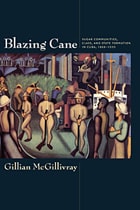
Blazing Cane
Sugar Communities, Class, and State Formation in Cuba, 1868–1959Gillian McGillivray
Duke University Press, 2009
Focusing on sugar communities in eastern and central Cuba, McGillivray recounts how farmers and workers pushed the Cuban government to move from exclusive to inclusive politics and back again. The revolutionary caudillo networks that formed between 1895 and 1898, the farmer alliances that coalesced in the 1920s, and the working-class groups of the 1930s affected both day-to-day local politics and larger state-building efforts. Not limiting her analysis to the island, McGillivray shows that twentieth-century Cuban history reflected broader trends in the Western Hemisphere, from modernity to popular nationalism to Cold War repression.
Civil War and State Formation
The Political Economy of War and Peace in LiberiaFelix Gerdes
Campus Verlag, 2013
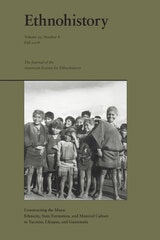
Constructing the Maya
Ethnicity, State Formation, and Material Culture in Yucatán, Chiapas, and Guatemala, Volume 55Paul K. Eiss, special issue editor
Duke University Press, 0
Contributors: David Carey Jr., Paul K. Eiss, Ben Fallaw, Stephen E. Lewis, Walter E. Little, John M. Watanabe
Everyday Forms of State Formation
Revolution and the Negotiation of Rule in Modern MexicoGilbert M. Joseph and Daniel Nugent, eds.
Duke University Press, 1994
Structured in the form of a dialogue between a distinguished array of Mexicanists and comparative social theorists, this volume boldly reassesses past analyses of the Mexican revolution and suggests new directions for future study. Showcasing a wealth of original archival and ethnographic research, this collection provides a new and deeper understanding of Mexico’s revolutionary experience. It also speaks more broadly to a problem of extraordinary contemporary relevance: the manner in which local societies and self-proclaimed "revolutionary" states are articulated historically. The result is a unique collection bridging social history, anthropology, historical sociology, and cultural studies in its formulation of new approaches for rethinking the multifaceted relationship between power, culture, and resistance.
Contributors. Ana María Alonso, Armando Bartra, Marjorie Becker, Barry Carr, Philip Corrigan, Romana Falcón, Gilbert M. Joseph, Alan Knight, Florencia E. Mallon, Daniel Nugent, Elsie Rockwell, William Roseberry, Jan Rus, Derek Sayer, James C. Scott

From Palestine to Israel
A Photographic Record of Destruction and State Formation, 1947-1950Ariella Azoulay
Pluto Press, 2011
In this carefully curated and beautifully presented photobook, Ariella Azoulay offers a new perspective on four crucial years in the history of Palestine/Israel.
The book reconstructs the processes by which the Palestinian majority in Mandatory Palestine became a minority in Israel, while the Jewish minority established a new political entity in which it became a majority ruling a minority Palestinian population. By reading over 200 photographs from that period, most of which were previously confined to Israeli state archives, Azoulay recounts the events and the stories that for years have been ignored or only partially acknowledged in Israel and the West.
Including substantial analytical text, this book will give activists, scholars and journalists a new perspective on the origins of the Palestine-Israel conflict.
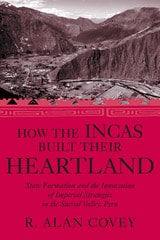
How the Incas Built Their Heartland
State Formation and the Innovation of Imperial Strategies in the Sacred Valley, PeruR. Alan Covey
University of Michigan Press, 2006
In How the Incas Built Their Heartland R. Alan Covey supplements an archaeological approach with the tools of a historian, forming an interdisciplinary study of how the Incas became sufficiently powerful to embark on an unprecedented campaign of territorial expansion and how such developments related to earlier patterns of Andean statecraft. In roughly a hundred years of military campaigns, Inca dominion spread like wildfire across the Andes, a process traditionally thought to have been set in motion by a single charismatic ruler, Pachacuti Inca Yupanqui. Taking nearly a century of archaeological research in the region around the Inca capital as his point of departure, Covey offers an alternative description of Inca society in the centuries leading up to imperial expansion. To do so, Covey proposes a new reading of the Spanish chronicles, one that focuses on processes, rather than singular events, occurring throughout the region surrounding Cusco, the Inca capital. His focus on long-term regional changes, rather than heroic actions of Inca kings, allows the historical and archaeological evidence to be placed on equal interpretive footing. The result is a narrative of Inca political origins linking Inca statecraft to traditions of Andean power structures, long-term ecological changes, and internal social transformations. By reading the Inca histories in a compatible way, Covey shows that it is possible to construct a unified theory of how the Inca heartland was transformed after AD 1000.
R. Alan Covey is Assistant Professor of Anthropology at Southern Methodist University.
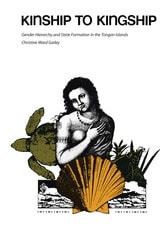
Kinship to Kingship
Gender Hierarchy and State Formation in the Tongan IslandsBy Christine Ward Gailey
University of Texas Press, 1987
Have women always been subordinated? If not, why and how did women’s subordination develop? Kinship to Kingship was the first book to examine in detail how and why gender relations become skewed when classes and the state emerge in a society.
Using a Marxist-feminist approach, Christine Ward Gailey analyzes women’s status in one society over three hundred years, from a period when kinship relations organized property, work, distribution, consumption, and reproduction to a class-based state society. Although this study focuses on one group of islands, Tonga, in the South Pacific, the author discusses processes that can be seen through the neocolonial world.
This ethnohistorical study argues that evolution from a kin-based society to one organized along class lines necessarily entails the subordination of women. And the opposite is also held to be true: state and class formation cannot be understood without analyzing gender and the status of women. Of interest to students of anthropology, political science, sociology, and women’s studies, this work is a major contribution to social history.
Moral Economies of Corruption
State Formation and Political Culture in NigeriaSteven Pierce
Duke University Press, 2016
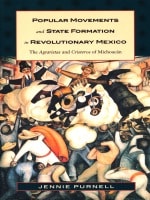
Popular Movements and State Formation in Revolutionary Mexico
The Agraristas and Cristeros of MichoacanJennie Purnell
Duke University Press, 1999
Rather than viewing the cristeros (supporters of the Church) as victims of false consciousness or as religious fanatics, as others have done, Purnell shows that their motivations—as well as the motivations of the agraristas (supporters of the revolutionary state)—stem from local political conflicts that began decades, and sometimes centuries, before the Revolution. Drawing on rich but underutilized correspondence between peasants and state officials written over the course of the nineteenth and twentieth centuries, Purnell shows how these conflicts shaped the relationships between property rights, religious practice, and political authority in the center-west region of Mexico and provides a nuanced understanding of the stakes and interests involved in subsequent conflicts over Mexican anticlericalism and agrarian reform in the 1920s.
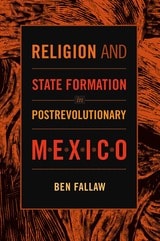
Religion and State Formation in Postrevolutionary Mexico
Ben Fallaw
Duke University Press, 2012
Ben Fallaw argues that previous scholarship has not appreciated the pervasive influence of Catholics and Catholicism on postrevolutionary state formation. By delving into the history of four understudied Mexican states, he is able to show that religion swayed regional politics not just in states such as Guanajuato, in Mexico's central-west "Rosary Belt," but even in those considered much less observant, including Campeche, Guerrero, and Hidalgo. Religion and State Formation in Postrevolutionary Mexico reshapes our understanding of agrarian reform, federal schooling, revolutionary anticlericalism, elections, the Segunda (a second Cristero War in the 1930s), and indigenism, the Revolution's valorization of the Mesoamerican past as the font of national identity.
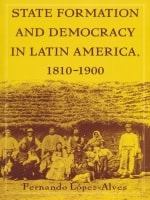
State Formation and Democracy in Latin America, 1810-1900
Fernando López-Alves
Duke University Press, 2000
Breaking with the traditional economic analysis of South American development, López-Alves argues that civil-military relations lay at the core of state building. By comparing three countries in particular—Uruguay, Colombia, and Argentina—during an intense phase of state and regime formation, he shows how war and the collective action of the rural poor contributed to the construction of central armies, the rise of new social classes, and the emergence of civilian organizations. He also examines characteristics unique to each country’s war-formed culture and discusses how coalitions were built during this period. Examples from Paraguay and Venezuela and references to state formation in Europe, the United States, Asia, and the Middle East add to the complexity and richness of the study’s comparative analysis.
Drawing on a vast bibliography of both primary and secondary sources, López-Alves goes beyond providing insights into the particular development of Latin American countries and introduces a comprehensive theory of state formation applicable to other regions. This book will interest Latin Americanists, historians, political scientists, and sociologists studying state formation.
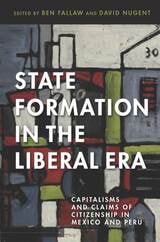
State Formation in the Liberal Era
Capitalisms and Claims of Citizenship in Mexico and PeruEdited by Ben Fallaw and David Nugent
University of Arizona Press, 2020
Mexico and Peru are widely regarded as two great centers of Latin American civilization. In State Formation in the Liberal Era, a diverse group of historians and anthropologists from the United States, the United Kingdom, and Latin America compare how the two countries advanced claims of statehood from the dawning of the age of global liberal capitalism to the onset of the Cold War. Chapters cover themes ranging from foreign banks to road building and labor relations. The introductions serve as an original interpretation of Peru’s and Mexico’s modern histories from a comparative perspective.
Focusing on the tensions between disparate circuits of capital, claims of statehood, and the contested nature of citizenship, the volume spans disciplinary and geographic boundaries. It reveals how the presence (or absence) of U.S. influence shaped Latin American history and also challenges notions of Mexico’s revolutionary exceptionality. The book offers a new template for ethnographically informed comparative history of nation building in Latin America.
State Formation
Anthropological PerspectivesEdited by Christian Krohn-Hansen and Knut G. Nustad
Pluto Press, 2005
The contributors argue that the state is not a fixed and definite object. Our perceptions of it are constantly changing, and differ from person to person. What is your idea of the state if you are a refugee? Or if you are living in post-aparteid South Africa? Our perceptions are formed and sustained by evolving discourses and techniques---these come from institutions such as government, but are also made by communities and individuals.
The contributors examine how state structures are viewed from the inside, by official state bodies, composed of bureaucrats and politicians; and how these state manifestations are supported, reproduced or transformed at a local level. An outline of theoretical approaches is followed by nine case studies ranging from South Africa to Peru to Norway.
With a good range of contributors including Cris Shore, Clifton Crais, Ana Alonso and Bruce Kapferer, this is a comprehensive critical analysis of anthropological approaches to the study of state formation.
The Political Economy of NGOs
State Formation in Sri Lanka and BangladeshJude L. Fernando
Pluto Press, 2011
Jude L. Fernando explores the paradoxical relationship between NGOs and capitalism, showing that supposedly progressive organisations often promote essentially the same policies and ideas as existing governments.
The book examines how a diverse group of NGOs have shaped state formation in Bangladesh and Sri Lanka. It argues that, rather than influencing state formation for the better, NGOs have been integrated into the capitalist system and their language adopted to give traditional exploitative social relations a transformative appearance.
This enlightening study will give pause to those who see NGOs as drivers of true social change and will encourage students of development studies to make a deeper analysis of state formation.
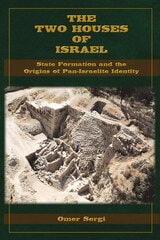
The Two Houses of Israel
State Formation and the Origins of Pan-Israelite IdentityOmer Sergi
SBL Press, 2023
The Two Houses of Israel: State Formation and the Origins of Pan-Israelite Identity bridges the gap between the biblical narrative of the great united monarchy ruled by David and Solomon and archaeological and historical reconstructions of a gradual, independent formation of Israel and Judah. Based on a thorough examination of the material remains and settlement patterns in the southern Levant during the Late Bronze Age and the Iron Age and on a review of the relevant historical sources, this book provides a detailed reconstruction of the ways in which Israel and Judah were formed as territorial polities and specifically how the house of David rose to power in Jerusalem and Judah. Omer Sergi further situates the stories of Saul and David in their accurate social and historical context in order to illuminate the historical conception of the united monarchy and the pan-Israelite ideology out of which it grew. Sergi provides a new history of the early Israelite monarchies, their formation, and the ways in which these social and political developments were commemorated in the cultural memory of generations to come.
The Unruly Dead
Spirits, Memory, and State Formation in Timor-LesteLia Kent
University of Wisconsin Press, 2024
With generous, careful ethnography and incisive analysis, Kent challenges comfortable, linear narratives of transitional justice and argues that this memory work is reshaping the East Timorese social and political order—a process in which the dead are active, and sometimes disruptive, participants. Community ties and even the landscape itself are imbued with their presence and demands, and the horrific scale of mass death in recent times—at least a third of the population perished during the Indonesian occupation—means Timor-Leste’s dead have real, significant power in the country’s efforts to remember, recover, and reestablish itself.