Results by title
5 books match the query 'State Legislatures'
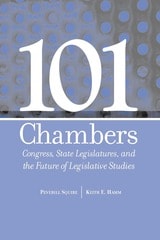
101 CHAMBERS
CONGRESS, STATE LEGISLATURES, & THE FUTURE OF LEGISLATIVE STUDIESPeverill Squire and Keith E. Hamm
The Ohio State University Press, 2005
Although legislative studies is thriving, it suffers from one glaring weakness: a lack of truly comparative, cross-institutional research. Instead, research focuses overwhelmingly on the U.S. Congress. This unfortunate fixation limits the way scholars approach the testing of many compelling theories of legislative organization and behavior, and it ignores the invaluable research possibilities that comparison with the 99 American state legislative chambers offers.
State legislatures are easily compared to Congress: They arise out of the same political culture and history. Their members represent the same parties and face the same voters in the same elections using the same rules. And the functions and roles are the same, with each fully capable of initiating, debating, and passing legislation. None of the methodological problems found when comparing presidential system legislatures with parliamentary system legislatures arise when comparing Congress and the state legislatures.
However, while there are great similarities, there are also important differences that provide scholars leverage for rigorously testing theories. The book compares and contrasts Congress and the state legislatures on histories, fundamental structures, institutional and organizational characteristics, and members. By highlighting the vast array of organizational schemes and behavioral patterns evidenced in state legislatures, the authors demonstrate that the potential for the study of American legislatures, as opposed to the separate efforts of Congressional and state legislative scholars, is too great to leave unexplored.

Accountability in State Legislatures
Steven Rogers
University of Chicago Press, 2023
A troubling portrait of democracy in US state legislatures.
State legislatures hold tremendous authority over key facets of our lives, ranging from healthcare to marriage to immigration policy. In theory, elections create incentives for state legislators to produce good policies. But do they?
Drawing on wide-ranging quantitative and qualitative evidence, Steven Rogers offers the most comprehensive assessment of this question to date, testing different potential mechanisms of accountability. His findings are sobering: almost ninety percent of American voters do not know who their state legislator is; over one-third of incumbent legislators run unchallenged in both primary and general elections; and election outcomes have little relationship with legislators’ own behavior.
Rogers’s analysis of state legislatures highlights the costs of our highly nationalized politics, challenging theories of democratic accountability and providing a troubling picture of democracy in the states.
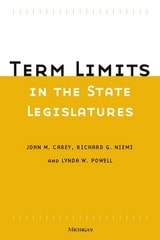
Term Limits in State Legislatures
John M. Carey, Richard G. Niemi, and Lynda W. Powell
University of Michigan Press, 2000
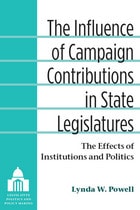
The Influence of Campaign Contributions in State Legislatures
The Effects of Institutions and PoliticsLynda W. Powell
University of Michigan Press, 2012
Campaign contributions are widely viewed as a corrupting influence but most scholarly research concludes that they have marginal impact on legislative behavior. Lynda W. Powell shows that contributions have considerable influence in some state legislatures but very little in others. Using a national survey of legislators, she develops an innovative measure of influence and delineates the factors that explain this great variation across the 99 U.S. state legislative chambers.
Powell identifies the personal, institutional, and political factors that determine how much time a legislator devotes to personal fundraising and fundraising for the caucus. She shows that the extent of donors' legislative influence varies in ways corresponding to the same variations in the factors that determine fundraising time. She also confirms a link between fundraising and lobbying with evidence supporting the theory that contributors gain access to legislators based on donations, Powell's findings have important implications for the debate over the role of money in the legislative process.
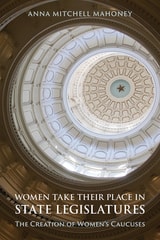
Women Take Their Place in State Legislatures
The Creation of Women's CaucusesAnna Mitchell Mahoney
Temple University Press, 2019
How do women strategically make their mark on state legislatures? Anna Mitchell Mahoney’s book traces the development of women’s state legislative caucuses and the influence both gender and party have on women’s ability to organize collectively. She provides a comprehensive analysis of how and why women organize around their gender identity in state legislatures—or why they do not.
Women Take Their Place in State Legislatures includes a quantitative analysis of institutional-level variables and caucus existence in all 50 states. Case studies of caucus attempts in New Jersey, Colorado, Pennsylvania, and Iowa between 2006 and 2010 examine attempts at creating women’s caucuses that succeeded or failed, and why. Mahoney’s interviews with 180 state legislators and their staff explore the motivations of caucus creators and participants. Ultimately, she finds that women’s organizing is contextual; it demonstrates the dynamic nature of gender.
Mahoney also provides insights into broad questions regarding gendered institutions, collective action, and political party governance. Women Take Their Place in State Legislatures fills a lacuna in the evaluation of women in government.