Results by title
6 books match the query 'State supervision'
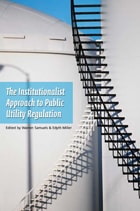
An Institutionalist Approach to Public Utility Regulation
Edythe S. Miller
Michigan State University Press, 2002
For the past several decades, a climate of deregulation has encompassed industries ranging from public utilities to mass transportation. Harry Martin Trebing has been at the forefront of this debate as one of the world’s foremost specialists in the field of public utility regulation. Warren J. Samuels and Edythe S. Miller have collected a series of articles that assess Trebing’s theories on public utility regulation while examining his towering contribution to the field.
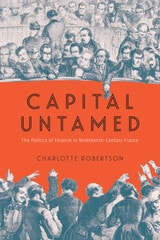
Capital Untamed
The Politics of Finance in Nineteenth-Century FranceCharlotte Robertson
University of Chicago Press, 2026
The story of a bold political experiment in nineteenth-century France to establish power through finance.
Amid the rise of industrial capitalism and revolutionary upheaval, French reformers asserted that finance should be reimagined as an instrument of economic and social transformation rather than left to the logic of private profit and speculation. In the 1850s, under Napoleon III’s authoritarian regime, this vision took institutional form as the Bonapartist state strategically deployed finance, broadened market participation, and sponsored new banks with the promise of directing investment toward infrastructure and industry. Yet this effort to harness and mobilize capital ran into a problem: The financial markets refused to be tamed.
Drawing on rich archival sources—from police surveillance and courtroom transcripts to investment manuals and petitions for incorporation—Capital Untamed reveals how the financial markets became an instrument of political power, frustrated state ambitions, and ultimately escaped attempts at mastery. In this striking debut, historian Charlotte Robertson shows how the French state and its citizens navigated a turbulent era of European capitalism animated by debates over the social purpose of financial capital. Ultimately, politicians’ efforts to establish legitimacy by reorganizing finance—and their confrontations with the limits of that project—set the stage for a form of modern discontent with the financial system that survives to this day.

Democracy and Regulation
How the Public Can Govern Essential ServicesGreg Palast, Theo MacGregor, and Jerrold Oppenheim
Pluto Press, 2002
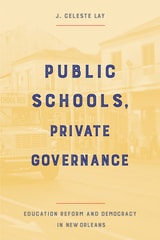
Public Schools, Private Governance
Education Reform and Democracy in New OrleansJ. Celeste Lay
Temple University Press, 2022
Two months after Hurricane Katrina, Louisiana took control of nearly all the public schools in New Orleans. Today, all of the city’s public schools are charter schools. Although many analyses mark the beginning of education reform in New Orleans with Katrina, in Public Schools, Private Governance, J. Celeste Layargues that the storm merely accelerated the timeline for reforms that had inched along incrementally over the previous decade. Both before and after Katrina, white reformers purposely excluded Black educators, community members, and parents.
Public Schools, Private Governance traces the slow, deliberate dismantling of New Orleans’ public schools, and the processes that have maintained the reforms made in Katrina’s immediate aftermath, showing how Black parents and residents were left without a voice and the officials charged with school governance, most of whom are white, with little accountability. Lay cogently explains how political minorities disrupted systems to create change and keep reforms in place, and the predictable political effects—exclusion, frustration, and resignation—on the part of those most directly affected.

The Government of Mistrust
Illegibility and Bureaucratic Power in Socialist VietnamKen MacLean
University of Wisconsin Press, 2013
The Industrial Organization and Regulation of the Securities Industry
Edited by Andrew W. Lo
University of Chicago Press, 1995
Ten original essays address topics including electronic trading and the "virtual"stock exchange; trading costs and liquidity on the London and Tokyo Stock Exchanges and in the German and Japanese government bond markets; international coordination among regulatory agencies; and the impact of changing margin requirements on stock prices, volatility, and liquidity.
This clear presentation of groundbreaking research will appeal to economists, lawyers, and legislators who seek a refreshingly new perspective on policy issues in the securities industry.