Results by title
18 books match the query 'State-sponsored terrorism'
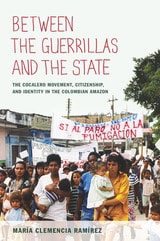
Between the Guerrillas and the State
The Cocalero Movement, Citizenship, and Identity in the Colombian AmazonMaría Clemencia Ramírez
Duke University Press, 2011
Cruel Modernity
Jean Franco
Duke University Press, 2013
Franco draws on human-rights documents, memoirs, testimonials, novels, and films, as well as photographs and art works, to explore not only cruel acts but the discriminatory thinking that made them possible, their long-term effects, the precariousness of memory, and the pathos of survival.
Cultures of Resistance
Collective Action and Rationality in the Anti-Terror AgeHeidi Reynolds-Stenson
Rutgers University Press, 2022
Cultures of Resistance provides new insight on a long-standing question: whether government efforts to repress social movements produce a chilling effect on dissent, or backfire and spur greater mobilization. In recent decades, the U.S. government’s repressive capacity has expanded dramatically, as the legal, technological, and bureaucratic tools wielded by agents of the state have become increasingly powerful. Today, more than ever, it is critical to understand how repression impacts the freedom to dissent and collectively express political grievances. Through analysis of activists’ rich and often deeply moving experiences of repression and resistance, the book uncovers key group processes that shape how individuals understand, experience, and weigh these risks of participating in collective action. Qualitative and quantitative analyses demonstrate that, following experiences of state repression, the achievement or breakdown of these group processes, not the type or severity of repression experienced, best explain why some individuals persist while others disengage. In doing so, the book bridges prevailing theoretical divides in social movement research by illuminating how individual rationality is collectively constructed, mediated, and obscured by protest group culture.
Disruptive Archives
Feminist Memories of Resistance in Latin America's Dirty WarsViviana Beatriz MacManus
University of Illinois Press, 2020
Haunting and methodologically innovative, Disruptive Archives attests to the power of women's storytelling and memory in the struggle to reclaim history.

Global Matrix
Nationalism, Globalism and State-TerrorismTom Nairn and Paul James
Pluto Press, 2005
Jallad
Death Squads and State Terror in South AsiaTasneem Khalil
Pluto Press, 2015
An unsparing indictment of an international system of terror that is fully countenanced by the West, Jallad presents close-up, detailed accounts of incidents of state terror and targeted violence throughout South Asia. Khalil, a reporter who himself endured torture at the hands of agents in Bangladesh, and whose remarkable story was featured in the New York Times, draws on countless hours of on-the-ground reporting and a broad network of activists and human rights advocates to build an undeniable portrait of the domination and repression that lies at the very core of statecraft in South Asia. Shielded by their protectors in the developed world, the perpetrators of these abuses deploy them strategically to silence dissent and crush opposition.
A brave, essential work of reporting and investigation, Jallad brings these horrific acts to prominence in order to make it impossible for Western governments to continue turning a blind eye to the human rights violations of their erstwhile allies.
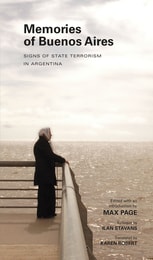
Memories of Buenos Aires
Signs of State Terrorism in ArgentinaMax Page
University of Massachusetts Press, 2013
In the 1970s, Argentina was the leader in the “Dirty War,” a violent campaign by authoritarian South American regimes to repress left-wing groups and any others who were deemed subversive. Over the course of a decade, Argentina's military rulers tortured and murdered upwards of 30,000 citizens. Even today, after thirty years of democratic rule, the horror of that time continues to roil Argentine society.
Argentina has also been in the vanguard in determining how to preserve sites of torture, how to remember the “disappeared,” and how to reflect on the causes of the Dirty War. Across the capital city of Buenos Aires are hundreds of grassroots memorials to the victims, documenting the scope of the state's reign of terror. Although many books have been written about this era in Argentina's history, the original Spanish-language edition of Memories of Buenos Aires was the first to identify and interpret all of these sites. It was published by the human rights organization Memoria Abierta, which used interviews with survivors to help unearth that painful history.
This translation brings this important work to an English-speaking audience, offering a comprehensive guidebook to clandestine sites of horror as well as innovative sites of memory. The book divides the 48 districts of the city into 9 sectors, and then proceeds neighborhood-by-neighborhood to offer descriptions of 202 known “sites of state terrorism” and 38 additional places where people were illegally detained, tortured, and killed by the government.
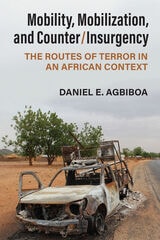
Mobility, Mobilization, and Counter/Insurgency
The Routes of Terror in an African ContextDaniel E. Agbiboa
University of Michigan Press, 2022
In Mobility, Mobilization, and Counter/Insurgency, Daniel Agbiboa takes African insurgencies back to their routes by providing a transdisciplinary perspective on the centrality of mobility to the strategies of insurgents, state security forces, and civilian populations caught in conflict. Drawing on one of the world’s deadliest insurgencies, the Boko Haram insurgency in northeast Nigeria and the Lake Chad region, this well-crafted and richly nuanced intervention offers fresh insights into how violent extremist organizations exploit forms of local immobility and border porosity to mobilize new recruits, how the state’s “war on terror” mobilizes against so-called subversive mobilities, and how civilian populations in transit are treated as could-be terrorists and subjected to extortion and state-sanctioned violence en route. The multiple and intersecting flows analyzed here upend Eurocentric representations of movement in Africa as one-sided, anarchic, and dangerous. Instead, this book underscores the contradictions of mobility in conflict zones as simultaneously a resource and a burden. Intellectually rigorous yet clear, engaging, and accessible, Mobility, Mobilization, and Counter/Insurgency is a seminal contribution that lays bare the neglected linkages between conflict and mobility.
Promises Beyond Memory
Archives, Art, and the Afterlives of Violence in Latin AmericaVikki Bell
Duke University Press, 2026
Silence on the Mountain
Stories of Terror, Betrayal, and Forgetting in GuatemalaDaniel Wilkinson
Duke University Press, 2004
Decades of terror-inspired fear have led the Guatemalans to adopt a survival strategy of silence so complete that it verges on collective amnesia. The author’s great triumph is that he finds a way for people to tell their stories, and it is through these stories—dramatic, intimate, heartbreaking—that we are shown the anatomy of a thwarted revolution that has relevance not only to Guatemala but also to countless places around the world where terror has been used as a political tool.
Surviving Mexico
Resistance and Resilience among Journalists in the Twenty-first CenturyBy Celeste González de Bustamante and Jeannine E. Relly
University of Texas Press, 2021
Mott KTA Journalism and Mass Communication Research Award, Kappa Tau Alpha
Tankard Book Award, Association for Education in Journalism and Mass Communication (AEJMC)
Knudson Latin America Prize, Association for Education in Journalism and Mass Communication (AEJMC)
Since 2000, more than 150 journalists have been killed in Mexico. Today the country is one of the most dangerous in the world in which to be a reporter. In Surviving Mexico, Celeste González de Bustamante and Jeannine E. Relly examine the networks of political power, business interests, and organized crime that threaten and attack Mexican journalists, who forge ahead despite the risks.
Amid the crackdown on drug cartels, overall violence in Mexico has increased, and journalists covering the conflict have grown more vulnerable. But it is not just criminal groups that want reporters out of the way. Government forces also attack journalists in order to shield corrupt authorities and the very criminals they are supposed to be fighting. Meanwhile some news organizations, enriched by their ties to corrupt government officials and criminal groups, fail to support their employees. In some cases, journalists must wait for a “green light” to publish not from their editors but from organized crime groups. Despite seemingly insurmountable constraints, journalists have turned to one another and to their communities to resist pressures and create their own networks of resilience. Drawing on a decade of rigorous research in Mexico, González de Bustamante and Relly explain how journalists have become their own activists and how they hold those in power accountable.
The Good Road
A K’iche’ Revolutionary TheopoliticsCarlota McAllister
Duke University Press, 2026
The Protection Racket State
Elite Politics, Military Extortion, and Civil War in El SalvadorWilliam Stanley
Temple University Press, 1996
In 1932 security forces in El Salvador murdered 25,000 peasants and workers. Between 1978 and 1991 the Salvadoran government killed an additional 50,000 civilians. Death squads maimed and tortured their victims, who included labor organizers, priests, and teachers. By the later months of 1980, government forces were slaughtering 1,000 civilians a month. Most of those killed were poor or worked with the poor. In per capita terms Salvadoran state terror was among the worst in the hemisphere.
States have killed more people than have rebellions, but we know very little about what factors influence this genocide. Why do states kill? In this provocative and chilling book, William Stanley demonstrates that the Salvadoran military state was essentially a protection racket. It offered protection to the elites from civilian uprising and in return received a concession to govern. This protection took the form of wide-scale murder. As Stanley puts it, "State violence was a currency of relations between state and non-state elites."
There are valuable lessons in this book for all those concerned with state-sponsored terror. It indicts the United States for having strengthened the might of the Salvadoran military. It challenges conventional wisdom about governments and repression and shows state-sponsored violence as much more than just a response to opposition.
The Quiet Revolutionaries
Seeking Justice in GuatemalaBy Frank M. Afflitto and Paul Jesilow
University of Texas Press, 2007
The last three decades of the twentieth century brought relentless waves of death squads, political kidnappings, and other traumas to the people of Guatemala. Many people fled the country to escape the violence. Yet, at the same moment, a popular movement for justice brought together unlikely bands of behind-the-scenes heroes, blurring ethnic, geographic, and even class lines.
The Quiet Revolutionaries is drawn from interviews conducted by Frank Afflitto in the early 1990s with more than eighty survivors of the state-sanctioned violence. Gathered under frequently life-threatening circumstances, the observations and recollections of these inspiring men and women form a unique perspective on collective efforts to produce change in politics, law, and public consciousness. Examined from a variety of perspectives, from sociological to historical, their stories form a rich ethnography. While it is still too soon to tell whether stable, long-term democracy will prevail in Guatemala, the successes of these fascinating individuals provide a unique understanding of revolutionary resistance.
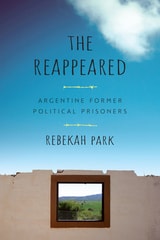
The Reappeared
Argentine Former Political PrisonersPark, Rebekah
Rutgers University Press, 2014
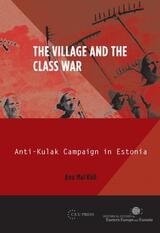
The Village and the Class War
Anti-Kulak Campaign in Estonia 1944-49Anu Mai Kõll
Central European University Press, 2013
Violence Work
State Power and the Limits of PoliceMicol Seigel
Duke University Press, 2018
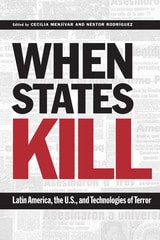
When States Kill
Latin America, the U.S., and Technologies of TerrorEdited by Cecilia Menjívar and Néstor Rodríguez
University of Texas Press, 2005
Since the early twentieth century, technological transfers from the United States to Latin American countries have involved technologies of violence for social control. As the chapters in this book illustrate, these technological transfers have taken various forms, including the training of Latin American military personnel in surveillance and torture and the provision of political and logistic support for campaigns of state terror. The human cost for Latin America has been enormous—thousands of Latin Americans have been murdered, disappeared, or tortured, and whole communities have been terrorized into silence.
Organized by region, the essays in this book address the topic of state-sponsored terrorism in a variety of ways. Most take the perspective that state-directed political violence is a modern development of a regional political structure in which U.S. political interests weigh heavily. Others acknowledge that Latin American states enthusiastically received U.S. support for their campaigns of terror. A few see local culture and history as key factors in the implementation of state campaigns of political violence. Together, all the essays exemplify how technologies of terror have been transferred among various Latin American countries, with particular attention to the role that the United States, as a "strong" state, has played in such transfers.