Results by title
5 books match the query 'Statehood (American politics)'
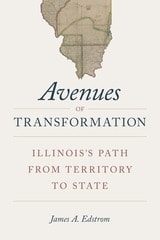
Avenues of Transformation
Illinois's Path from Territory to StateJames A. Edstrom
Southern Illinois University Press, 2022
A territory split by slavery, a state forged for union
Avenues of Transformation traces the surprising path, marked by shame, ambition, and will that led to Illinois’s admission to the Union in 1818. Historian James A. Edstrom guides the reader through this story by associating each stage of the narrative—the original statehood campaign, the passage of Illinois’s statehood-enabling act by Congress, and Illinois’s first constitutional convention—with the primary leaders in each of those episodes. The lives of these men—Daniel Pope Cook, Nathaniel Pope, and Elias Kent Kane—reflect the momentous tangle of politics, slavery, and geography. This history maps the drive for statehood in the conflict between nation and state, in the perpetuation of slavery, and in the sweep of water and commerce. It underscores the ways in which the Prairie State is uniquely intertwined—economically, socially, and politically—with every region of the Union: North, South, East, and West—and captures the compelling moment when Illinois statehood stood ready to more perfectly unify the nation.
This volume is the first full-length book in over a century to describe and analyze Illinois’s admission to the Union. It marks the first time that a historian has analyzed in detail the roll-call votes of the first state constitutional convention, seated evenly by pro- and antislavery delegates. Edstrom’s wit and prose weave a lively narrative of political ambition and human failure. Patiently crafted, Avenues of Transformation will be the first source for readers to turn to for gaining a better understanding of Illinois statehood.
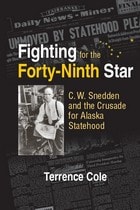
Fighting for the Forty-Ninth Star
C. W. Snedden and the Crusade for Alaska StatehoodTerrence Cole
University of Alaska Press, 2010
C.W. "Bill" Snedden, the publisher of America's farthest north daily newspaper, the Fairbanks Daily News-Miner, helped lead the battle of the Far North against the Deep South. Working behind the scenes with his protege, a young attorney named Ted Stevens, and a fellow Republican newspaperman, Secretary of Interior Fred Seaton, Snedden's "magnificent obsession" would open the door to development of the oil fields at Prudhoe Bay, inspire establishment of the Arctic Wildlife Range (now the Arctic National Wildlife Refuge), and add the forty-ninth star to the flag.
Fighting for the Forty-Ninth Star is the story of how the publisher of a little newspaper four thousand miles from Washington, D.C., helped convince Congress that Alaskans should be second-class citizens no more.
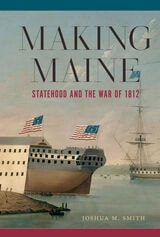
Making Maine
Statehood and the War of 1812Joshua M. Smith
University of Massachusetts Press, 2022
Honorable mention for U.S. Maritime History, John Lyman Book Awards
After the Revolutionary War ended, the new American nation grappled with a question about its identity: Were the states sovereign entities or subordinates to a powerful federal government? The War of 1812 brought this vexing issue into sharp relief, as a national government intent on waging an unpopular war confronted a populace in Massachusetts that was vigorously opposed to it. Maine, which at the time was part of Massachusetts, served as the battleground in this political struggle.
Joshua M. Smith recounts an innovative history of the war, focusing on how it specifically affected what was then called the District of Maine. Drawing on archival materials from the United States, Britain, and Canada, Smith exposes the bitter experience of Maine’s citizens during that conflict as they endured multiple hardships, including starvation, burdensome taxation, smuggling, treason, and enemy occupation. War’s inherent miseries, along with a changing relationship between regional and national identities, gave rise to a statehood movement that rejected a Boston-centric worldview in favor of a broadly American identity.
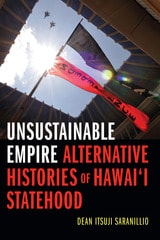
Unsustainable Empire
Alternative Histories of Hawai‘i StatehoodDean Itsuji Saranillio
Duke University Press, 2018
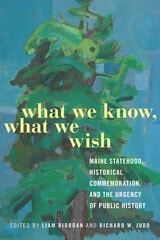
What We Know, What We Wish
Maine Statehood, Historical Commemoration, and the Urgency of Public HistoryEdited by Liam Riordan and Richard W. Judd
University of Massachusetts Press, 2025
Cities, states, and nations are grappling with how best to commemorate historical events and anniversaries in ways that are fair, accurate, and open public dialogue about the often contested past. This volume springs from varied approaches to the historical commemoration of Maine’s state bicentennial in 2020 that involved academics, independent scholars, local and statewide cultural organizations, sovereign Wabanaki nations, and the state itself in the form of the Maine State Bicentennial Commission. While wide-ranging in their goals and values, all sought to take advantage of opportunities for collaboration to contribute to a dynamic and multi-faceted practice of public history. These new essays use Maine’s bicentennial as a focal point to put public history theory into action. Its diverse contributors share stories about the past that move beyond celebration to reflect crucial ways that the past shapes our understanding of the present and our aspirations for the future.
This volume’s core argument is that academics need to collaborate more fully with independent scholars, history-based cultural institutions, and the general public in order for public history to thrive and to improve the quality of civic life. What We Know, What We Wish does this through wide ranging essays that discuss the long statehood era in Maine from the 1770s to 1820s as well as its legacies in the state centennial commemoration of 1920 and museum exhibits from the 2020 bicentennial. The occupational and cultural diversity of the collection’s contributors together with the content of their essays offer a model for how to put public history principles into practice to foreground meaningful historical reflection that is urgently needed in divided communities around the world.
Contributors include the volume editors, as well as Maulian Bryant, Osihkiyol (Zeke) Crofton-Macdonald, Charles H. Lagerbom, Ryan LaRochelle, Stuart Kestenbaum, Michael McVaugh, Kevin D. Murphy, Micah A. Pawling, Jessica Skwire Routhier, Donald Soctomah, Laura Fecych Sprague, Alan Taylor, and Laurel Thatcher Ulrich.