Results by title
5 books match the query 'Statelessness'
Citizenship in Question
Evidentiary Birthright and StatelessnessBenjamin N. Lawrance and Jacqueline Stevens, editors
Duke University Press, 2017
Exile, Non-Belonging and Statelessness in Grangaud, Jabès, Lubin and Luca
No Man's LanguageGreg Kerr
University College London, 2021
Poetry has often been understood as a powerful vector of collective belonging. The idea that certain poets are emblematic of a national culture is one of the chief means by which literature historicizes itself, inscribes itself in a shared cultural past, and supplies modes of belonging to those who consume it. But, how does the exiled, migrant, or translingual poet complicate this narrative? For Armen Lubin, Ghérasim Luca, Edmond Jabès, and Michelle Grangaud, the practice of poetry is inseparable from a sense of restlessness or unease. Ranging across borders within and beyond the Francosphere—from Algeria, Armenia, Egypt, and Romania—this book shows how a poetic practice inflected by exile, statelessness, or non-belonging has the potential to disrupt long-held assumptions about the relation between subjects, the language they use, and the place from which they speak.
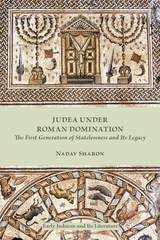
Judea under Roman Domination
The First Generation of Statelessness and Its LegacyNadav Sharon
SBL Press, 2017
Investigate a relatively neglected but momentous period in Judean history
Nadav Sharon closely examines a critical period in Judean history, which saw the end of the Hasmonean dynasty and the beginning of Roman domination of Judea leading up to the kingship of Herod (67-37 BCE). In this period renowned Roman figures such as Pompey the Great, Julius Caesar, Gaius Cassius (a conspirator against Caesar), and Mark Anthony, led the Roman Republic on the eve of its transformation into an Empire, each having his own dealings with—and holding sway over—Judea at different times. This volume explores the impact of the Roman conquest on the authors of the Dead Sea Scrolls, enhances the understanding of later Judean-Roman relations and the roots of the Great Revolt, and examines how this early period of Roman domination had on impact on later developments in Judean society and religion.
Features:
- Part one dedicating to reconstructing Judean history from the death of Alexander to the reign of King Herod
- Part two examining the effects of Roman domination on Judean society
- Maps, illustrations, and appendices

Stateless
Tienshi Lara Chen
National University of Singapore Press, 2023
"In the springtime of the year that I was twenty-one, I found myself stuck at the border between two familiar countries, unable to enter either. I had never felt my statelessness so keenly.”
Japan’s 1971 termination of diplomatic ties with the Republic of China left 9,200 Chinese residents stateless. Tienshi “Lara” Chen was one of them, born to Chinese parents in Yokohama’s Chinatown. What does it mean to be stateless? What does it feel like?
To answer, Stateless presents Chen’s engaging autobiographical account of her bi-cultural upbringing and Japanese education. She reflects on her experience of statelessness eventually led her into a career spanning academia and activism, and she analyzes the contradictions inherent in the concepts of nationality, nation-state, and citizenship, in a world where individual nationality, identity, and experience are increasingly complex. She concludes that the current system of regulating individuals with citizenship is unworkable in the long run.
Blending life writing, auto-ethnography, and a study of stateless communities around Asia, this book unpacks the idea of citizenship by showing the hidden everyday narratives and lived experiences of stateless persons who have no legal ties to any nation-state. Originally published in Japanese, this adapted and updated English edition critically engages with questions of borders, mobility, belonging, and identity.
Statelessness
On Almost Not ExistingTony C. Brown
University of Minnesota Press, 2022
A pathbreaking new genealogy of statelessness
Just as the modern state and the citizenship associated with it are commonly thought of as a European invention, so too is citizenship’s negation in the form of twentieth-century diaspora and statelessness. Statelessness sets forth a new genealogy, suggesting that Europe first encountered mass statelessness neither inside its own borders nor during the twentieth century, as Hannah Arendt so influentially claimed, but outside of itself—in the New World, several hundred years earlier.
Through close readings of political philosophers from Hobbes to Rousseau to Kant, Tony C. Brown argues that statelessness became a central problem for political thought early on, with far-reaching implications for thinking both on the state and on being human. What Europeans thought they saw among the “savages” of the Americas was life without political order, life less than human. Lacking almost everything those deemed clearly human had achieved, the stateless existed in a radically precarious, almost inhuman privation.
And yet this existence also raised the unsettling possibility that state-based existence may not be inevitable, necessary, or even ideal. This possibility, as Brown shows, prompts the response—as defensive as it was aggressive—that we call Enlightenment political philosophy, which arguably still orders much thinking on being stateless today, including our discourses concerning migrants and Indigenous peoples.