Results by title
3 books match the query 'Statutes'

Law in Everyday Japan
Sex, Sumo, Suicide, and StatutesMark D. West
University of Chicago Press, 2005
Compiling case studies based on seven fascinating themes—karaoke-based noise complaints, sumo wrestling, love hotels, post-Kobe earthquake condominium reconstruction, lost-and-found outcomes, working hours, and debt-induced suicide—Law in Everyday Japan offers a vibrant portrait of the way law intermingles with social norms, historically ingrained ideas, and cultural mores in Japan. Each example is informed by extensive fieldwork. West interviews all of the participants-from judges and lawyers to defendants, plaintiffs, and their families-to uncover an everyday Japan where law matters, albeit in very surprising ways.
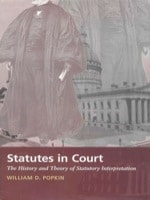
Statutes in Court
The History and Theory of Statutory InterpretationWilliam D. Popkin
Duke University Press, 1999
Popkin begins by discussing the British origins of statutory interpretation in this country. He then maps the evolving conceptions of the judicial role in the United States from Revolutionary times through the twentieth century before presenting his “ordinary judging” theory—one that asks the judge to use modest judicial discretion to assist the legislature in implementing good government. Claiming that theory cannot account for everything a judge does when determining statutory meaning or writing an opinion, Popkin shows how judges who strive to be conscientious in interpreting the law are often hampered by the lack of both a framework in which to fit their approach and a well-understood common vocabulary to explain what they do. Statutes in Court fills that gap.
This work will be valuable to anyone concerned about the judicial role in the interpretation of laws—from judiciary officials and law professors to legal historians and political scientists.
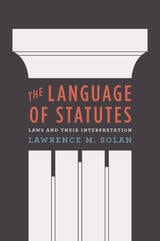
The Language of Statutes
Laws and Their InterpretationLawrence M. Solan
University of Chicago Press, 2010
Pulling the rug out from debates about interpretation, The Language of Statutes joins together learning from law, linguistics, and cognitive science to illuminate the fundamental issues and problems in this highly contested area. Here, Lawrence M. Solan argues that statutory interpretation is alive, well, and not in need of the major overhaul that many have suggested. Rather, he suggests, the majority of people understand their rights and obligations most of the time, with difficult cases occurring in circumstances that we can predict from understanding when our minds do not work in a lawlike way.
Solan explains that these cases arise because of the gap between our inability to write crisp yet flexible laws on one hand and the ways in which our cognitive and linguistic faculties are structured on the other. Making our lives easier and more efficient, we’re predisposed to absorb new situations into categories we have previously formed—but in the legislative and judicial realms this can present major difficulties. Solan provides an excellent introduction to statutory interpretation, rejecting the extreme arguments that judges have either too much or too little leeway, and explaining how and why a certain number of interpretive problems are simply inevitable.