Results by title
2 books match the query 'Steiner, Frederick R.'
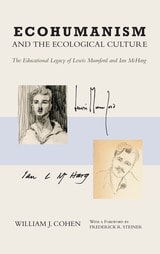
Ecohumanism and the Ecological Culture
The Educational Legacy of Lewis Mumford and Ian McHargWilliam J. Cohen
Temple University Press, 2019
Lewis Mumford, one of the most respected public intellectuals of the twentieth century, speaking at a conference on the future environments of North America, said, “In order to secure human survival we must transition from a technological culture to an ecological culture.” In Ecohumanism and the Ecological Culture, William Cohen shows how Mumford’s conception of an educational philosophy was enacted by Mumford’s mentee, Ian McHarg, the renowned landscape architect and regional planner at the University of Pennsylvania. McHarg advanced a new way to achieve an ecological culture―through an educational curriculum based on fusing ecohumanism to the planning and design disciplines.
Cohen explores Mumford’s important vision of ecohumanism—a synthesis of natural systems ecology with the myriad dimensions of human systems, or human ecology―and how McHarg actually formulated and made that vision happen. He considers the emergence of alternative energy systems and new approaches to planning and community development to achieve these goals.
The ecohumanism graduate curriculum should become the basis to train the next generation of planners and designers to lead us into the ecological culture, thereby securing the educational legacy of both Lewis Mumford and Ian McHarg.
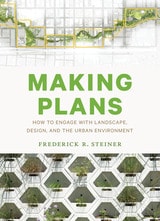
Making Plans
How to Engage with Landscape, Design, and the Urban EnvironmentBy Frederick R. Steiner
University of Texas Press, 2018
“Community and regional planning involve thinking ahead and formally envisioning the future for ourselves and others,” according to Frederick R. Steiner. “Improved plans can lead to healthier, safer, and more beautiful places to live for us and other species. We can also plan for places that are more just and more profitable. Plans can help us not only to sustain what we value but also to transcend sustainability by creating truly regenerative communities, that is, places with the capacity to restore, renew, and revitalize their own sources of energy and materials.”
In Making Plans, Steiner offers a primer on the planning process through a lively, firsthand account of developing plans for the city of Austin and the University of Texas campus. As dean of the UT School of Architecture, Steiner served on planning committees that addressed the future growth of the city and the university, growth that inevitably overlapped because of UT’s central location in Austin. As he walks readers through the planning processes, Steiner illustrates how large-scale planning requires setting goals and objectives, reading landscapes, determining best uses, designing options, selecting courses for moving forward, taking actions, and adjusting to changes. He also demonstrates that planning is an inherently political, sometimes messy, act, requiring the intelligence and ownership of the affected communities. Both wise and frank, Making Plans is an important philosophical and practical statement on planning by a leader in the field.