Results by title
4 books match the query 'Steiner, George'
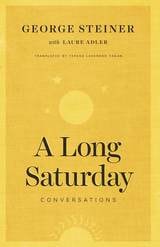
A Long Saturday
ConversationsGeorge Steiner with Laure Adler
University of Chicago Press, 2017
George Steiner is one of the preeminent intellectuals of our time. The Washington Post has declared that no one else “writing on literature can match him as polymath and polyglot, and few can equal the verve and eloquence of his writing,” while the New York Times says of his works that “the erudition is almost as extraordinary as the prose: dense, knowing, allusive.” Reading in many languages, celebrating the survival of high culture in the face of modern barbarisms, Steiner probes the ethics of language and literature with unparalleled grace and authority. A Long Saturday offers intimate insight into the questions that have absorbed him throughout his career.
In a stimulating series of conversations, Steiner and journalist Laure Adler discuss a range of topics, including Steiner’s boyhood in Vienna and Paris, his education at the University of Chicago and Harvard, and his early years in academia. Books are a touchstone throughout, but Steiner and Adler’s conversations also range over music, chess, psychoanalysis, the place of Israel in Jewish life, and beyond. Blending thoughts on subjects of broad interest in the humanities—the issue of honoring Richard Wagner and Martin Heidegger in spite of their politics, or Virginia Woolf’s awareness of the novel as a multivocal form, for example—with personal reflections on life and family, Steiner demonstrates why he is considered one of today’s greatest minds. Revealing and exhilarating, A Long Saturday invites readers to pull up a chair and listen in on a conversation with a master.
In a stimulating series of conversations, Steiner and journalist Laure Adler discuss a range of topics, including Steiner’s boyhood in Vienna and Paris, his education at the University of Chicago and Harvard, and his early years in academia. Books are a touchstone throughout, but Steiner and Adler’s conversations also range over music, chess, psychoanalysis, the place of Israel in Jewish life, and beyond. Blending thoughts on subjects of broad interest in the humanities—the issue of honoring Richard Wagner and Martin Heidegger in spite of their politics, or Virginia Woolf’s awareness of the novel as a multivocal form, for example—with personal reflections on life and family, Steiner demonstrates why he is considered one of today’s greatest minds. Revealing and exhilarating, A Long Saturday invites readers to pull up a chair and listen in on a conversation with a master.
[more]
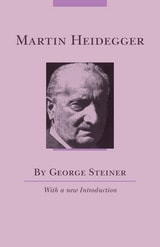
Martin Heidegger
George Steiner
University of Chicago Press, 1987
A compact, lucid introduction to the work of one of the most important, challenging, and controversial philosophers of the twentieth century
Acquaintance with the work of Martin Heidegger is indispensable to an understanding of contemporary thought and culture. His work has had a profound influence on a number of disciplines, including theology, Sartrean existentialism, linguistics, Hellenic studies, the structuralist and hermeneutic schools of textual interpretation, literary theory, and literature itself. With characterisitc lucidity and style, George Steiner makes this philosopher’s immensely difficult body of work accessible to the general reader. The breadth of Steiner’s learning and interests also allows him to place Heidegger in a broader Continental literary-cultural context. In a new Introduction, Steiner addresses language and philosophy and the rise of Nazism
Acquaintance with the work of Martin Heidegger is indispensable to an understanding of contemporary thought and culture. His work has had a profound influence on a number of disciplines, including theology, Sartrean existentialism, linguistics, Hellenic studies, the structuralist and hermeneutic schools of textual interpretation, literary theory, and literature itself. With characterisitc lucidity and style, George Steiner makes this philosopher’s immensely difficult body of work accessible to the general reader. The breadth of Steiner’s learning and interests also allows him to place Heidegger in a broader Continental literary-cultural context. In a new Introduction, Steiner addresses language and philosophy and the rise of Nazism
[more]
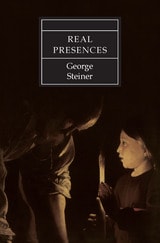
Real Presences
George Steiner
University of Chicago Press, 1989
A powerful argument for the presence of the divine within art, from one of the twentieth-century's leading thinkers
In Real Presences, George Steiner, whom A. S. Byatt praised as "a late, late, late, late Renaissance man," addressed one of the most challenging and important questions about art and human understanding: Can there be major dimensions of a poem, a painting, a musical composition created in the absence of God? Or is God always a real presence in the arts? Drawing examples from across centuries and cultures, Steiner passionately argues that a transcendent reality grounds all genuine art and human communication.
In Real Presences, George Steiner, whom A. S. Byatt praised as "a late, late, late, late Renaissance man," addressed one of the most challenging and important questions about art and human understanding: Can there be major dimensions of a poem, a painting, a musical composition created in the absence of God? Or is God always a real presence in the arts? Drawing examples from across centuries and cultures, Steiner passionately argues that a transcendent reality grounds all genuine art and human communication.
[more]

The Portage to San Cristobal of A. H.
A NovelGeorge Steiner
University of Chicago Press, 1999
Imagine, thirty years after the end of World War II, Israeli Nazi-hunters, some of whom lost relatives in the gas chambers of Nazi Germany, find a silent old man deep in the Amazon jungle. He is Adolph Hitler. The narrative that follows is a profound and disturbing exploration of the nature of guilt, vengeance, language, and the power of evil—each undiminished over time. George Steiner's stunning novel, now with a new afterword, will continue to provoke our thinking about Nazi Germany's unforgettable past.
"Two readings have convinced me that this is a fiction of extraordinary power and thoughtfulness. . . . [A] remarkable novel."—Bernard Bergonzi, Times Literary Supplement
"In this tour de force Mr. Steiner makes his reader re-examine, to whatever conclusions each may choose, a history from which we would prefer to avert our eyes."—Edmund Fuller, Wall Street Journal
"Portage largely avoids both the satisfactions of the traditional novel and the horrifying details of Holocaust literature. Instead, Steiner has taken as his model the political imaginings of an Orwell or Koestler. . . . He has produced a philosophic fantasy of remarkable intensity."—Otto Friedrich, Time
[more]