Results by title
7 books match the query 'Steps'
Dance of the Dialectic
STEPS IN MARX'S METHODBertell Ollman
University of Illinois Press, 2003
Marx made extremely creative use of dialectical method to analyze the origins, operation, and direction of capitalism. Unfortunately, his promised book on method was never written, so that readers wishing to understand and evaluate Marx's theories, or to revise or use them, have had to proceed without a clear grasp of the dialectic in which the theories are framed. The result has been more disagreement over "what Marx really meant" than over the writings of any other major thinker.
In putting Marx's philosophy of internal relations and his use of the process of abstraction--two little-studied aspects of dialectics--at the center of this account, Ollman provides a version of Marx's method that is at once systematic, scholarly, clear and eminently useful.
Ollman not only sheds important new light on what Marx really meant in his varied theoretical pronouncements, but in carefully laying out the steps in Marx's method makes it possible for a reader to put the dialectic to work in his or her own research. He also convincingly argues the case for why social scientists and humanists as well as philosophers should want to do so.

Distilling Hope
12 Stories to Distill the 12 StepsBeth Ohlsson
Parkhurst Brothers, Inc., 2017
“Old stories are universal and want to be told. To bring those stories out into the world as a vehicle for navigating sobriety and recovery is a glorious thing.
I was hired to be an addictions counselor for the therapeutic community at the Frederick County Adult Detention Center. Susan Gordon encouraged me to tell them stories. I thought she was crazy, but I trusted her judgment and told them stories. The impact those stories had on those men changed my life. I worked in addictions for 15 years, taking those stories with me to very agency in which I worked. The women at the Center 4 Clean Start in Salisbury, MD were every bit as receptive to story as the men who were in jail.”
--Beth Ohlsson

Haifa
City of StepsNili Scharf Gold
Brandeis University Press, 2017

Steps to a New Edition of the Hebrew Bible
Ronald Hendel
SBL Press, 2016
Understand the purpose and background of the new The Hebrew Bible: A Critical Edition project
Our understanding of the textual history of the Hebrew Bible has been transformed in the wake of the discovery of the Dead Sea Scrolls. Hendel explores and refines this new knowledge and formulates a rationale for a new edition of the Hebrew Bible. The chapters situate The Hebrew Bible; A Critical Edition project in a broad historical context, from the beginnings of textual criticism in late antiquity and the Renaissance to the controversies in contemporary theory and practice. This book combines close analysis with broad synthesis, yielding new perspectives on the text of the Hebrew Bible.
Features- Theory and practice of textual criticism
- Textual history of the Hebrew Bible
- History of text-critical scholarship

Steps to an Ecology of Mind
Collected Essays in Anthropology, Psychiatry, Evolution, and EpistemologyGregory Bateson
University of Chicago Press, 2000

The Steps of Nemesis
A Dramatic Chronicle in Six Scenes from Party Life in the USSR (1936–1938)Nikolai Evreinov
Diaphanes, 2022
In the 1910s the Russian theater director and theorist Nikolai Evreinov (1879–1953) insisted on the theatricalization of life. Twenty years later, Evreinov, who had left Russia in 1924, was in exile in Paris when Stalin staged three elaborate political show trials in Moscow. Evreinov then meticulously read the transcripts of the trials in the Russian-language press, collected material on Nikolai Bukharin and the other defendants, consulted with experts, and finally wrote a play, his response to the staging of a judicial farce. With this response, he also wanted to rehabilitate his idea of the theatricalization of life. After all, the theatricalization of life does not mean performing false confessions, constructing conspiracies, fabricating facts, or casting hired witnesses. In his theatrical theory, Evreinov was careful not to make the theater of life invisible. His play is therefore not a historical reconstruction, but an imaginary look behind the scenes, in which the Stalinist perpetrators confess to the real crime in the end: the theater. Expertly translated into English for the first time by Zachary King, The Steps of Nemesis brings a fascinating play to a whole new world.
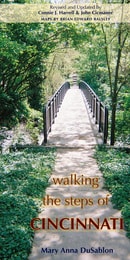
Walking the Steps Of Cincinnati
A Guide to the Queen City’s Scenic and Historic SecretsMary Anna DuSablon
Ohio University Press, 2014
Walking the Steps of Cincinnati: A Guide to the Queen City’s Scenic and Historic Secrets is a revised and updated version of Mary Anna DuSablon’s original guidebook, first published in 1998. This new edition describes and maps thirty-four walks of varying lengths and levels of difficulty around the neighborhoods of Cincinnati, following scenic or historic routes and taking in many of the city’s more than four hundred sets of steps. Some of these walks follow the same routes laid out by DuSablon in the first edition of the guide; others have been revised to reflect changes in the city and its neighborhoods, the physical condition of the steps, and the scenic views of Cincinnati that they afford; and still others are altogether new.
In writing their descriptions of the walks, authors Connie J. Harrell and John Cicmanec have retraced each path and taken all new photographs of the steps as well as architectural and natural landmarks along the way. Cartographer Brian Balsley has drawn a fresh set of maps, and Roxanne Qualls, vice-mayor of Cincinnati, has graciously written a new foreword.