Results by title
5 books match the query 'Stocks'
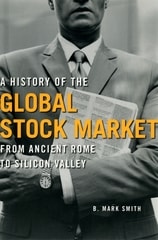
A History of the Global Stock Market
From Ancient Rome to Silicon ValleyB. Mark Smith
University of Chicago Press, 2004
The stock market is central to the global economy. Tens of millions of people look to it to provide for a comfortable retirement. Central bankers watch it closely as they set monetary policy. Businesses around the world are forced to adjust the way they operate to meet the demands of equity investors. Yet very little has been written about how the modern global stock market came to be. In A History of the Global Stock Market, B. Mark Smith weaves an entertaining tale that ranges from medieval trading companies and nineteenth-century robber barons to modern theorists and international speculators. Here, Smith debunks the popular myth that the market is inevitably subject to recurring speculative bubbles and discredits the notion that the current "globalization" of the market is something radically different from what has occurred in the past.
Informative, entertaining, and written for specialists and non-specialists alike, A History of the Global Stock Market is a worthy read for anyone who wants to understand the role of the stock market in the global economy.
Informative, entertaining, and written for specialists and non-specialists alike, A History of the Global Stock Market is a worthy read for anyone who wants to understand the role of the stock market in the global economy.
[more]
Expectations and the Structure of Share Prices
John G. Cragg and Burton G. Malkiel
University of Chicago Press, 1982
John G. Cragg and Burton G. Malkiel collected detailed forecasts of professional investors concerning the growth of 175 companies and use this information to examine the impact of such forecasts on the market evaluations of the companies and to test and extend traditional models of how stock market values are determined.
[more]
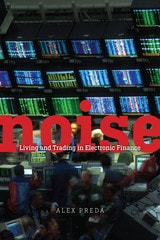
Noise
Living and Trading in Electronic FinanceAlex Preda
University of Chicago Press, 2017
We often think of finance as a glamorous world, a place where investment bankers amass huge profits in gleaming downtown skyscrapers. There’s another side to finance, though—the millions of amateurs who log on to their computers every day to make their own trades. The shocking truth, however, is that less than 2% of these amateur traders make a consistent profit. Why, then, do they do it?
In Noise, Alex Preda explores the world of the people who trade even when by all measures they would be better off not trading. Based on firsthand observations, interviews with traders and brokers, and on international direct trading experience, Preda’s fascinating ethnography investigates how ordinary people take up financial trading, how they form communities of their own behind their computer screens, and how electronic finance encourages them to trade more and more frequently. Along the way, Preda finds the answer to the paradox of amateur trading—the traders aren’t so much seeking monetary rewards in the financial markets, rather the trading itself helps them to fulfill their own personal goals and aspirations.
In Noise, Alex Preda explores the world of the people who trade even when by all measures they would be better off not trading. Based on firsthand observations, interviews with traders and brokers, and on international direct trading experience, Preda’s fascinating ethnography investigates how ordinary people take up financial trading, how they form communities of their own behind their computer screens, and how electronic finance encourages them to trade more and more frequently. Along the way, Preda finds the answer to the paradox of amateur trading—the traders aren’t so much seeking monetary rewards in the financial markets, rather the trading itself helps them to fulfill their own personal goals and aspirations.
[more]
The Fama Portfolio
Selected Papers of Eugene F. FamaEugene F. Fama
University of Chicago Press, 2017
Few scholars have been as influential in finance and economics as University of Chicago professor Eugene F. Fama. Over the course of a brilliant and productive career, Fama has published more than one hundred papers, filled with diverse, highly innovative contributions.
Published soon after the fiftieth anniversary of Fama’s appointment to the University of Chicago and his receipt of the Nobel Prize in Economics, The Fama Portfolio offers an authoritative compilation of Fama’s central papers. Many are classics, including his now-famous essay on efficient capital markets. Others, though less famous, are even better statements of the central ideas. Fama’s research considers key questions in finance, both as an academic field and an industry: How is information reflected in asset prices? What is the nature of risk that scares people away from larger returns? Does lots of buying and selling by active managers produce value for their clients? The Fama Portfolio provides for the first time a comprehensive collection of his work and includes introductions and commentary by the book’s editors, John H. Cochrane and Tobias Moskowitz, as well as by Fama’s colleagues, themselves top scholars and successful practitioners in finance. These essays emphasize how the ideas presented in Fama’s papers have influenced later thinking in financial economics, often for decades.
Published soon after the fiftieth anniversary of Fama’s appointment to the University of Chicago and his receipt of the Nobel Prize in Economics, The Fama Portfolio offers an authoritative compilation of Fama’s central papers. Many are classics, including his now-famous essay on efficient capital markets. Others, though less famous, are even better statements of the central ideas. Fama’s research considers key questions in finance, both as an academic field and an industry: How is information reflected in asset prices? What is the nature of risk that scares people away from larger returns? Does lots of buying and selling by active managers produce value for their clients? The Fama Portfolio provides for the first time a comprehensive collection of his work and includes introductions and commentary by the book’s editors, John H. Cochrane and Tobias Moskowitz, as well as by Fama’s colleagues, themselves top scholars and successful practitioners in finance. These essays emphasize how the ideas presented in Fama’s papers have influenced later thinking in financial economics, often for decades.
[more]
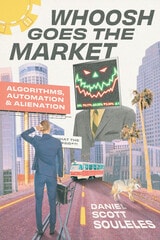
Whoosh Goes the Market
Algorithms, Automation, and AlienationDaniel Scott Souleles
University of Chicago Press, 2024
A vivid, fast-paced inside look at financial markets, the people who work on them, and how technology is changing their world (and ours).
Markets are messy, and no one knows this better than traders who work tirelessly to predict what they will do next. In Whoosh Goes the Market, Daniel Scott Souleles takes us into the day-to-day experiences of a team at a large trading firm, revealing what it’s actually like to make and lose money on contemporary capital markets.
The traders Souleles shadows have mostly moved out of the pits and now work with automated, glitch-prone computer systems. They remember the days of trading manually, and they are suspicious of algorithmically driven machine-learning systems. Openly musing about their own potential extinction, they spend their time expressing fear and frustration in profanity-laced language. With Souleles as our guide, we learn about everything from betting strategies to inflated valuations, trading swings, and market manipulation. This crash course in contemporary finance vividly reveals the existential anxiety at the evolving front lines of American capitalism.
[more]