Results by title
17 books match the query 'Storm'
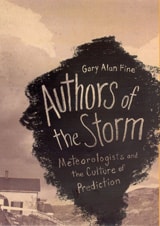
Authors of the Storm
Meteorologists and the Culture of PredictionGary Alan Fine
University of Chicago Press, 2007
Whether it is used as an icebreaker in conversation or as the subject of serious inquiry, “the weather” is one of the few subjects that everyone talks about. And though we recognize the faces that bring us the weather on television, how government meteorologists and forecasters go about their jobs is rarely scrutinized. Given recent weather-related disasters, it’s time we find out more. In Authors of the Storm, Gary Alan Fine offers an inside look at how meteorologists and forecasters predict the weather.
Based on field observation and interviews at the Storm Prediction Center in Oklahoma, the National Weather Service in Washington, D.C., and a handful of midwestern outlets, Fine finds a supremely hard-working, insular clique of professionals who often refer to themselves as a “band of brothers.” In Fine’s skilled hands, we learn their lingo, how they “read” weather conditions, how forecasts are written, and, of course, how those messages are conveyed to the public. Weather forecasts, he shows, are often shaped as much by social and cultural factors inside local offices as they are by approaching cumulus clouds. By opening up this unique world to us, Authors of the Storm offers a valuable and fascinating glimpse of a crucial profession.
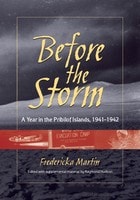
Before the Storm
A Year in the Pribilof Islands, 1941-1942Fredericka Martin
University of Alaska Press, 2010
From June of 1941 through the following summer, Fredericka Martin lived with her husband, Dr. Samuel Berenberg, on remote St. Paul Island in Alaska. During that time, Martin delved into the complex history of the Unangan people, and Before the Storm draws from her personal accounts of that year and her research to present a fascinating portrait of a time and a people facing radical change. A government-ordered evacuation of all Aleuts from the island in the face of World War II, which Martin recounts in her journal, proved but the first step in a long struggle by native peoples to gain independence, and, as editor Raymond L. Hudson explains, Martin came to play a significant role in the effort.
Flying through a Hole in the Storm
PoemsFleda Brown
Ohio University Press, 2021
Inside the Storm I Want to Touch the Tremble
Carolyn Oliver
University of Utah Press, 2022
Oliver’s polyphonic gathering of speakers includes lovers and saints, painters and dead poets, a hawk and a mother. In varied forms (ghazals and prose poems, dialogues and erasures, bref double and Golden Shovel, among others) these poems bear witness to and seek reprieve from disasters at once commonplace and terrifying. “I can’t surface for every scalpel slice, / I need a dreamy estuary present,” she writes.
Stumbling toward joy across time and space, these poems hum with fear and desire, bewildering loss, and love’s lush possibilities.
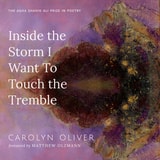
Inside the Storm I Want to Touch the Tremble
Carolyn Oliver
University of Utah Press, 2022
Oliver’s polyphonic gathering of speakers includes lovers and saints, painters and dead poets, a hawk and a mother. In varied forms (ghazals and prose poems, dialogues and erasures, bref double and Golden Shovel, among others) these poems bear witness to and seek reprieve from disasters at once commonplace and terrifying. “I can’t surface for every scalpel slice, / I need a dreamy estuary present,” she writes.
Stumbling toward joy across time and space, these poems hum with fear and desire, bewildering loss, and love’s lush possibilities.
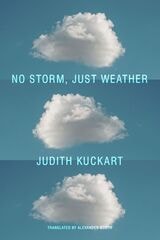
No Storm, Just Weather
Judith Kuckart
Seagull Books, 2023
Sunday evening, Tegel Airport, Berlin: A woman strikes up a conversation with a man, Robert Sturm, who is thirty-six years old and eighteen years her junior. He is on his way to Siberia and will return the following Saturday. She cannot wait . . .
In 1981 she came to West Berlin as an eighteen-year-old to study medicine and met Viktor, who was twice her age. Though he opened the world up to her, he remained closed himself. At the turn of the millennium and thirty-six, she meets Johann. He is thirty-six too. They try to make a life together, but their jobs aren’t the only things that are precarious. Saturday morning, Tegel Airport again: For six days, her everyday life and her memories have become entwined. Why are the men in her life always thirty-six? Is she still the person she remembers? Or, being someone who knows their way around the mind, is she in fact what she has forgotten?
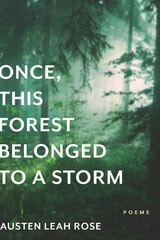
Once, This Forest Belonged to a Storm
Austen Leah Rose
University of Massachusetts Press, 2023
Does history live inside of us? Are we capable of transcending the past or are we destined to repeat it? With understated humor and grace, Once, This Forest Belonged to a Storm wrestles with questions of inheritance, spiritual unrest, the integrity of the self, and humanity’s relationship to the natural world. Excavating both personal and historical trauma and the rippling effects of the Holocaust, Austen Leah Rose writes of “the silence that follows after silence.” The poems in this debut collection map a surreal journey from alienation to belonging, as our speaker floats across the night sky over Los Angeles, communes with Shakespeare in a hotel room, attends a dinner party in outer space, and drifts down a river for fourteen years with her sister.
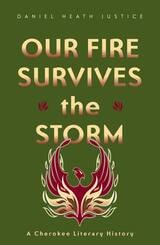
Our Fire Survives the Storm
A Cherokee Literary HistoryDaniel Heath Justice
University of Minnesota Press, 2006
Through cycles of war and peace, resistance and assimilation, trauma and regeneration, Cherokees have long debated what it means to be Cherokee through protest writings, memoirs, fiction, and retellings of traditional stories. Justice employs the Chickamauga consciousness of resistance and Beloved Path of engagement—theoretical approaches that have emerged out of Cherokee social history—to interpret diverse texts composed in English, a language embraced by many as a tool of both access and defiance.
Justice’s analysis ultimately locates the Cherokees as a people of many perspectives, many bloods, mingled into a collective sense of nationhood. Just as the oral traditions of the Cherokee people reflect the living realities and concerns of those who share them, Justice concludes, so too is their literary tradition a textual testament to Cherokee endurance and vitality.
Daniel Heath Justice is assistant professor of aboriginal literatures at the University of Toronto.
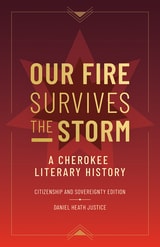
Our Fire Survives the Storm
A Cherokee Literary History, Citizenship and Sovereignty EditionDaniel Heath Justice
University of Minnesota Press, 2026
The twentieth-anniversary edition of the path-clearing study of Cherokee writing in English, with an emphatic refocus on voices from the three Cherokee tribal nations
This Citizenship and Sovereignty Edition of Our Fire Survives the Storm is a thoroughly updated, nationhood-focused, twentieth-anniversary revision of Daniel Heath Justice’s influential study of Cherokee writing in English. Through politically astute and historically grounded readings of diverse texts by citizens of the Cherokee Nation, United Keetoowah Band of Cherokee Indians, and Eastern Band of Cherokee Indians, Justice connects Cherokee literature to Indigenous sovereignty, nationhood, and collective futurity.
Guided by a reparative vision that directly contends with the outdated literary legacies of the book’s first edition, this revision confronts the ongoing harms of unsubstantiated and false Cherokee heritage claims on literary studies, replacing readings of primary texts by unverified claimants with those of Cherokee citizen writers. As Justice addresses issues of accountability, he engages with the past two decades of Indigenous scholarship, fully updating terminology, concepts, and scholarly resources. He expands and deepens the intellectual and historical context for Cherokee literary production introduced in the first edition, and he discusses Cherokee writing and community in the mid-twentieth century, the Cherokee Freedmen’s long struggle for justice, and the future of Cherokee nationhood.
Highlighting the work of authors who illustrate the transformative collective discourses of what it means to be Cherokee, Justice examines the richness of Cherokee literary expression through motifs of roots, removal, and nationhood in traditional stories, speeches, legal and governance documents, memoirs, short stories, novels, and plays. An invitation to reflective criticism, this new edition of Our Fire Survives the Storm is grounded in the belief that Indigenous nationhood is a necessary ethical response to the violence of the settler imaginary.
Retail e-book files for this title are screen-reader friendly with images accompanied by short alt text and/or extended descriptions.
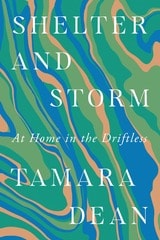
Shelter and Storm
At Home in the Driftlessdean
University of Minnesota Press, 2025
Living mindfully with nature during a time of uncertainty
In the midst of the environmental crises of the early twenty-first century, Tamara Dean sought a way to live lightly on the planet. Her quest drew her to a landscape unlike any other: the Driftless area of Wisconsin, a region untouched by glaciers, marked by steep hills and deeply carved valleys, capped with forests and laced with cold, spring-fed streams. There, she confronted, in ways large and small, the challenges of meeting basic needs while facing the ravages of climate change—an experience at once soul-stirring and practical that she recounts in Shelter and Storm.
Dean’s boundless curiosity and gift for storytelling imbue these essays with urgency and a sense of adventure. She invites readers to share in her discoveries while hunting for water, learning that a persistent weed could be food, or burning a hayfield to recreate a prairie. Contending with the fallout of fires, floods, and tornadoes, she offers responses to natural disasters that reflect the importance of community, now and for generations to come. Whether tracking down a rare, blue-glowing firefly, engineering a beaver-friendly waterway to appease a dying neighbor, or building a house of earthen blocks, Dean unites personal experience with science and history, presenting a perspective as informative as it is compelling.
Keenly attentive to the stakes for our planet’s future—and the implications of extreme weather, shifting agricultural practices, and political divides—Shelter and Storm illuminates a thoughtful way forward for anyone concerned about climate change and its far-reaching consequences or for anyone searching, as Dean has, for a more sustainable way to live.
Retail e-book files for this title are screen-reader friendly.

Storm from Paradise
The Politics of Jewish MemoryJonathan Boyarin
University of Minnesota Press, 1992
Storm from Paradise was first published in 1992. Minnesota Archive Editions uses digital technology to make long-unavailable books once again accessible, and are published unaltered from the original University of Minnesota Press editions.
"Usefully complicating common sense understandings of history, catastrophe, loss, otherness, and possibility through reflections on contemporary Jewishness, Boyarin draws on Benjamins's famous image of the Angel of History blown into the future by a "storm from paradise" to constantly interrogate and recuperate the past, "without pretending for long that we can recoup its plentitude". The book's seven thoughtful essays are at times deliberately intangible but always worth reading. An important book for the rethinking of the relevance of Jewishness to anthropology and cultural studies." –Religious Studies Review
"An essay in the richest sense of that term, inspired by and modeled on Walter Benjamin's essays. Based on varied, diverse, and abundantly cross-disciplinary readings, it moves and builds, questions and interrogates, and ultimately convinces us that the Jewish experience with being the 'other' and, conversely and recently, with 'othering' is indeed relevant to theorists of contemporary culture." –Marianne Hirsch
Jonathan Boyarin is the author of Palestine and Jewish History, and co-editor, with Daniel Boyarin, of Jews and Other Differences and Powers of Diaspora.
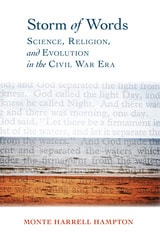
Storm of Words
Science, Religion, and Evolution in the Civil War EraMonte Harrell Hampton
University of Alabama Press, 2014
A study of the ways that southern Presbyterians in the wake of the Civil War contended with a host of cultural and theological questions
Southern Presbyterian theologians enjoyed a prominent position in antebellum southern culture. Respected for both their erudition and elite constituency, these theologians identified the southern society as representing a divine, Biblically ordained order. Beginning in the 1840s, however, this facile identification became more difficult to maintain, colliding first with antislavery polemics, then with Confederate defeat and reconstruction, and later with women’s rights, philosophical empiricism, literary criticisms of the Bible, and that most salient symbol of modernity, natural science.
As Monte Harrell Hampton shows in Storm of Words, modern science seemed most explicitly to express the rationalistic spirit of the age and threaten the Protestant conviction that science was the faithful “handmaid” of theology. Southern Presbyterians disposed of some of these threats with ease. Contemporary geology, however, posed thornier problems. Ambivalence over how to respond to geology led to the establishment in 1859 of the Perkins Professorship of Natural Science in Connexion with Revealed Religion at the seminary in Columbia, South Carolina. Installing scientist-theologian James Woodrow in this position, southern Presbyterians expected him to defend their positions.
Within twenty-five years, however, their anointed expert held that evolution did not contradict scripture. Indeed, he declared that it was in fact God’s method of creating. The resulting debate was the first extended evolution controversy in American history. It drove a wedge between those tolerant of new exegetical and scientific developments and the majority who opposed such openness. Hampton argues that Woodrow believed he was shoring up the alliance between science and scripture—that a circumscribed form of evolution did no violence to scriptural infallibility. The traditionalists’ view, however, remained interwoven with their identity as defenders of the Lost Cause and guardians of southern culture.
The ensuing debate triggered Woodrow’s dismissal. It also capped a modernity crisis experienced by an influential group of southern intellectuals who were grappling with the nature of knowledge, both scientific and religious, and its relationship to culture—a culture attempting to define itself in the shadow of the Civil War and Reconstruction.
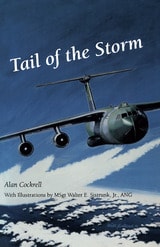
Tail of the Storm
Flying Missions in the First Gulf WarAlan Cockrell
University of Alabama Press, 1995
A Gulf War memoir that captures the poetry and peril of flight.
Within days of Saddam Hussein’s invasion of Kuwait, the far reaching arm of American airpower sprang into action. The skyscapes of the North Atlantic, Europe, and the Mediterranean became laced with the contrails of great jets flowing day and night toward the Persian Gulf. From the skies, manpower and material poured onto the bleak sands under the ominous clouds of the gathering storm, and in only a few weeks the size of the effort eclipsed that of the Berlin Airlift.
The thousands of crewmembers flying the jets, as well as those servicing and managing them, became the backbone of history’s largest air logistical operation. Many of these men and women were Air Force reservists, and the author participated as a pilot of a C-141B Starlifter with the Mississippi Air National Guard.
Cockrell writes lyrically about flying and about the emotional and intellectual satisfaction enjoyed by those who fly. His focus is on the people recalled to active duty, who flew thousands of hours, coping with fatigue, cracked wings, missile attacks, and, in some cases, deteriorating businesses and families at home. Tail of the Storm gives expression to their love of flight, as well as their dedication to the endangered values of duty, honor, country. This story is good reading—not only for those who share the author’s enthusiasm for flying but also for those who read for pleasure and have a curiosity about a pilot’s world.
The Edge of the Storm
A NovelBy Agustín Yáñez
University of Texas Press, 1963
This tale of a repressive priest and his small Mexican village during the eighteen months preceding the Revolution of 1910 is a great novel, one that exposes the struggle between human desire and paralyzing fear—fear of humanity, fear of nature, fear of the wrath of God. Agustín Yáñez probes the actions of people caught in life’s currents, enthralling his readers with mounting dramatic tension as he shows that no power can forge saints from the human masses, that any attempt to do so, in fact, often has exactly the opposite result.
Yáñez brings to his work a deep understanding of people—his people—and he illuminates a great truth—that no one, anywhere, seems very strange when we understand the environment that has produced him or her.

The Storm & Other Poems
Eugenio Montale
Oberlin College Press, 1978
Weathering the Storm
Independent Writing Programs in the Age of Fiscal AusterityRichard N. Matzen Jr.
Utah State University Press, 2019
Leading writing specialists at the University of Texas at Austin, Syracuse University, the University of Minnesota, and many other institutions document and think carefully about the on-the-ground obstacles that have made the creation of IWPs unique. From institutional naysayers in English departments to skeptical administrators, IWPs and the faculty within them have surmounted not only negative economics but also negative rhetorics. This collection charts the story of this journey as writing faculty continually make the case for the importance of writing in the university curriculum.
Independence has, for the most part, allowed IWPs to better respond to the Great Recession, but to do so they have had to define writing studies in relation to other disciplines and departments. Weathering the Storm will be of great interest to faculty and graduate students in rhetoric and composition, writing program administrators, and writing studies and English department faculty.
Contributors: Linda Adler-Kassner, Lois Agnew, Alice Batt, David Beard, Davida Charney, Amy Clements, Diane Davis, Frank Gaughan, Heidi Skurat Harris, George H. Jensen, Rodger LeGrand, Drew M. Loewe, Mark Garrett Longaker, Cindy Moore, Peggy O’Neill, Chongwon Park, Louise Wetherbee Phelps, Mary Rist, Valerie Ross, John J Ruszkiewicz, Eileen E. Schell, Madeleine Sorapure, Chris Thaiss, Patrick Wehner, Jamie White-Farnham, Carl Whithaus, Traci A. Zimmerman
Women of the Storm
Civic Activism after Hurricane KatrinaEmmanuel David
University of Illinois Press, 2017