Results by title
6 books match the query 'Storyteller'
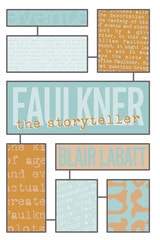
Faulkner the Storyteller
Blair Labatt
University of Alabama Press, 2006
A study exploring the role of event and plot in William Faulkner’s fiction.
Faulkner the Storyteller addresses the role of event and plot in Faulkner's fiction and the creation of an implied teller behind the tale. Novels like The Sound and the Fury and Absalom, Absalom! are often thought of as canonical modernist texts antagonistic to traditional notions of plot and storytelling. Blair Labatt, however, argues that Faulkner's fiction, regardless of its modernist gestures, is filled and driven by sophisticated manifestations of plot—willed challenges, structural targets, gambits, designs, engagements, and battles—a language of competition and conflict and a syntax of events.
Labatt examines Faulkner's short stories, such as "Mountain Victory," "That Evening Sun," and "Barn Burning," and the architecture of the Snopes Trilogy (The Hamlet, The Town, and The Mansion), and finds that Faulkner's deployment of cause and effect is central to his narratives. Labatt also explores how Faulkner's use of plot creates an implied voice that lends a humorous element to his story's twists and turns that often brackets and encloses the pathos of his characters.
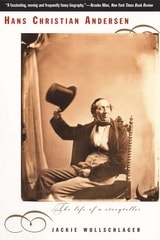
Hans Christian Andersen
The Life of a StorytellerJackie Wullschlager
University of Chicago Press, 2002
Drawing on letters, diaries, and other original sources (many never before translated from the Danish), Wullschlager shows in this compelling, extensively researched biography how Andersen's writings—darker and more diverse than previously recognized—reflected the complexities of his life, a far cry from the "happily ever after" of a fairy tale. As we follow in his footsteps from Golden Age Copenhagen to the princely courts of Germany and the villas of southern Italy, Andersen becomes a figure every bit as fascinating as a character from one of his stories—a gawky, self-pitying, and desperate man, but also one of the most gifted storytellers the world has ever known.
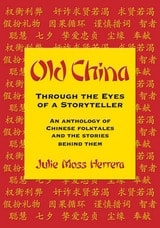
Old China Through the Eyes of a Storyteller
Julie Moss Herrera
Parkhurst Brothers, Inc., 2012
“Having traveled on the same People to People Ambassador journey to China with Julie, I have seen Julie's anthology from inception to fruition. It is a masterful, engaging, informative and scholarly addition to our understanding and appreciation of Chinese culture, particularly storytelling and folk traditions, from ancient days to today. Practicing storytellers will especially appreciate her tips for telling and context clues at the end of each story.”
--Judith Heineman, storyteller, producer and Illinois Humanities Road Scholar
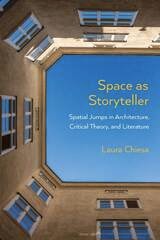
Space as Storyteller
Spatial Jumps in Architecture, Critical Theory, and LiteratureLaura Chiesa
Northwestern University Press, 2016
Taylor Swift as Storyteller
Identity, Power, and Digital CultureEdited by Alison Halsall
The Ohio State University Press, 2027
Taylor Swift as Storyteller examines one of the most influential cultural figures of the twenty-first century as both artist and “star text,” arguing that Swift’s global impact is shaped through the dynamic interplay of music, media, fandom, and branding. Bringing together literary scholars, ethnographers, and musicologists, this collection positions Swift as not just a pop figure but a transmedial construct.
Contributors explore how Swift’s carefully curated personae—from girl-next-door to feminist icon to “tortured poet”—generate powerful affective connections with audiences while also functioning as strategic marketing tools. At the same time, contributors retheorize authorship and control in the digital age. By foregrounding the roles of management, branding, and platform circulation, and by interrogating the participatory roles of Swifties as cocreators of meaning, Taylor Swift as Storyteller complicates the idea of singular authorship. Attending to questions of feminism, authorship, nostalgia, and literary adaptation, this collection ultimately reveals how Swift’s enterprise both reflects and reshapes contemporary media culture, illuminating the complex relationship between narrative, identity, and power in the digital age.
Contributors:
Natalie Abbott, Alexander Carpenter, Zixiao Chen, Katie E. Cline, Jennifer Duggan, Rachel M. Friars, Andrea LeMahieu Glaws, Wendy J. Glenn, Alison Halsall, Roxanne Harde, Juliette Holder, Erika Kvistad, Zhimou Li, Sarah E. Maier, Catherine McCarthy, Elly McCausland, Laura Carman McClintock, Adrianna Mirabal, Linh S. Nguy?n, Hazel O’Brien, Anah-Jayne Samuelson, L. M. Schmidt, Katlin Marisol Sweeney-Romero
The Philosopher and the Storyteller
Eric Voegelin and Twentieth-Century LiteratureCharles R. Embry
University of Missouri Press, 2018
Throughout his philosophical career, Eric Voegelin had much to say about literature in both his published work and his private letters. Many of his most trenchant comments regarding the analysis of literature appear in his correspondence with critic Robert Heilman, and, through his familiarity with that exchange, Charles Embry has gained extraordinary insight into Voegelin’s literary views.
The Philosopher and the Storyteller is the first book-length study of the literary dimensions of Voegelin’s philosophy—and the first to use his philosophy to read specific novels. Bringing to bear a thorough familiarity with both Voegelin and great literature, Embry shows that novels—like myths, philosophy, and religious texts—participate in the human search for the truth of existence, and that reading literature within a Voegelinian framework exposes the existential and philosophical dimensions of those works.
Embry focuses on two key elements of Voegelin’s philosophy as important for reading literature: metaxy, the in-between of human consciousness, and metalepsis, human participation in the community of being. He shows how Voegelin’s philosophy in general is rooted in literary-symbolic interpretation and, therefore, provides a foundation for the interpretation of literature. And finally he explores Voegelin’s insistence that the soundness of literary criticism lies in the consciousness of the reader.
Embry then offers Voegelinian readings that vividly illustrate the principles of this approach. First he considers Graham Swift’s Waterland as an example of the human search for meaning in the modern world, then he explores the deformation and recovery of reality in Heimito von Doderer’s long and complex novel The Demons, and finally he examines how Flannery O’Connor’s The Violent Bear It Away mythically expresses the flux of divine presence in what Voegelin calls the Time of the Tale.
The Philosopher and the Storyteller unites fiction and philosophy in the common quest to understand our nature, our world, and our cosmos. A groundbreaking exploration of the connection between Voegelin and twentieth-century literature, this book opens a new window on the philosopher’s thought and will motivate readers to study other novels in light of this approach.