Results by title
26 books match the query 'Strangers'
A Man in the Wheatfield
Robert Laxalt
University of Nevada Press, 2002
Brothers and Strangers
Black Zion, Black Slavery, 1914–1940Ibrahim Sundiata
Duke University Press, 2003
In an account based on extensive archival research, including work in the Liberian National Archives, Sundiata explains how Garvey’s plan collapsed when faced with opposition from the Liberian elite, opposition that belied his vision of a unified Black World. In 1930 the League of Nations investigated labor conditions and, damningly, the United States, land of lynching and Jim Crow, accused Liberia of promoting “conditions analogous to slavery.” Subsequently various plans were put forward for a League Mandate or an American administration to put down slavery and “modernize” the country. Threatened with a loss of its independence, the Liberian government turned to its “brothers beyond the sea” for support. A varied group of white and black anti-imperialists, among them W. E. B. Du Bois, took up the country’s cause. In revealing the struggle of conscience that bedeviled many in the black world in the past, Sundiata casts light on a human rights predicament which, he points out, continues in twenty-first-century African nations as disparate as Sudan, Mauritania, and the Ivory Coast.
Brothers and Strangers
The East European Jew in German and German Jewish Consciousness, 1800–1923Steven E. Aschheim
University of Wisconsin Press, 1983
Brothers and Strangers traces the history of German Jewish attitudes, policies, and stereotypical images toward Eastern European Jews, demonstrating the ways in which the historic rupture between Eastern and Western Jewry developed as a function of modernism and its imperatives. By the 1880s, most German Jews had inherited and used such negative images to symbolize rejection of their own ghetto past and to emphasize the contrast between modern “enlightened” Jewry and its “half-Asian” counterpart. Moreover, stereotypes of the ghetto and the Eastern Jew figured prominently in the growth and disposition of German anti-Semitism. Not everyone shared these negative preconceptions, however, and over the years a competing post-liberal image emerged of the Ostjude as cultural hero. Brothers and Strangers examines the genesis, development, and consequences of these changing forces in their often complex cultural, political, and intellectual contexts.

Children Of Strangers
Kathryn Morgan
Temple University Press, 1981

Collaborating with Strangers
Facilitating Workshops in Libraries, Classes, and NonprofitsBess G. de Farber
American Library Association, 2017
From Strangers to Neighbors
Post-Disaster Resettlement and Community Building in HondurasBy Ryan Alaniz
University of Texas Press, 2017
Natural disasters, the effects of climate change, and political upheavals and war have driven tens of millions of people from their homes and spurred intense debates about how governments and nongovernmental organizations (NGOs) should respond with long-term resettlement strategies. Many resettlement efforts have focused primarily on providing infrastructure and have done little to help displaced people and communities rebuild social structure, which has led to resettlement failures throughout the world. So what does it take to transform a resettlement into a successful community?
This book offers the first long-term comparative study of social outcomes through a case study of two Honduran resettlements built for survivors of Hurricane Mitch (1998) by two different NGOs. Although residents of each arrived from the same affected neighborhoods and have similar demographics, twelve years later one resettlement wrestles with high crime, low participation, and low social capital, while the other maintains low crime, a high degree of social cohesion, participation, and general social health. Using a multi-method approach of household surveys, interviews, ethnography, and analysis of NGO and community documents, Ryan Alaniz demonstrates that these divergent resettlement trajectories can be traced back to the type and quality of support provided by external organizations and the creation of a healthy, cohesive community culture. His findings offer important lessons and strategies that can be utilized in other places and in future resettlement policy to achieve the most effective and positive results.
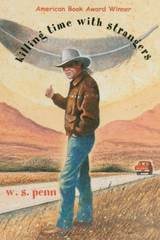
Killing Time with Strangers
W. S. Penn
University of Arizona Press, 2000
Young Pal needs help with his dreaming.
Palimony Blue Larue, a mixblood growing up in a small California town, suffers from a painful shyness and wants more than anything to be liked. That's why Mary Blue, his Nez Perce mother, has dreamed the weyekin, the spirit guide, to help her bring into the world the one lasting love her son needs to overcome the diffidence that runs so deep in his blood. The magical (and not totally competent) weyekin pops in and out of Pal's life at the most unexpected times—and in the most unlikely guises—but seems to have difficulty setting him on the right path. Is there any hope for Palimony Blue?
Don't ask his father, La Vent Larue; La Vent is past hope, past help, a city zoning planner and a pawn in the mayor's development plans who ends up crazy and in jail after he shoots the mayor in the—well, never mind. Better to ask Pal's mother, who summons the weyekin when she isn't working on a cradle board for Pal and his inevitable bride. And while you're at it, ask the women in Pal's life: Sally the preacher's daughter, Brandy the waitressing flautist, Tara the spoiled socialite. And be sure to ask Amanda, if you can catch her. If you can dream her.
Using comic vision to address serious concerns of living, Penn has written a freewheeling novel that will surpass most readers' expectations of "ethnic fiction." Instead of the usual polemics, it's marked by a sense of humor and a playfulness of language that springs directly from Native American oral tradition.
What more can be said about a book that has to be read to the end in order to get to the beginning? That Killing Time with Strangers is unlike any novel you have read before? Or perhaps that it is agonizingly familiar, giving us glimpses of a young man finding his precarious way in life? But when the power of dreaming is unleashed, time becomes negotiable and life's joys and sorrows go up for grabs. And as sure as yellow butterflies will morph into Post-It notes, you will know you have experienced a new and utterly captivating way of looking at the world.
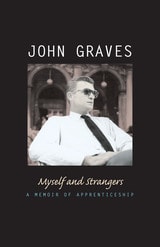
Myself and Strangers
A Memoir of ApprenticeshipBy John Graves
University of Texas Press, 2005
In Myself and Strangers, John Graves, the highly regarded author of Goodbye to a River and other classic works, recalls the decade-long apprenticeship in which he found his voice as a writer. He recounts his wanderings from Texas to Mexico, New York, and Spain, where, like Hemingway, he hoped to find the material with which to write books that mattered. With characteristic honesty, Graves admits the false starts and dead ends that dogged much of his writing, along with the exhilaration he felt when the words finally flowed. He frankly describes both the pleasures and the restlessness of expatriate life in Europe after World War II—as well as his surprising discovery, when family obligations eventually called him home to Texas, that the years away had prepared him to embrace his native land as the fit subject matter for his writing. For anyone seeking the springs that fed John Graves' best-loved books, this memoir of apprenticeship will be genuinely rewarding.

Neighbors and Strangers
The Fundamentals of Foreign AffairsWilliam R. Polk
University of Chicago Press, 1997
Indeed, going deeper into the human experience, Polk documents "fear of the foreigner" as a visceral response so deep-seated and so pervasive that it transcends human memory, individual experience and even logical analysis. More generally, he shows that the tension created by having to live as neighbors with those who, in the definition of contemporaries, were irredeemably alien has been one of the major causes of the rise of civilizations.
Accessible and engaging, Neighbors and Strangers is a revelatory look at how foreign affairs are a profound reflection of human nature.
Of Gods & Strangers
Tina Chang
Four Way Books, 2011

Sex with Strangers
Michael Lowenthal
University of Wisconsin Press, 2021
Recognizing that any partner is unknowable on some level, Michael Lowenthal writes about how intimacy can make strangers of us all. A newly ordained priest struggles with guilt and longing when he runs into his ex-girlfriend. A woman weighs the cost of protecting her daughter from a man they both adore. A teenage busboy has a jolting brush with a famous musician. A young man tries to salvage a long-distance relationship while caring for his mentor, an erotic writer dying of AIDS.
In edgy, disquieting stories, Lowenthal traces the paths that attraction and erotic encounters take, baffling and rueful as often as electrifying. This fraught and funny volume forces us to grapple with our own subconscious desires and question how well we can ever really know ourselves.
States And Strangers
Refugees And Displacements Of StatecraftNevzat Soguk
University of Minnesota Press, 1999
Looks at the role of refugees in international relations.
Refugees may flee their country, but can they escape the confining, defining logic of all the voices that speak for them? As refugees multiply in our troubled world, more and more scholars, studies, and pundits focus on their plight. Most of these analyses, says Nevzat Soguk, start from a model that shares the assumptions manifested in traditional definitions of citizen, nation, and state. Within this hierarchy, he argues, a refugee has no place to go. States and Strangers questions this paradigm, particularly its vision of the territoriality of life.
A radical retheorization of the refugee from a Foucauldian perspective, the book views the international refugee regime not as a simple tertiary response, arising from the practice of states regarding refugee problems, but as itself an aspect of the regimentation of statecraft. The attendant discourse negates the multiplicity of refugee events and experience; by assigning the refugee an identity-someone without the citizen’s grounding within a territorial space-the state renders him voiceless and deprives him of representation and protection. States and Strangers asks how this happens and how it can be avoided.Using historical, archival research and interpretive strategies drawn from a genealogical approach, Soguk considers the role of the refugee in the emergence and maintenance of the sovereign territorial state from the late seventeenth century to contemporary times. ISBN 0-8166-3166-2 Cloth/jacket £00.00 $62.95x340 Pages 5 7/8 x 9 MarchBorderlines Series, volume 11Translation inquiries: University of Minnesota Press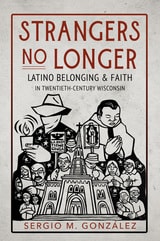
Strangers No Longer
Latino Belonging and Faith in Twentieth-Century WisconsinSergio M. González
University of Illinois Press, 2024
Hospitality practices grounded in religious belief have long exercised a profound influence on Wisconsin’s Latino communities. Sergio M. González examines the power relations at work behind the types of hospitality--welcoming and otherwise--practiced on newcomers in both Milwaukee and rural areas of the Badger State. González’s analysis addresses central issues like the foundational role played by religion and sacred spaces in shaping experiences and facilitating collaboration among disparate Latino groups and across ethnic lines; the connections between sacred spaces and the moral justification for social justice movements; and the ways sacred spaces evolved into places for mitigating prejudice and social alienation, providing sanctuary from nativism and repression, and fostering local and transnational community building.
Perceptive and original, Strangers No Longer reframes the history of Latinos in Wisconsin by revealing religion’s central role in the settlement experience of immigrants, migrants, and refugees.

Strangers and Neighbors
Relations between Blacks and Jews in the United StatesMaurianne Adams
University of Massachusetts Press, 1999
Much has been written about the historic relationship between American blacks and Jews. Some accounts stress the strong alliance for social justice between the two groups during the civil rights movement, while others portray bleaker moments and include accusations of Jewish racism or black anti-Semitism. What is often missing is a larger historical perspective. This volume provides a wide range of analyses and documents that help us move beyond stereotypes and portray the full complexity of black-Jewish relations in America over the past three hundred years.
Following two introductory sections addressing “Themes and Issues” and “African Americans as the Chosen People,” the book is divided into five historical periods: the Atlantic slave trade and slavery in the New World; emancipation to the Great Depression; the era of the Depression and World War II; World War II through 1967; and 1968 to the present. Each section contains a mix of scholarly articles, historical documents, and contemporary perspectives. A final section entitled “Where Do We Go from Here?” suggests ways to rebuild a coalition between blacks and Jews in the twenty-first century. Throughout the volume, the editors' goal is not to achieve closure but to invite further discussion about the historical relationship between two large, evolving, and diverse peoples. The selections reveal that the experiences of American blacks and Jews, although intersecting at several critical junctures, have not been parallel, and that significant geographical, class, political, and religious differences exist within both communities that preclude easy generalizations.
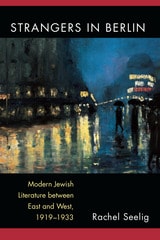
Strangers in Berlin
Modern Jewish Literature between East and West, 1919–1933Rachel Seelig
University of Michigan Press, 2016
Author Rachel Seelig portrays Berlin during the Weimar Republic as a “threshold” between exile and homeland in which national and artistic commitments were reexamined, reclaimed, and rebuilt. In the pulsating yet precarious capital of Germany’s first fledgling democracy, the collision of East and West engendered a broad spectrum of poetic styles and Jewish national identities.

Strangers in Light Coats
Selected Poems, 2014–2020Ghassan Zaqtan
Seagull Books, 2023
Ghassan Zaqtan is not only one of the most significant Palestinian poets at work today, but one of the most important poets writing in Arabic. Since the publication of his first collection in 1980, Zaqtan’s presence as a poet has evolved with the same branching and cumulative complexity as his poems—an invisible system of roots insistently pushing through the impacted soil of political and national narratives.
Strangers in Light Coats is the third collection of Zaqtan’s poetry to appear in English. It brings together poems written between 2014 and 2020 drawn from six volumes of poetry. Catching and holding the smallest particles of observation and experience in their gravity, the poems sprout and grow as though compelled, a trance of process in which fable, myth, and elegy take form only to fall apart and reconfigure, each line picked apart by the next and brought into the new body.
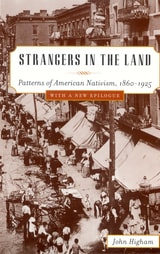
Strangers in the Land
Patterns of American Nativism, 1860-1925Higham, John
Rutgers University Press, 1988
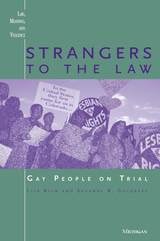
Strangers to the Law
Gay People on TrialLisa Keen and Suzanne B. Goldberg
University of Michigan Press, 2000
Starting with the background of the initiative, the authors tell us about the debates over strategy, the court proceedings, and the impact of each stage of the litigation on the parties involved. The authors explore the meaning of legal protection for gay people and the arguments for and against the Colorado initiative.
This book is essential reading for anyone interested in the development of civil rights protections for gay people and the evolution of what it means to be gay in contemporary American society and politics. In addition, it is a rich story well told, and will be of interest to the general reader and scholars working on issues of civil rights, majority-minority relations, and the meaning of equal rights in a democratic society.
Suzanne Goldberg is an attorney with the Lambda Legal Defense and Education Fund. Lisa Keen is Senior Editor at the Washington Blade newspaper.

Strangers to the Law
Gay People on TrialLisa Keen and Suzanne B. Goldberg
University of Michigan Press, 1998
Starting with the background of the initiative, the authors tell us about the debates over strategy, the court proceedings, and the impact of each stage of the litigation on the parties involved. The authors explore the meaning of legal protection for gay people and the arguments for and against the Colorado initiative.
This book is essential reading for anyone interested in the development of civil rights protections for gay people and the evolution of what it means to be gay in contemporary American society and politics. In addition, it is a rich story well told, and will be of interest to the general reader and scholars working on issues of civil rights, majority-minority relations, and the meaning of equal rights in a democratic society.
Suzanne Goldberg is an attorney with the Lambda Legal Defense and Education Fund. Lisa Keen is Senior Editor at the Washington Blade newspaper.

Strangers
A Book of PoemsDavid Ferry
University of Chicago Press, 1983
"Strangers is a remarkably good book for a reader sufficiently attentive to hear its quiet power, to let it work in its distinctive way."—Boston Globe
"The poems of David Ferry's Strangers are in fact one book, and it is a splendid one. There is the same austere and poignant voice throughout, asking the unanswerable things, speaking of all that is withheld from us, confronting the unknownness that dwells even in the familiar and dear. Painful and touching, the book offers a distinctive vision which is at the same time inescapably true."—Richard Wilbur

Talking to Strangers
Patricia Dobler
University of Wisconsin Press, 1986
In her first book of poems, Patricia Dobler records her memories of the Ohio mill town where she grew up in the 1950s. but the poems range over time and the memories of others, as well: her immigrant Hungarian grandparents, her parent's tensions during hard times (”Years spilled on the kitchen table, / picked over like beans or old bills”), the dangers, losses, and occasional triumphs of hard-working men and women.
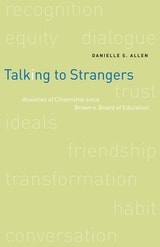
Talking to Strangers
Anxieties of Citizenship since Brown v. Board of EducationDanielle Allen
University of Chicago Press, 2004
Returning to the landmark Brown v. Board of Education decision of 1954 and to the famous photograph of Elizabeth Eckford, one of the Little Rock Nine, being cursed by fellow "citizen" Hazel Bryan, Allen argues that we have yet to complete the transition to political friendship that this moment offered. By combining brief readings of philosophers and political theorists with personal reflections on race politics in Chicago, Allen proposes strikingly practical techniques of citizenship. These tools of political friendship, Allen contends, can help us become more trustworthy to others and overcome the fossilized distrust among us.
Sacrifice is the key concept that bridges citizenship and trust, according to Allen. She uncovers the ordinary, daily sacrifices citizens make to keep democracy working—and offers methods for recognizing and reciprocating those sacrifices. Trenchant, incisive, and ultimately hopeful, Talking to Strangers is nothing less than a manifesto for a revitalized democratic citizenry.

The Color of Strangers, the Color of Friends
Alan Peshkin
University of Chicago Press, 1991
"Peshkin strikes a hopeful chord, revealing what social encounters among ethnic groups—at their best—can be like in America."—Education Digest
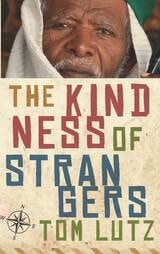
The Kindness of Strangers
Tom Lutz
University of Iowa Press, 2021
You may never visit these places, but Tom Lutz will do it for you. And while global media may serve up a steady diet of division, violence, oppression, hatred, and strife, The Kindness of Strangers shows that people the world over are much more likely to meet strangers with interest, empathy, welcome, and compassion.
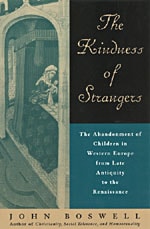
The Kindness of Strangers
The Abandonment of Children in Western Europe from Late Antiquity to the RenaissanceJohn Boswell
University of Chicago Press, 1998

The Kingdom of Strangers
Elias Khoury
University of Arkansas Press, 1996