Results by title
6 books match the query 'Strategic aspects'

Fools' Crusade
Yugoslavia, NATO and Western DelusionsDiana Johnstone
Pluto Press, 2002
Thanks to massive deception and self-deception by media and politicians, even the anti-globalisation movement failed to grasp the implications of the aggressive military globalisation pursued by the United States, from Iraq to Afghanistan and beyond.
In this study, Diana Johnstone identifies the common geopolitical interests running through all these past, present and future military interventions. She argues persuasively that outside intervention creates rather than solves problems and cannot be justified.
Johnstone shows that the 'War in Kosovo' was in reality the model for future destruction of countries seen as potential threats to the hegemony of the 'International Community', led by the United States.
Georgia
Pawn in the New Great GamePer Gahrton
Pluto Press, 2010
The 2008 Ossetia War underlined the fact that Georgia is caught in a political struggle between East and West. Per Gahrton analyses American and Russian policy towards the country and provides a firsthand account of the Rose Revolution of 2003, its origin and aftermath.
The book traces the increasing US involvement in Georgia and the Russian reaction of anger, sanctions and, eventually, invasion. Gahrton's analysis is based on interviews with key politicians and his experience as the rapporteur of the European Parliament on South Caucasus. At centre stage is the growing opposition against authoritarian aspects of President Mikheil Saakashvili’s regime and the mysterious death of Prime Minister Zhvania in 2005. The book also asks if the Rose Revolution was a conspiracy or a genuine popular uprising.
This truly authoritative account of Georgia is a must for students studying international relations in the aftermath of The Cold War.

Israel and the American National Interest
A Critical ExaminationCheryl A. Rubenberg
University of Illinois Press, 1986
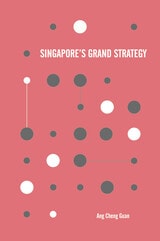
Singapore's Grand Strategy
Cheng Guan Ang
National University of Singapore Press, 2023
Even small states can have grand strategies. Singapore, despite its poor natural resource endowment, small population, and size, has often been described as punching above its weight in international affairs. Part of this stems from the way Singapore strategically integrates the different diplomatic, political, and defense-oriented tools at its disposal. To explore this, Singapore’s Grand Strategy offers a fresh and useful diplomatic, defense, and security history of Singapore, from its independence in 1965 through today’s period of strategic realignment.
Most previous studies of grand strategy have focused on super- or at least middle powers, but this book presents an important contribution to international relations and strategic studies by showing how the concept can help explain the strategic posture and achievements of small states as well. Moreover, he brings a historian's perspective to a subject usually tackled by political scientists. The result will be useful and important for scholars in these fields.
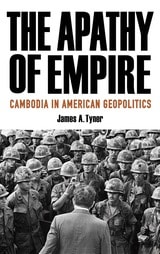
The Apathy of Empire
Cambodia in American GeopoliticsJames A. Tyner
University of Minnesota Press, 2024
What America’s intervention in Cambodia during the Vietnam War reveals about Cold War–era U.S. national security strategy
The Apathy of Empire reveals just how significant Cambodia was to U.S. policy in Indochina during the Vietnam War, broadening the lens to include more than the often-cited incursion in 1970 or the illegal bombing after the Paris Peace Accords in 1973. This theoretically informed and thoroughly documented case study argues that U.S. military intervention in Cambodia revealed America’s efforts to construct a hegemonic spatial world order.
James Tyner documents the shift of America’s post-1945 focus from national defense to national security. He demonstrates that America’s expansionist policies abroad, often bolstered by military power, were not so much about occupying territory but instead constituted the construction of a new normal for the exercise of state power. During the Cold War, Vietnam became the geopolitical lodestar of this unfolding spatial order. And yet America’s grand strategy was one of contradiction: to build a sovereign state (South Vietnam) based on democratic liberalism, it was necessary to protect its boundaries—in effect, to isolate it—through both covert and overt operations in violation of Cambodia’s sovereignty. The latter was deemed necessary for the former.
Questioning reductionist geopolitical understandings of states as central or peripheral, Tyner explores this paradox to rethink the formulation of the Cambodian war as sideshow, revealing it instead as a crucial site for the formation of this new normal.
Retail e-book files for this title are screen-reader friendly.
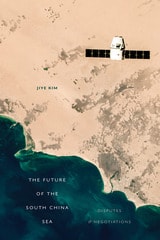
The Future of the South China Sea
Disputes and NegotiationsJiye Kim
University of Michigan Press, 2026
By incorporating negotiation records, such as the 1958 Declaration on China’s Territorial Sea, the 1992 ASEAN Declaration, and the 2005 Tripartite Agreement, Jiye Kim traces how China reshapes its interests into negotiation agendas, providing critical insights into the nation’s diplomacy and making a significant contribution to an existing literature on the South China Sea that has been largely dominated by analyses of great power rivalry. This book sheds light on China’s underlying interests as living and adaptable entities, providing scholars with a detailed, evidence-based understanding of the complexities that define one of the world’s most contested maritime regions.