Results by title
4 books match the query 'Straus, Scott'
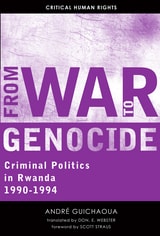
From War to Genocide
Criminal Politics in Rwanda, 1990–1994André Guichaoua, Translated by Don E. Webster, Foreword by Scott Straus
University of Wisconsin Press, 2017
In April 1994 Rwanda exploded in violence, with political, social, and economic divisions most visible along ethnic lines of the Hutu and Tutsi factions. The ensuing killings resulted in the deaths of as much as 20 percent of Rwanda's population. André Guichaoua, who was present as the genocide began, unfolds a complex story with multiple actors, including three major political parties that each encompassed a spectrum of positions, all reacting to and influencing a rapidly evolving situation. Economic polarities, famine-fueled privation, clientelism, corruption, north-south rivalries, and events in the neighboring nations of Burundi and Uganda all deepened ethnic tensions, allowing extremists to prevail over moderates.
Guichaoua draws on years of meticulous research to describe and analyze this history. He emphasizes that the same virulent controversies that fueled the conflict have often influenced judicial, political, and diplomatic responses to it, reproducing the partisan cleavages between the former belligerents and implicating state actors, international institutions, academics, and the media. Guichaoua insists upon the imperative of absolute intellectual independence in pursuing the truth about some of the gravest human rights violations of the twentieth century.
Guichaoua draws on years of meticulous research to describe and analyze this history. He emphasizes that the same virulent controversies that fueled the conflict have often influenced judicial, political, and diplomatic responses to it, reproducing the partisan cleavages between the former belligerents and implicating state actors, international institutions, academics, and the media. Guichaoua insists upon the imperative of absolute intellectual independence in pursuing the truth about some of the gravest human rights violations of the twentieth century.
[more]
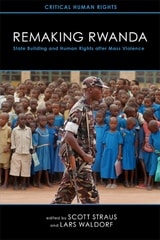
Remaking Rwanda
State Building and Human Rights after Mass ViolenceScott Straus
University of Wisconsin Press, 2011
In the mid-1990s, civil war and genocide ravaged Rwanda. Since then, the country’s new leadership has undertaken a highly ambitious effort to refashion Rwanda’s politics, economy, and society, and the country’s accomplishments have garnered widespread praise. Remaking Rwanda is the first book to examine Rwanda’s remarkable post-genocide recovery in a comprehensive and critical fashion. By paying close attention to memory politics, human rights, justice, foreign relations, land use, education, and other key social institutions and practices, this volume raises serious concerns about the depth and durability of the country’s reconstruction.
Edited by Scott Straus and Lars Waldorf, Remaking Rwanda brings together experienced scholars and human rights professionals to offer a nuanced, historically informed picture of post-genocide Rwanda—one that reveals powerful continuities with the nation’s past and raises profound questions about its future.
Best Special Interest Books, selected by the American Association of School Librarians
Best Special Interest Books, selected by the Public Library Reviewers
[more]
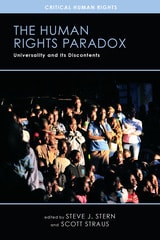
The Human Rights Paradox
Universality and Its DiscontentsEdited by Steve J. Stern and Scott Straus
University of Wisconsin Press, 2014
Human rights are paradoxical. Advocates across the world invoke the idea that such rights belong to all people, no matter who or where they are. But since humans can only realize their rights in particular places, human rights are both always and never universal.
The Human Rights Paradox is the first book to fully embrace this contradiction and reframe human rights as history, contemporary social advocacy, and future prospect. In case studies that span Africa, Latin America, South and Southeast Asia, and the United States, contributors carefully illuminate how social actors create the imperative of human rights through relationships whose entanglements of the global and the local are so profound that one cannot exist apart from the other. These chapters provocatively analyze emerging twenty-first-century horizons of human rights—on one hand, the simultaneous promise and peril of global rights activism through social media, and on the other, the force of intergenerational rights linked to environmental concerns that are both local and global. Taken together, they demonstrate how local struggles and realities transform classic human rights concepts, including “victim,” “truth,” and “justice.”
Edited by Steve J. Stern and Scott Straus, The Human Rights Paradox enables us to consider the consequences—for history, social analysis, politics, and advocacy—of understanding that human rights belong both to “humanity” as abstraction as well as to specific people rooted in particular locales.
[more]
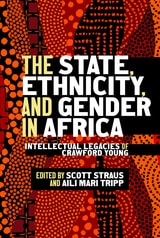
The State, Ethnicity, and Gender in Africa
Intellectual Legacies of Crawford YoungEdited by Scott Straus and Aili Mari Tripp
University of Wisconsin Press, 2024
Postcolonialism, the politics of ethnic and religious identity, and the role of women in African society and politics have become important, and often connected, foci in African studies. Here, fifteen chapters explore these themes in tandem. With essays that span the continent, this volume showcases the political histories, challenges, and promise of contemporary Africa.
Written in honor of Crawford Young, a foundational figure in the study of African politics, the essays reflect the breadth and intellectual legacy of this towering scholar and illustrate the vast impact Young had, and continues to have, on the field. The book’s themes build from his seminal publications, and the essays were written by leading scholars who were trained by Young.
Written in honor of Crawford Young, a foundational figure in the study of African politics, the essays reflect the breadth and intellectual legacy of this towering scholar and illustrate the vast impact Young had, and continues to have, on the field. The book’s themes build from his seminal publications, and the essays were written by leading scholars who were trained by Young.
[more]