Results by title
2 books match the query 'Street Fight'

Street Fight
Mean America and the War on Sesame StreetMichael Davis
Rutgers University Press, 2027
Education in the United States is under attack, but there’s still one street that’s full of hope. Sesame Street was created in 1969 with the aim to help less fortunate children better prepare for school. Since then, it has been viewed by an estimated 190 million children across 150 countries and prepared generations of children for kindergarten. Without Sesame Street, where would they go?
Within the walls of Sesame Workshop’s idea factory, the people behind the show have been battling forces that would have snuffed it out long ago. Its federal funding has been slashed, despite it being the gold standard of children’s educational programming, and only through heroic efforts has it avoided cancellation. Meanwhile, Sesame Workshop continues to address educational and social needs in children that would otherwise go unmet.
Street Fight weighs how the ongoing experiment in educating preschoolers through television has served the world’s children, while also revealing the limitations and complications that left some viewers behind. Drawing from over two hundred interviews and including oral histories from the show’s performers and executives, journalist Michael Davis pulls back the curtain to look at the people and events that shaped Sesame Street from the 1990s to the present. From public scandals to behind-the-scenes tensions, Street Fight traces the evolution of a beloved American institution against the backdrop of a rapidly changing media landscape.
All too often, Sesame Street only makes the news during a media firestorm. This book recounts what happens the other 364 days of the year
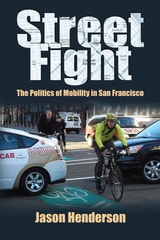
Street Fight
The Politics of Mobility in San FranciscoJason Henderson
University of Massachusetts Press, 2013
Faced with intolerable congestion and noxious pollution, cities around the world are rethinking their reliance on automobiles. In the United States a loosely organized livability movement seeks to reduce car use by reconfiguring urban space into denser, transit-oriented, walkable forms, a development pattern also associated with smart growth and new urbanism. Through a detailed case study of San Francisco, Jason Henderson examines how this is not just a struggle over what type of transportation is best for the city, but a series of ideologically charged political fights over issues of street space, public policy, and social justice.
Historically San Francisco has hosted many activist demonstrations over its streets, from the freeway revolts of the 1960s to the first Critical Mass bicycle rides decades later. Today the city's planning and advocacy establishment is changing zoning laws to limit the number of parking spaces, encouraging new car-free housing near transit stations, and applying “transit first” policies, such as restricted bus lanes. Yet Henderson warns that the city's accomplishments should not be romanticized. Despite significant gains by livability advocates, automobiles continue to dominate the streets, and the city's financially strained bus system is slow and often unreliable.
Both optimistic and cautionary, Henderson argues that ideology must be understood as part of the struggle for sustainable cities and that three competing points of view—progressive, neoliberal, and conservative—have come to dominate the contemporary discourse about urban mobility. Consistent with its iconic role as an incubator of environmental, labor, civil rights, and peace movements, San Francisco offers a compelling example of how the debate over sustainable urban transportation may unfold both in the United States and globally.