Results by title
3 books match the query 'Street theater'

Carnival Theater
Uruguay’s Popular Performers and National CultureGustavo Remedi
University of Minnesota Press, 2004
Offers a new model for interpreting popular national culture through Uruguay’s carnival theater troupes
The murgas are troupes of performers, musicians, writers, and creators who, during Montevideo’s Carnival, perform on the tablados, temporary stages built in the neighborhoods of Uruguay’s capital city each year. Throughout the period of Uruguay’s subjection to a brutal dictatorship and in the following era of “democratization,” the murgas, envisioned originally as popular theater, were transformed into a symbol of social resistance, celebrated by many and perceived by others as menacing and subversive.
Focusing on the cultural practices of the lower classes and more specifically on the processes and productions of the murgas, Gustavo Remedi’s Carnival Theater is a deeply thoughtful consideration of Uruguayan society’s identity crisis and subsequent redefinition in the wake of the authoritarian-bureaucratic-technocratic regimes of the 1970s. A revealing work of cultural criticism, the book proposes a new set of criteria for the interpretation and critique of national culture.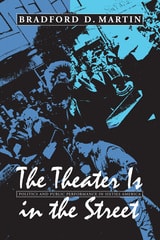
The Theater Is in the Street
Politics and Public Performance in 1960s AmericaBradford D. Martin
University of Massachusetts Press, 2004
During the 1960s, the SNCC Freedom Singers, The Living Theatre, the Diggers, the Art Workers Coalition, and the Guerrilla Art Action Group fused art and politics by staging unexpected and uninvited performances in public spaces. Through their activism and the response it provoked, art, theater, and politics began to converge and assume a new visibility in everyday life. While their specific political visions varied, these groups shared the impulse to stage performances and actions publicly—"in the streets"—eschewing museums, theaters, and other conventional halls of culture. Bradford D. Martin offers detailed portraits of each of these groups and examines why they embraced public performance as a vehicle to express and advance their politics.
At a time when the New Left and the counterculture were on the rise, these artists reflected the decade's political and cultural radicalism and helped to define a new aesthetic. Civil rights activists mobilized singing in the struggle for desegregation, introducing a vibrant musical form into the public space. The Living Theatre culminated an arduous quest to mesh artistic and political goals, leading audiences from theaters into the streets to begin the “beautiful nonviolent anarchist revolution.” The Diggers playfully engaged San Francisco's counterculture in politics with their carnivalesque public actions. The Art Workers Coalition and the Guerrilla Action Art Group sought to disrupt the conventional art world, mounting protests in and around New York City museums.
By questioning the values and assumptions that separated art from politics, these groups not only established public performance as a legitimate aesthetic but also provided a new creative vocabulary for future generations of artists. Their continued involvement with the women's liberation movement, rural communes, and political street theater into the 1970s and beyond challenges the popular myth that activists disengaged from politics after the 1960s.
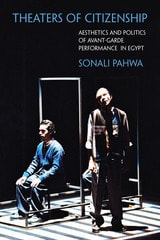
Theaters of Citizenship
Aesthetics and Politics of Avant-Garde Performance in EgyptSonali Pahwa
Northwestern University Press, 2020
In 2004, independent cultural institutions were sites for more democratic forms of youth organization and cultural participation than were Egyptian state theaters. Sonali Pahwa looks at identity formation within this infrastructure for new cultural production: festivals, independent troupes, workshops, and manifesto movements. Bringing institutional changes in dialogue with new performance styles on stages and streets, Pahwa conceptualizes performance culture as a school of citizenship. Independent theater incubated hope in times of despair and pointed to different futures for the nation’s youth than those seen in television and newspapers. Young dramatists countered their generation’s marginalization in the neoliberal economy, media, and political institutions as they performed alternative visions for the nation. An important contribution to the fields of anthropology and performance studies, Pahwa’s analysis will also interest students of sociology and Egyptian history.