Results by title
2 books match the query 'Street-railroads'
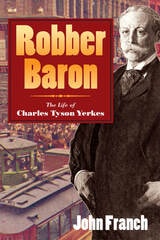
Robber Baron
The Life of Charles Tyson YerkesJohn Franch
University of Illinois Press, 2006
Robber Baron is the first biography of the streetcar magnate Charles Tyson Yerkes (1837-1905), who stands alongside J.P. Morgan and Andrew Carnegie as one of the most colorful and controversial public figures in Gilded Age America. John Franch draws upon every available source to tell the story of the man who was the mastermind behind Chicago’s Loop Elevated and the London Underground, the namesake of the University of Chicago’s observatory, and the inspiration for Frank Cowperwood, the ruthless protagonist of Theodore Dreiser's Trilogy of Desire: The Financier, The Titan, and The Stoic. Despite various philanthropic efforts, Yerkes and his unscrupulous tactics were despised by the press and public, and he left Chicago a bitter man. While Yerkes’s enduring public works testify to his success and desire to leave a lasting impression on his world, Robber Baron also uncovers the cost of this boundless ambition.
[more]
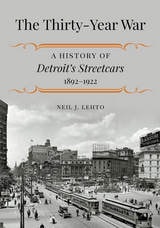
The Thirty-Year War
A History of Detroit's Streetcars, 1892–1922Neil J. Lehto
Michigan State University Press, 2017
Streetcars played an especially important role in society around the turn of the twentieth century in Detroit, in part because of the downtown hub-and-spoke design of its main streets. During this period the streetcar was the main mode of transportation for the average citizen, as horse-drawn carriages and automobiles were not found outside of the upper class. Control over streetcar franchises was highly coveted—this control was simultaneous with having power over how and where people were transported throughout the city, making it an incredible political tool. The Thirty-Year War was a battle waged between 1892 and 1922 by the City of Detroit against the politically powerful and deeply entrenched corporations that owned streetcar franchises for control of the city’s streetway system. This compelling history shows how and why the owners of monopoly franchises of great public utilities such as bridges, street railways, electricity, natural gas, and cable television will protect and defend their privilege against public ownership or control, and is an example of how one city successfully fought back.
[more]