Results by title
2 books match the query 'Stuarts, 1603-1714'

From Counter-Reformation to Glorious Revolution
Hugh Trevor-Roper
University of Chicago Press, 1992
This collection is the third in a series which gathers the best historical essays of Hugh Trevor-Roper, considered by many the unequalled master of the form.
The pieces here range from an account of the Jesuit Matteo Ricci's mission in China in the sixteenth century to a discussion of the Anglo-Scottish Union. They include essays on medicine at the early Stuart Court, on the plunder of artistic treasures in Europe during the wars of the seventeenth century, on the plans of Hugo Grotius to create a new universal church on an Anglican base, on the Glorious Revolution of 1688 and religious toleration thereafter. There are also biographical studies of Archbishop Laud, Matthew Wren, the Earl of Clarendon, and Prince Rupert.
As Noel argument wrote in Our Age, Hugh Trevor-Roper has "perfected the historical essay as the most beguiling form of enlightening readers about the past. He is the most eloquent, sophisticated and assured historian of Our Age, and has never written an inelegant sentence or produced an incoherent arguement."
[more]
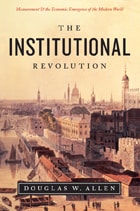
The Institutional Revolution
Measurement and the Economic Emergence of the Modern WorldDouglas W. Allen
University of Chicago Press, 2011
Few events in the history of humanity rival the Industrial Revolution. Following its onset in eighteenth-century Britain, sweeping changes in agriculture, manufacturing, transportation, and technology began to gain unstoppable momentum throughout Europe, North America, and eventually much of the world—with profound effects on socioeconomic and cultural conditions.
In The Institutional Revolution, Douglas W. Allen offers a thought-provoking account of another, quieter revolution that took place at the end of the eighteenth century and allowed for the full exploitation of the many new technological innovations. Fundamental to this shift were dramatic changes in institutions, or the rules that govern society, which reflected significant improvements in the ability to measure performance—whether of government officials, laborers, or naval officers—thereby reducing the role of nature and the hazards of variance in daily affairs. Along the way, Allen provides readers with a fascinating explanation of the critical roles played by seemingly bizarre institutions, from dueling to the purchase of one’s rank in the British Army.
Engagingly written, The Institutional Revolution traces the dramatic shift from premodern institutions based on patronage, purchase, and personal ties toward modern institutions based on standardization, merit, and wage labor—a shift which was crucial to the explosive economic growth of the Industrial Revolution.
[more]