Results by title
4 books match the query 'Stupidity'
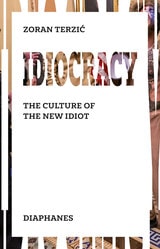
Idiocracy
The Culture of the New IdiotZoran Terzic
Diaphanes, 2021
There is a new quality of idiocy today. While the old idiot derived knowledge from isolation, the new idiot refuses all understanding of the world. A figure of systematic incompetence, the new idiot is impacting global culture and politics alike, giving rise to surprising, often absurd competences. Yesterday’s “fake news” or “post-truths” can be read today as evidence of an ongoing transformation of self-politics in which the idiotic impulse is redefining our experience of the world. Despite talk of global awareness, the isolated self of the many is all the more effective. It brings about a culture of happy singletons strolling towards a black hole that has become their substitute for society.
Zoran Terzić’s wide-ranging essay takes up the figure of the idiot and follows its numerous appearances throughout intellectual history in an examination of the “art of the idiotic” that both reflects and transcends the freneticism of the present.
Zoran Terzić’s wide-ranging essay takes up the figure of the idiot and follows its numerous appearances throughout intellectual history in an examination of the “art of the idiotic” that both reflects and transcends the freneticism of the present.
[more]
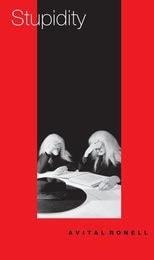
Stupidity
Avital Ronell
University of Illinois Press, 2001
In Stupidity Avital Ronell explores the fading empire of cognition, modulating stupidity into idiocy, puerility, and the figure of the ridiculous philosopher instituted by Kant. Drawing on a range of writers including Dostoevsky, Schlegel, Musil, and Wordsworth, Stupidity investigates ignorance, dumbfounded-ness, and the limits of reason.
[more]

The Queer Art of Failure
Jack Halberstam
Duke University Press, 2011
The Queer Art of Failure is about finding alternatives—to conventional understandings of success in a heteronormative, capitalist society; to academic disciplines that confirm what is already known according to approved methods of knowing; and to cultural criticism that claims to break new ground but cleaves to conventional archives. Jack Halberstam proposes “low theory” as a mode of thinking and writing that operates at many different levels at once. Low theory is derived from eccentric archives. It runs the risk of not being taken seriously. It entails a willingness to fail and to lose one’s way, to pursue difficult questions about complicity, and to find counterintuitive forms of resistance. Tacking back and forth between high theory and low theory, high culture and low culture, Halberstam looks for the unexpected and subversive in popular culture, avant-garde performance, and queer art. Halberstam pays particular attention to animated children’s films, revealing narratives filled with unexpected encounters between the childish, the transformative, and the queer. Failure sometimes offers more creative, cooperative, and surprising ways of being in the world, even as it forces us to face the dark side of life, love, and libido.
[more]
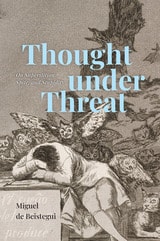
Thought under Threat
On Superstition, Spite, and StupidityMiguel de Beistegui
University of Chicago Press, 2022
Thought under Threat reveals and combats the forces diminishing the power and role of critical thinking, whether in our individual lives or collectively.
Thought under Threat is an attempt to understand the tendencies that threaten thinking from within. These tendencies have always existed. But today they are on the rise and frequently encouraged, even in our democracies. People “disagree” with science and distrust experts. Political leaders appeal to the hearts and guts of “the people,” rather than their critical faculties. Stupidity has become a right, if not a badge of honor; superstition is on the rise; and spite is a major political force. Thinking is considered “elitist.”
To see those obstacles as vices of thought, Miguel de Beistegui argues, we need to understand stupidity not as a lack of intelligence or judgment, but as the tendency to raise false problems and trivial questions. Similarly, we need to see spite not as a moral vice, but as a poison that blurs and distorts our critical faculties. Finally, superstition is best described not as a set of false beliefs, but as a system that neutralizes one’s ability to think for oneself.
For de Beistegui, thinking is intrinsically democratic and a necessary condition for the exercise of freedom. Thought under Threat shows how a training of thought itself can be used to ward off those vices, lead to productive deliberation, and, ultimately, create a thinking community.
[more]