Results by title
3 books match the query 'Sturtevant, Victoria'
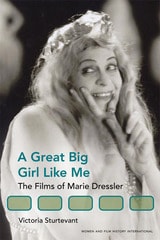
A Great Big Girl Like Me
The Films of Marie DresslerVictoria Sturtevant
University of Illinois Press, 2008
This premier analysis of her body of work explores how Dressler refocused the generic frame of her films beyond the shallow problems of the rich and beautiful, instead dignifying the marginalized, the elderly, women, and the poor. Sturtevant inteprets the meanings of Dressler's body through different genres, venues, and historical periods by looking at her vaudeville career, her transgressive representation of an "unruly" yet sexual body in Emma and Christopher Bean, ideas of the body politic in the films Politics and Prosperity, and Dressler as a mythic body in Min and Bill and Tugboat Annie.
Hysterical!
Women in American ComedyEdited by Linda Mizejewski and Victoria Sturtevant; foreword by Kathleen Rowe Karlyn
University of Texas Press, 2017
Ideal for classroom use, this anthology of original essays by the leading authorities on women’s comedy surveys the disorderly, subversive, and unruly performances of women comics from silent film to contemporary multimedia
Winner, Susan Koppleman Award for Best Anthology, Multi-Authored, or Edited Book in Feminist Studies, Popular and American Culture Associations (PACA), 2017
Amy Schumer, Samantha Bee, Mindy Kaling, Melissa McCarthy, Tig Notaro, Leslie Jones, and a host of hilarious peers are killing it nightly on American stages and screens large and small, smashing the tired stereotype that women aren’t funny. But today’s funny women aren’t a new phenomenon—they have generations of hysterically funny foremothers. Fay Tincher’s daredevil stunts, Mae West’s linebacker walk, Lucille Ball’s manic slapstick, Carol Burnett’s athletic pratfalls, Ellen DeGeneres’s tomboy pranks, Whoopi Goldberg’s sly twinkle, and Tina Fey’s acerbic wit all paved the way for contemporary unruly women, whose comedy upends the norms and ideals of women’s bodies and behaviors.
Hysterical! Women in American Comedy delivers a lively survey of women comics from the stars of the silent cinema up through the multimedia presences of Tina Fey and Lena Dunham. This anthology of original essays includes contributions by the field’s leading authorities, introducing a new framework for women’s comedy that analyzes the implications of hysterical laughter and hysterically funny performances. Expanding on previous studies of comedians such as Mae West, Moms Mabley, and Margaret Cho, and offering the first scholarly work on comedy pioneers Mabel Normand, Fay Tincher, and Carol Burnett, the contributors explore such topics as racial/ethnic/sexual identity, celebrity, stardom, censorship, auteurism, cuteness, and postfeminism across multiple media. Situated within the main currents of gender and queer studies, as well as American studies and feminist media scholarship, Hysterical! masterfully demonstrates that hysteria—women acting out and acting up—is a provocative, empowering model for women’s comedy.
It's All in the Delivery
Pregnancy in American Film and Television ComedyVictoria Sturtevant
University of Texas Press, 2024
2025 John G. Cawelti Award for the Best Textbook/Primer, Popular Culture Association/American Culture Association (PCA/ACA)
2025 Longlist, Kraszna-Krausz Moving Image Book Award
How changing depictions of pregnancy in comedy from the start of the twentieth century to the present show an evolution in attitudes toward women’s reproductive roles and rights.
Some of the most groundbreaking moments in American film and TV comedy have centered on pregnancy, from Lucille Ball’s real-life pregnancy on I Love Lucy, to the abortion plot on Maude; Murphy Brown’s controversial single motherhood; Arnold Schwarzenegger’s pregnancy in Junior; or the third-trimester stand-up special Ali Wong: Baby Cobra.
In the first book-length study of pregnancy in popular comedy, Victoria Sturtevant examines the slow evolution of pregnancy tropes during the years of the Production Code; the sexual revolution and changing norms around nonmarital pregnancy in the 1960s and ‘70s; and the emphasis on biological clocks, infertility, adoption, and abortion from the 1980s to now.
Across this history, popular media have offered polite evasions and sentimentality instead of real candor about the physical and social complexities of pregnancy. But comedy has often led the way in puncturing these clichés, pointing an irreverent and satiric lens at the messy and sometimes absurd work of gestation. Ultimately, Sturtevant argues that comedy can reveal the distortions and lies that treat pregnancy as simple and natural “women’s work,” misrepresentations that rest at the heart of contemporary attacks on reproductive rights in the US.