Results by title
8 books match the query 'Substance'
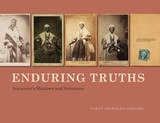
Enduring Truths
Sojourner's Shadows and SubstanceDarcy Grimaldo Grigsby
University of Chicago Press, 2015
Featuring the largest collection of Truth’s photographs ever published, Enduring Truths is the first book to explore how she used her image, the press, the postal service, and copyright laws to support her activism and herself. Darcy Grimaldo Grigsby establishes a range of important contexts for Truth’s portraits, including the strategic role of photography and copyright for an illiterate former slave; the shared politics of Truth’s cartes de visite and federal banknotes, which were both created to fund the Union cause; and the ways that photochemical limitations complicated the portrayal of different skin tones. Insightful and powerful, Enduring Truths shows how Truth made her photographic portrait worth money in order to end slavery—and also became the strategic author of her public self.
Henri Bergson’s Creative Evolution 100 Years Later
Special Issue of SubStance, Issue 114, 36:3 (2007)Michael Kolkman
University of Wisconsin Press, 2007
This special issue of SubStance (2007) celebrates the centennial of Henri Bergson’s Creative Evolution, published in 1907. Since evolution is a living process and not a completed history, any understanding of it must necessarily be open-ended. If no one can have the last word, Bergson writes, the project of understanding evolution “will only be built up by the collective and progressive effort of many thinkers, of many observers also, completing, correcting and improving one another.”
Included in the issue are articles from Bergson scholars from the United States, Japan, France and Great Britain. Topics in the issue range from Bergson’s encounters with Darwin, Nietzsche, Derrida and Deleuze, and from the analytical to the metaphysical.

Names and Substance in the Australian Subsection System
C. G. von Brandenstein
University of Chicago Press, 1982
Though the author has restricted the results of his research to Aboriginal Australia, his methodological approach is generalizable. Hence this work will be of importance to specialists in many areas.
Property, Substance, and Effect
Anthropological Essays on Persons and ThingsMarilyn Strathern
HAU, 2022
Property, Substance, and Effect draws on Marilyn Strathern’s longstanding interest in the reification of social relations. If the world is shrinking in terms of resources and access to them, it is expanding in terms of new candidates for proprietorship. How new relations are brought into being is among the many questions about property, ownership, and knowledge that these essays bring together.
Twenty years have not diminished the interest in the book’s opening challenge: if one were inventing a method of enquiry by which to configure the complexity of social life, one might wish to invent something like the anthropologist’s ethnographic practice. A wide range of studies deliberately brings into conversation claims people make on one another through relations imagined in the form of body-substance along with the increasing visibility of conceptual or intellectual work as property. Whether one lives in Papua New Guinea or Great Britain, categories of knowledge are being dissolved and reformed at a tempo that calls for reflection—and for the kind of lateral reflection afforded through the “ethnographic effect.”
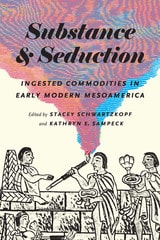
Substance and Seduction
Ingested Commodities in Early Modern MesoamericaEdited by Stacey Schwartzkopf and Kathryn E. Sampeck
University of Texas Press, 2017
Chocolate and sugar, alcohol and tobacco, peyote and hallucinogenic mushrooms—these seductive substances have been a nexus of desire for both pleasure and profit in Mesoamerica since colonial times. But how did these substances seduce? And when and how did they come to be desired and then demanded, even by those who had never encountered them before? The contributors to this volume explore these questions across a range of times, places, and peoples to discover how the individual pleasures of consumption were shaped by social, cultural, economic, and political forces.
Focusing on ingestible substances as a group, which has not been done before in the scholarly literature, the chapters in Substance and Seduction trace three key links between colonization and commodification. First, as substances that were taken into the bodies of both colonizers and colonized, these foods and drugs participated in unexpected connections among sites of production and consumption; racial and ethnic categories; and free, forced, and enslaved labor regimes. Second, as commodities developed in the long transition from mercantile to modern capitalism, each substance in some way drew its enduring power from its ability to seduce: to stimulate bodies; to alter minds; to mark class, social, and ethnic boundaries; and to generate wealth. Finally, as objects of scholarly inquiry, each substance rewards interdisciplinary approaches that balance the considerations of pleasure and profit, materiality and morality, and culture and political economy.
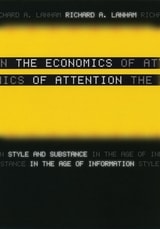
The Economics of Attention
Style and Substance in the Age of InformationRichard A. Lanham
University of Chicago Press, 2006
With all the verve and erudition that have established his earlier books as classics, Richard A. Lanham here traces our epochal move from an economy of things and objects to an economy of attention. According to Lanham, the central commodity in our new age of information is not stuff but style, for style is what competes for our attention amidst the din and deluge of new media. In such a world, intellectual property will become more central to the economy than real property, while the arts and letters will grow to be more crucial than engineering, the physical sciences, and indeed economics as conventionally practiced. For Lanham, the arts and letters are the disciplines that study how human attention is allocated and how cultural capital is created and traded. In an economy of attention, style and substance change places. The new attention economy, therefore, will anoint a new set of moguls in the business world—not the CEOs or fund managers of yesteryear, but new masters of attention with a grounding in the humanities and liberal arts.
Lanham’s The Electronic Word was one of the earliest and most influential books on new electronic culture. The Economics of Attention builds on the best insights of that seminal book to map the new frontier that information technologies have created.
The Political Animal
Special Issue of SubStance, Issue 117, 37:3 (2008)Chris Danta
University of Wisconsin Press, 2008
In the variegated history of the philosophical definitions of man, one has survived since it has been given the status of the self-evident. The definition in question comes from Aristotle’s Politics: “the human is a political animal” (1253a3). There is something indisputable about this characterization: humans are, indeed, the most social of animals – they are denizens of the polis with its institutions and laws, its rulers, judges and generals. It would be difficult to contend that any other animal has recourse to the political as much as the human.
Aristotle’s Politics need not be surrendered to the strictures of humanism. It remains amenable to the new schema for the political animal that we are sketching here. Each article collected in this issue responds – in its own way and by establishing its own protocols – to the exigency of the animal as it was formulated in Aristotle’s Politics. Each article is an act of response, a moment of interruption.
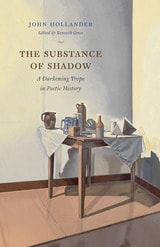
The Substance of Shadow
A Darkening Trope in Poetic HistoryJohn Hollander
University of Chicago Press, 2016
Shadow shows itself here in myriad literary identities, revealing its force as a way of seeing and a form of knowing, as material for fable and parable. Taking up a vast range of texts—from the Bible, Dante, Shakespeare, and Milton to Poe, Dickinson, Eliot, and Stevens—Hollander describes how metaphors of shadow influence our ideas of dreaming, desire, doubt, and death. These shadows of poetry and prose fiction point to unknown, often fearful domains of human experience, showing us concealed shapes of truth and possibility. Crucially, Hollander explores how shadows in poetic history become things with a strange substance and life of their own: they acquire the power to console, haunt, stalk, wander, threaten, command, and destroy. Shadow speaks, even sings, revealing to us the lost as much as the hidden self.
An extraordinary blend of literary analysis and speculative thought, Hollander’s account of the substance of shadow lays bare the substance of poetry itself.