Results by title
3 books match the query 'Suleiman, Susan Rubin'
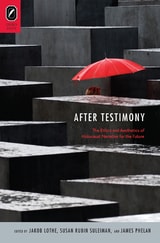
After Testimony
The Ethics and Aesthetics of Holocaust Narrative for the FutureEdited by Jakob Lothe, Susan Rubin Suleiman, and James Phelan
The Ohio State University Press, 2012
After Testimony: The Ethics and Aesthetics of Holocaust Narrative for the Future collects sixteen essays written with the awareness that we are on the verge of a historical shift in our relation to the Third Reich’s programmatic genocide. Soon there will be no living survivors of the Holocaust, and therefore people not directly connected to the event must assume the full responsibility for representing it. The contributors believe that this shift has broad consequences for narratives of the Holocaust. By virtue of being “after” the accounts of survivors, storytellers must find their own ways of coming to terms with the historical reality that those testimonies have tried to communicate. The ethical and aesthetic dimensions of these stories will be especially crucial to their effectiveness. Guided by these principles and employing the tools of contemporary narrative theory, the contributors analyze a wide range of Holocaust narratives—fictional and nonfictional, literary and filmic—for the dual purpose of offering fresh insights and identifying issues and strategies likely to be significant in the future. In addition to the editors, the contributors are Daphna Erdinast-Vulcan, Sidra DeKoven Ezrahi, Anniken Greve, Jeremy Hawthorn, Marianne Hirsch, Irene Kacandes, Phillipe Mesnard, J. Hillis Miller, Michael Rothberg, Beatrice Sandberg, Anette H. Storeide, Anne Thelle, and Janet Walker.

Exile and Creativity
Signposts, Travelers, Outsiders, Backward GlancesSusan Rubin Suleiman, ed.
Duke University Press, 1998
In essays that range chronologically from the Renaissance to the 1990s, geographically from the Danube to the Andes, and historically from the Inquisition to the Holocaust, the complexities and tensions of exile and the diversity of its experiences are examined. Recognizing exile as an interior experience as much as a physical displacement, this collection discusses such varied topics as intellectual exile and seventeenth-century French literature; different versions of home and of the novel in the writings of Bakhtin and Lukács; the displacement of James Joyce and Clarice Lispector; a young journalist’s meeting with James Baldwin in the south of France; Jean Renoir’s Hollywood years; and reflections by the descendents of European emigrés. Strikingly, many of the essays are themselves the work of exiles, bearing out once more the power of the personal voice in scholarship.
With the exception of the contribution by Henry Louis Gates Jr., these essays were originally published in a special double issue of Poetics Today in 1996. Exile and Creativity will engage a range of readers from those whose specific interests include the problems of displacement and diaspora and the European Holocaust to those whose broad interests include art, literary and cultural studies, history, film, and the nature of human creativity.
Contributors. Zygmunt Bauman, Janet Bergstrom, Christine Brooke-Rose, Hélène Cixous, Tibor Dessewffy, Marianne Hirsch, Denis Hollier, Henry Louis Gates Jr., Linda Nochlin, Leo Spitzer, Susan Rubin Suleiman, Thomas Pavel, Doris Sommer, Nancy Huston, John Neubauer, Ernst van Alphen, Alicia Borinsky, Svetlana Boym, Jacqueline Chénieux-Gendron
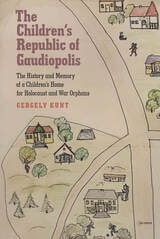
The Children’s Republic of Gaudiopolis
The History and Memory of a Children’s Home for Holocaust and War Orphans (1945–1950)Gergely Kunt
Central European University Press, 2022
Gaudiopolis (The City of Joy) was a pedagogical experiment that operated in a post–World War II orphanage in Budapest. This book tells the story of this children’s republic that sought to heal the wounds of wartime trauma, address prejudice and expose the children to a firsthand experience of democracy. The children were educated in freely voicing their opinions, questioning authority, and debating ideas.
The account begins with the saving of hundreds of Jewish children during the Siege of Budapest by the Lutheran minister Gábor Sztehlo together with the International Red Cross. After describing the everyday life and practices of self-rule in the orphanage that emerged from this rescue operation, the book tells how the operation of the independent children’s home was stifled after the communist takeover and how Gaudiopolis was disbanded in 1950.
The book then discusses how this attempt of democratization was erased from collective memory. The erasure began with the banning of a film inspired by Gaudiopolis. The Communist Party financed Somewhere in Europe in 1947 as propaganda about the construction of a new society, but the film’s director conveyed a message of democracy and tolerance instead of adhering to the tenets of socialist realism. The book breaks the subsequent silence on “The City of Joy,” which lasted until the fall of the Iron Curtain and beyond.