Results by title

11 books match the query 'Summa theologica'
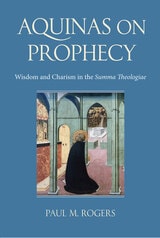
cover of Aquinas on Prophecy: Wisdom and Charism in the <i>Summa Theologiae</i>

Aquinas on Prophecy

Wisdom and Charism in the <i>Summa Theologiae</i>

Paul M. Rogers

Catholic University of America Press, 2023
Aquinas on Prophecy argues that a lacuna exists (especially among Anglophone scholars of Aquinas) that neglects to identify his most famous work as a prophetic witness to the transformative effect of Christian theology. Through a detailed examination of Aquinas’s treatment of prophecy in the Summa Theologiae (II-II, QQ.171-174), Paul Rogers reveals how prophetic testimony is central to the understanding of Christian revelation, faith, and theology, since it presents an initial (and historically-rooted) model for a Christian pedagogy that attempts to affect intellectual and moral transformation through communicating knowledge about God. The theologian thus conceived by Aquinas exercises analogously a prophetic, and hence social, function among Christian believers that has a special care for their spiritual and moral guidance. In contrast to readings of Aquinas that portray him as overly reliant on Aristotelian gnoseology (e.g., Jenkins 1997), Rogers lays out a reading more in line with recent ‘ressourcement’ Thomistic interpreters that identifies in his account of prophecy a creative adaptation of Arabic-Aristotelian gnoseology in the service of clarifying difficulties that had arisen in the thirteenth century surrounding the reception of a patristic (and predominantly Augustinian) tradition of prophetic illumination or vision. In the hands of Aquinas, the traditional Augustinian theory of prophetic illumination was re-envisioned and reinvigorated, which in turn allowed him to reassert confidently prophecy’s status as certain knowledge (scientia) that required its own distinct ‘light’, comparable to the light of natural reason and the lights of faith and glory. Highlighting prophecy in Aquinas’s thought helps especially to refocus today’s readers on how knowledge of the final end as revealed was for Aquinas the ultimate moral objective shared by both the prophet and theologian: a point that is best appreciated when his account of prophecy is related back to his understanding of sacred doctrine and faith as a whole—the book’s central task.
[more]
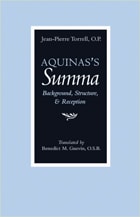
cover of Aquinas's Summa: background, structure, & reception

Aquinas's Summa

background, structure, & reception

Jean-Pierre Torrell

Catholic University of America Press, 2005
In this concise new volume by the acclaimed author of the biography of Saint Thomas Aquinas, Jean-Pierre Torrell brings his expertise to bear on Aquinas's Summa Theologiae.
[more]
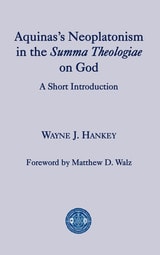
cover of Aquinas’s Neoplatonism in the Summa Theologiae on God: A Short Introduction

Aquinas’s Neoplatonism in the Summa Theologiae on God

A Short Introduction

Wayne J. Hankey

St. Augustine's Press, 2016

[more]
cover of Intro Summa Theologiae Thomas Aquinas: John Of St. Thomas

Intro Summa Theologiae Thomas Aquinas

John Of St. Thomas

John Of St. Thomas

St. Augustine's Press, 2004
[more]
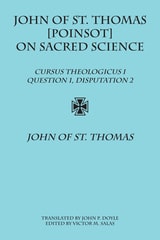
cover of John of St. Thomas [Poinsot] on Sacred Science: Cursus Theologicus I, Question 1, Disputation 2

John of St. Thomas [Poinsot] on Sacred Science

Cursus Theologicus I, Question 1, Disputation 2

John Of St. Thomas

St. Augustine's Press, 2012

This volume offers an English translation of John of St. Thomas’s Cursus theologicus I, question I, disputation 2. In this particular text, the Dominican master raises questions concerning the scientific status and nature of theology. At issue, here, are a number of factors: namely, Christianity’s continual coming to terms with the “Third Entry” of Aristotelian thought into Western Christian intellectual culture – specifically the Aristotelian notion of ‘science’ and sacra doctrina’s satisfaction of those requirements – the Thomistic-commentary tradition, and the larger backdrop of the Iberian Peninsula’s flourishing “Second Scholasticism.” 
    In this latter context, John of St. Thomas applies the theological principles of Thomas Aquinas to the Scholastic disputes preoccupying Thomist, Franciscan, and Jesuit theologians, such as Cajetan, Bañez, Luis de Molina, Vazquez, Suárez – to name only a few – in a tour de force of theological thinking throughout the entire period of Scholasticism. In the process – and not insignificantly – the status quaestionis of theology’s scientific character is clearly framed and answered according to John’s satisfaction. 
    Key to John of St. Thomas’s resolution of the question is his understanding of the continuity of the     power of human reason with the super-intelligibility of divine revelation spelled out in terms of what he calls “virtual revelation.” This text presented in this volume is a quintessential example of the deep and abiding harmony that flourished between faith and reason as well as grace and nature within the golden era of Baroque Scholasticism.
[more]
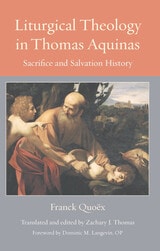
cover of Liturgical Theology in Thomas Aquinas: Sacrifice and Salvation History

Liturgical Theology in Thomas Aquinas

Sacrifice and Salvation History

Franck Quoex

Catholic University of America Press, 2023
In this volume, Fr. Franck Quoëx responds to Joseph Ratzinger’s call for a renewed appreciation of liturgical rite. A student of Pierre Gy, OP, he brings to this study of Aquinas’s liturgical theology a rare combination of expert knowledge of liturgical sources and history and the best of modern historical-critical research guided by sound theological judgment. Fr. Quoëx frames his study with an overview of the problem of rite in modern theological-anthropological discourse, before turning to Aquinas’ theory of worship in the treatise on the virtue of religion. He then explores Aquinas’ doctrine on the cultic dimensions of the Eucharist and other sacraments in his sacramental theology more broadly, finishing with a close study of the mass commentary of the Tertia Pars. Although there has been increasing attention to Thomas’s treatment of religion as a virtue, none have approached him from an anthropological angle with a focus on the nature of liturgical rite, or fully exploited the perspectives of liturgical scholarship to shed light on sacramental theology. Quoëx’s work, as the work of a Thomist, liturgist, and medievalist well versed in medieval liturgical development and in the genre of often-allegorical liturgical commentary, opens up this crucial but neglected facet of Aquinas’ theological synthesis. Few books have been published on Aquinas’s liturgical theology. Now that interest in Aquinas’s virtue theory and sacramental theology is growing rapidly, Quoëx’s studies are an invitation to further reflection on the topic of Aquinas’s liturgical theology with its manifold ramifications for and connections with other theological topics in his Summa, including his theological anthropology, his soteriology, his treatment of the Old and New Laws, and his account of the virtue of religion in connection with the other virtues.
[more]
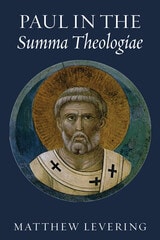
cover of Paul in the Summa Theologiae

Paul in the Summa Theologiae

Matthew Levering

Catholic University of America Press, 2014
Aquinas's commentaries on St. Paul are well known and have received significant attention in the past few years. It is widely known, too, that Aquinas quotes Paul often in the Summa theologiae. This aspect of the Summa, however, has not been studied in detail. This book seeks to fill that lacuna in scholarship.
[more]
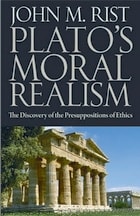
cover of Plato's Moral Realism: The Discovery of the Presuppositions of Ethics

Plato's Moral Realism

The Discovery of the Presuppositions of Ethics

John M. Rist

Catholic University of America Press, 2012
Surveying many of Plato's dialogues from the early, middle, and late periods, prominent philosopher John M. Rist shows how Plato gradually came to realize the need for metaphysics to support his ethical position and that a rigorous ethics required a secure metaphysics grounded in universal values.
[more]
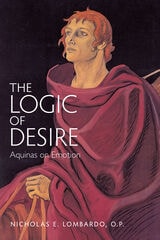
cover of The Logic of Desire: Aquinas on Emotion

The Logic of Desire

Aquinas on Emotion

Nicholas E. Lombardo, O.P.

Catholic University of America Press, 2011
Focusing on the Summa theologiae, Nicholas Lombardo contributes to the recovery, reconstruction, and critique of Aquinas's account of emotion in dialogue with both the Thomist tradition and contemporary analytic philosophy
[more]
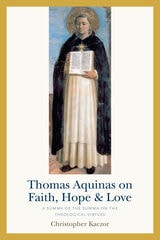
cover of Thomas Aquinas on Faith, Hope, and Love: A Summa of the Summa on the Theological Virtues

Thomas Aquinas on Faith, Hope, and Love

A Summa of the Summa on the Theological Virtues

Christopher Kaczor

Catholic University of America Press, 2020
Thomas Aquinas on Faith, Hope, and Love is designed to make as easy as possible a first reading of key passages from the Summa theologiae. This book contains selections from the Summa that are most influential, most important, or likely to be most interesting to the contemporary reader. The text of the Summa itself is edited and arranged for beginners. Each article begins with Thomas’s answers to the question at hand and then goes to the first objection, followed by the reply to the first objection, the second objection and its reply, and so on. This arrangement provides a greater accessibility and ease in following the argument. Below the text, copious footnotes illuminate the text as a professor in the classroom might. Some notes provide historical background to figures that Thomas presupposes his reader will know such as Gratian, Dionysius, and Lombard. Other notes offer doctrinal summaries of other parts of the Summa that illuminate what Thomas says about faith, hope, or love. Thomas had an enormous influence on theologians, Church councils, and popes after his time, so some footnotes examine this influence. Thomas drew heavily on sources of wisdom before him, so other footnotes summarize the teachings of earlier authors, such as Aristotle and Augustine. This book also contains introductory essays on the Summa, on faith, on hope, and on love, which provide an overview to situate the reader and place treatment of the theological virtues in its larger context of the Summa. For those who have never read Thomas Aquinas on faith, hope, and love (and for those who teach them), this book provides ready access to the wisdom of the Angelic doctor.
[more]
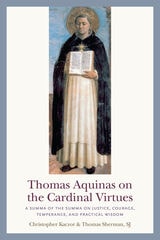
cover of Thomas Aquinas on the Cardinal Virtues: A Summa of the Summa on Prudence, Justice, Temperance, and Courage

Thomas Aquinas on the Cardinal Virtues

A Summa of the Summa on Prudence, Justice, Temperance, and Courage

Christopher Kaczor

Catholic University of America Press, 2020

Thomas Aquinas on the Cardinal Virtues provides essential passages from Thomas's treatment of the cardinal virtues in the Summa theologiae, edited and explained for classroom use or the independent reader. Arranged for beginners, this book contains passages from the Summa theologiae of great historical import, contemporary relevance, or intrinsic interest combined with abundant footnotes aiding the modern reader. Each individual article is arranged so that the question, e.g. “Is capital punishment moral?” is followed directed by Thomas’s answer. Then the first objection is raised, followed immediately by Thomas’s response, the second objection is raised and then Thomas answers it, and so forth. The abundant footnotes help first time readers navigate key theological and philosophical terms which may be unfamiliar. In addition, the notes provide biographical information about key authors cited by Thomas, such as Tully, Vegetius, and Gregory the Great. The footnotes sometimes look back at the sources and philosophical roots of what Thomas teaches. Other notes note how authors after Aquinas including theologians, church councils, and popes developed, synthesized, and sometimes rejected what Thomas teaches. In sum, this book seeks to illuminate Thomas’s teaching on the cardinal virtues such as a teacher might do in the classroom.
[more]