Results by title
4 books match the query 'Superheroes in comics'

Country Songs for Alice
Emma Binder
Tupelo Press, 2024
In Country Songs for Alice, a nonbinary, queer narrator passes through the crucible of love, romance, and heartbreak against the backdrop of rural America—a landscape which offers luminous belonging, even as the hazards of homophobia, loneliness, and isolation loom large. Part roadtrip, part mixtape, these poems are explorations of love, music, romance, pageantry, loneliness, and belonging in the rural places and small towns that seem to preclude queer culture. Country Songs for Alice not only tells the story of a relationship and its dissolution but reclaims country western imagery and aesthetics for a queer audience, dousing the narrator’s experience in the language of cowboys, horses, rodeos, trucks, and desert skies.

Small Altars
Justin Gardiner
Tupelo Press, 2024
In Small Altars, Justin Gardiner delves into the world of comic books and superheroes as a means for coming to terms with the many struggles of his brother’s life, as well as his untimely death, offering a lyric and honest portrayal of the tolls of mental illness, the redemptive powers of art and familial love, and the complex workings of grief.
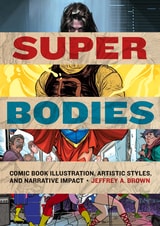
Super Bodies
Comic Book Illustration, Artistic Styles, and Narrative ImpactJeffrey A. Brown
University of Texas Press, 2023
Finalist — San Diego Comic-Con International 2024 Eisner Award in Best Academic/Scholarly Work
2024 MPCA/ACA Best Book for Use in the Classroom, Midwest Popular Culture Association / Midwest American Culture Association (MPCA/ACA)
An examination of the art in superhero comics and how style influences comic narratives.
For many, the idea of comic book art implies simplistic four-color renderings of stiff characters slugging it out. In fact, modern superhero comic books showcase a range of complex artistic styles, with diverse connotations. Leading comics scholar Jeffrey A. Brown assesses six distinct approaches to superhero illustration—idealism, realism, cute, retro, grotesque, and noir—examining how each visually represents the superhero as a symbolic construct freighted with meaning.
Whereas comic book studies tend to focus on text and narrative, Super Bodies gives overdue credit to the artwork, which is not only a principal source of the appeal of comic books but also central to the values these works embody. Brown argues that superheroes are to be taken not as representations of people but as iconic types, and the art conveys this. Even the most realistic comic illustrations are designed to suggest not persons but ideas—ideas about bodies and societies. Thus the appearance of superheroes both directly and indirectly influences the story being told as well as the opinions readers form concerning justice, authority, gender, puberty, sexuality, ethnicity, violence, and other concepts central to political and cultural life.
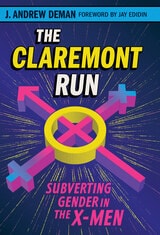
The Claremont Run
Subverting Gender in the X-MenJ. Andrew Deman; Foreword by Jay Edidin
University of Texas Press, 2023
Winner — 2024 Will Eisner Comic Industry Awards in Best Academic/Scholarly Work, announced at San Diego Comic-Con International (2024)
A data-driven deep dive into a legendary comics author’s subversion of gender norms within the bestselling comic of its time.
By the time Chris Claremont’s run as author of Uncanny X-Men ended in 1991, he had changed comic books forever. During his sixteen years writing the series, Claremont revitalized a franchise on the verge of collapse, shaping the X-Men who appear in today’s Hollywood blockbusters. But, more than that, he told a new kind of story, using his growing platform to articulate transgressive ideas about gender nonconformity, toxic masculinity, and female empowerment.
J. Andrew Deman’s investigation pairs close reading and quantitative analysis to examine gender representation, content, characters, and story structure. The Claremont Run compares several hundred issues of Uncanny X-Men with a thousand other Marvel comics to provide a comprehensive account of Claremont’s sophisticated and progressive gender politics. Claremont’s X-Men upended gender norms: where female characters historically served as mere eye candy, Claremont’s had leading roles and complex, evolving personalities. Perhaps more surprisingly, his male superheroes defied and complicated standards of masculinity. Groundbreaking in their time, Claremont’s comics challenged readers to see the real world differently and transformed pop culture in the process.