Results by title

9 books match the query 'Supply and demand'

cover of Canaries in the Code Mine: Precarity and the Future of Tech Work

Canaries in the Code Mine

Precarity and the Future of Tech Work

Max Papadantonakis

Temple University Press, 2025

The idea that the tech industry is a secure field with jobs and opportunities for growth is a myth. There is widespread precarity among software developers, who experience uncertainty, anxiety, and imposter syndrome as technological advancements threaten job security. Max Papadantonakis investigates this phenomenon in his revealing study, Canaries in the Code Mine. He indicates that precarity is not just about the risk of losing one’s job; it is about living in a career where basic needs and rights are not guaranteed.

Interviewing 120 software developers from leading tech firms, Papadantonakis shows how temporary contracts, project cancellations, and company downsizing undermine the security of even highly skilled professionals. He also highlights the systemic inequalities that shape the tech industry, showing how age, race, and gender often dictate the opportunities and responsibilities software developers have—or are denied.  

Canaries in the Code Mine highlights a disturbing reality of privilege and vulnerability within the tech industry. Papadantonakis engages in a critical discourse on the evolving nature of work in the digital era, emphasizing the need to shape an equitable future in the rapidly evolving landscape.
[more]
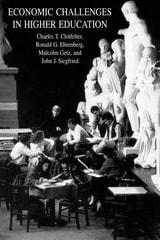
cover of Economic Challenges in Higher Education

Economic Challenges in Higher Education

Charles T. Clotfelter, Ronald G. Ehrenberg, Malcolm Getz, and John J. Siegfried

University of Chicago Press, 1991

The last two decades have been a turbulent period for American higher education, with profound demographic shifts, gyrating salaries, and marked changes in the economy. While enrollments rose about 50% in that period, sharp increases in tuition and fees at colleges and universities provoke accusations of inefficiency, even outright institutional greed and irresponsibility. As the 1990s progress, surpluses in the academic labor supply may give way to shortages in many fields, but will there be enough new Ph.D.'s to go around?

Drawing on the authors' experience as economists and educators, this book offers an accessible analysis of three crucial economic issues: the growth and composition of undergraduate enrollments, the supply of faculty in the academic labor market, and the cost of operating colleges and universities. The study provides valuable insights for administrators and scholars of education.
[more]
cover of Generating Jobs: How to Increase Demand for Less-Skilled Workers

Generating Jobs

How to Increase Demand for Less-Skilled Workers

Richard B. Freeman

Russell Sage Foundation, 1998

The American economy is in danger of leaving its low-skilled workers behind. In the last two decades, the wages and employment levels of the least educated and experienced workers have fallen disastrously. Where willing workers once found ready employment at reasonable wages, our computerized, service-oriented economy demands workers who can read and write, master technology, deal with customers, and much else. Improved education and training will alleviate this problem in the long run, but educating the new workforce will take a substantial national investment over many years. In the meantime, we face increasingly acute questions about how to include low-skill workers in today's economy. Generating Jobs takes a hard look at these questions, and asks whether anything can be done to improve the lot of low-skilled workers by intervening in the labor market on their behalf. These micro demand-side policies seek to improve wages and employment levels—either by lowering the costs of hiring low-skilled workers through employer subsidies, or by raising wage levels, benefit levels, or hours of employment, or by providing employment via government jobs. Although these policies are not currently popular in the U.S., they have long been used in many countries. Generating Jobs provides a clear-eyed assessment of this history, and asks if any of these policies might be applicable to the current problems of low-skilled workers in the United States. The results are surprising. Several recently touted panaceas turn out to be costly and ineffective in the American labor market. Enterprise zones, for instance, are an expensive way of moving jobs into areas of high unemployment, costing as much as $60,000 per job. Similarly, job-sharing, which has had uneven success in Europe, turns out to be ill-suited to conditions in the U.S., where wages are relatively low and workers need to work long hours to maintain income. On the other hand, a number of older, less flashy policies turn out to have real, if modest, benefits. Wage subsidies have increased employment among qualifying workers, and public employment policies can increase the number of workers from targeted groups working during the program. While acknowledging that many solutions are counterproductive, this definitive review of active labor market policies shows that many programs can offer real help. More than any rhetoric, Generating Jobs is the best guide to future action and a serious response to those who claim that nothing can be done.
[more]
cover of How Many Doctors Do We Need?

How Many Doctors Do We Need?

Duncan Yaggy and Patricia Hodgson, eds.

Duke University Press, 1986

This volume addresses the public and private policies affecting physician supply in the United States, focusing on the physician surplus, market forces, and geographic distribution of physicians, life-style choices and evolving practice patterns, market influences of foreign medical graduates, the university's role in establishing priorities for medical education, and other pertinent topics.
[more]
cover of Making Their Days Happen: Paid Personal Assistance Services Supporting People with Disability Living in Their Homes and Communities

Making Their Days Happen

Paid Personal Assistance Services Supporting People with Disability Living in Their Homes and Communities

Lisa I. Iezzoni

Temple University Press, 2022

Most Americans—even those with significant disability—want to live in their homes and communities. Unpaid family members or friends often work as “informal” caregivers, helping those who need assistance— and many feel they have no option but to serve. In contrast, paid personal assistance services workers (PAS) provide a lifeline to those consumers with complex needs and limited social networks. However, there is a crisis looming in the increasing needs for paid PAS and the limited available PAS workforce.

Making Their Days Happen explores disability, health, and civil rights, along with relevant federal and state labor policies related to personal assistance services. Lisa Iezzoni addresses the legal context of paid PAS as well as financing mechanisms for obtaining home-based personal assistance. She also draws upon interviews she conducted with paid PAS consumers and PAS workers to explore PAS experiences and their perspectives about their work. 

Offering recommendations for improving future experiences of PAS consumers and providers, Iezzoni emphasizes that people with disabilities want to be a part of society, and PAS workers who do this low-wage work find satisfaction in helping them achieve their goals.

[more]
cover of The Proletarian Gamble: Korean Workers in Interwar Japan

The Proletarian Gamble

Korean Workers in Interwar Japan

Ken C. Kawashima

Duke University Press, 2009

Koreans constituted the largest colonial labor force in imperial Japan during the 1920s and 1930s. Caught between the Scylla of agricultural destitution in Korea and the Charybdis of industrial depression in Japan, migrant Korean peasants arrived on Japanese soil amid extreme instability in the labor and housing markets. In The Proletarian Gamble, Ken C. Kawashima maintains that contingent labor is a defining characteristic of capitalist commodity economies. He scrutinizes how the labor power of Korean workers in Japan was commodified, and how these workers both fought against the racist and contingent conditions of exchange and combated institutionalized racism.

Kawashima draws on previously unseen archival materials from interwar Japan as he describes how Korean migrants struggled against various recruitment practices, unfair and discriminatory wages, sudden firings, racist housing practices, and excessive bureaucratic red tape. Demonstrating that there was no single Korean “minority,” he reveals how Koreans exploited fellow Koreans and how the stratification of their communities worked to the advantage of state and capital. However, Kawashima also describes how, when migrant workers did organize—as when they became involved in Rōsō (the largest Korean communist labor union in Japan) and in Zenkyō (the Japanese communist labor union)—their diverse struggles were united toward a common goal. In The Proletarian Gamble, his analysis of the Korean migrant workers' experiences opens into a much broader rethinking of the fundamental nature of capitalist commodity economies and the analytical categories of the proletariat, surplus populations, commodification, and state power.

[more]
cover of Tyranny of the Market: A Critique of Theoretical Foundations

Tyranny of the Market

A Critique of Theoretical Foundations

Douglas Vickers

University of Michigan Press, 1995
This book critically reviews and evaluates a number of central theoretical concepts that have shaped economists' analysis of markets. In a rigorous discussion of the demand and supply sides of the market, Douglas Vickers questions the cogency of many of the established ideas and tools of economic analysis. The critique relies considerably on the significance of real historical time and the epistemic uniqueness of individuals in decision making. The author identifies deficiencies in the concepts of utility and its cognate -- preference orderings on the demand side of the market, and in marginal productivity and the related theory of income distribution on the supply side. Setting the critique of received traditions in historical perspective, The Tyranny of the Market reviews the bequests to contemporary theory of classical and neoclassical economics. The analytical problem of the place and significance of money in economic argument is addressed and the nonneutrality and substantial endogeneity of money are clarified. The book's analysis of macromarket failure, or the failure of the market system to provide automatically for the full employment of economic resources, incorporates a monetary-flow model of the macroeconomy. Economic theorists and scholars in related disciplines will appreciate the originality of the book's critique of the neoclassical and competing systems of thought.
[more]
cover of What Employers Want: Job Prospects for Less-Educated Workers

What Employers Want

Job Prospects for Less-Educated Workers

Harry J. Holzer

Russell Sage Foundation, 1996
A very important contribution to the field of labor economics, and in particular to the understanding of the labor market forworkers with relatively low skill levels. I think we have the sense that the market looks bad, but haven't been clear on how bad it is, or how it got that way. What Employers Want provides some of the answers and identifies the important questions. It is essential reading. —Jeffrey S. Zax, University of Colorado at Boulder The substantial deterioration in employment and earnings among the nation's less-educated workers, especially minorities and younger males in the nation's big cities, has been tentatively ascribed to a variety of causes: an increase in required job skills, the movement of companies from the cities to the suburbs, and a rising unwillingness to hire minority job seekers. What Employers Want is the first book to replace conjecture about today's job market with first-hand information gleaned from employers about who gets hired. Drawn from asurvey of over 3,000 employers in four major metropolitan areas—Los Angeles, Boston, Atlanta, and Detroit—this volume provides a wealth of data on what jobs are available to the less-educated, in what industries, what skills they require, where they are located, what they pay, and how they are filled. The evidence points to a dramatic surge in suburban, white-collar jobs. The manufacturing industry—once a steady employer of blue-collar workers—has been eclipsed by the expanding retail trade and service industries, where the vast majority of jobs are in clerical, managerial, or sales positions. Since manufacturing establishments have been the most likely employers to move from the central cities to the suburbs, the shortage of jobs for low-skill urban workers is particularly acute. In the central cities, the problem is compounded and available jobs remain vacant because employers increasingly require greater cognitive and social skills as well as specific job-related experience. Holzer reveals the extent to which minorities are routinely excluded by employer recruitment and screening practices that rely heavily on testing, informal referrals, and stable work histories. The inaccessible location and discriminatory hiring patterns of suburban employers further limit the hiring of black males in particular, while earnings, especially for minority females, remain low. Proponents of welfare reform often assume that stricter work requirements and shorter eligibility periods will effectively channel welfare recipients toward steady employment and off federal subsidies. What Employers Want directly challenges this premise and demonstrates that only concerted efforts to close the gap between urban employers and inner city residents can produce healthy levels of employment in the nation's cities. Professor Holzer outlines the measures that will benecessary—targeted education and training programs, improved transportation and job placement, heightened enforcement of antidiscrimination laws, and aggressive job creation strategies. Repairing urban labor markets will not be easy. This book shows why. A Volume in the Multi-City Study of Urban Inequality
[more]
cover of Working and Poor: How Economic and Policy Changes Are Affecting Low-Wage Workers

Working and Poor

How Economic and Policy Changes Are Affecting Low-Wage Workers

Rebecca M. Blank

Russell Sage Foundation, 2006

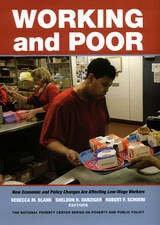
Over the last three decades, large-scale economic developments, such as technological change, the decline in unionization, and changing skill requirements, have exacted their biggest toll on low-wage workers. These workers often possess few marketable skills and few resources with which to support themselves during periods of economic transition. In Working and Poor, a distinguished group of economists and policy experts, headlined by editors Rebecca Blank, Sheldon Danziger, and Robert Schoeni, examine how economic and policy changes over the last twenty-five years have affected the well-being of low-wage workers and their families. Working and Poor examines every facet of the economic well-being of less-skilled workers, from employment and earnings opportunities to consumption behavior and social assistance policies. Rebecca Blank and Heidi Schierholz document the different trends in work and wages among less-skilled women and men. Between 1979 and 2003, labor force participation rose rapidly for these women, along with more modest increases in wages, while among the men both employment and wages fell. David Card and John DiNardo review the evidence on how technological changes have affected less-skilled workers and conclude that the effect has been smaller than many observers claim. Philip Levine examines the effectiveness of the Unemployment Insurance program during recessions. He finds that the program's eligibility rules, which deny benefits to workers who have not met minimum earnings requirements, exclude the very people who require help most and should be adjusted to provide for those with the highest need.  On the other hand, Therese J. McGuire and David F. Merriman show that government help remains a valuable source of support during economic downturns.  They find that during the most recent recession in 2001, when state budgets were stretched thin, legislatures resisted political pressure to cut spending for the poor. Working and Poor provides a valuable analysis of the role that public policy changes can play in improving the plight of the working poor. A comprehensive analysis of trends over the last twenty-five years, this book provides an invaluable reference for the public discussion of work and poverty in America. A Volume in the National Poverty Center Series on Poverty and Public Policy
[more]