Results by title
7 books match the query 'Suspicion'

Fields of Suspicion
Landmines and the Making of Peace in Rural ColombiaDiana Pardo Pedraza
Duke University Press, 2027
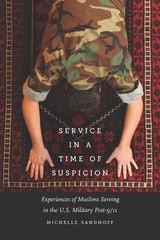
Service in a Time of Suspicion
Experiences of Muslims Serving in the U.S. Military Post-9/11Michelle Sandhoff
University of Iowa Press, 2017
In Service in a Time of Suspicion, fifteen such service members talk about what it means to be Muslim, American, and a uniformed member of the armed services in the twenty-first century. These honest accounts remind us of our shared humanity.
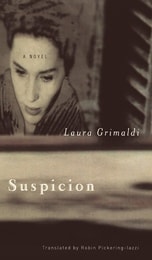
Suspicion
A NovelLaura Grimaldi
University of Wisconsin Press, 2003
In the shadow of the "Monster of Florence," a serial murderer who has terrorized Italy for seventeen years, Laura Grimaldi sets her tense psychological thriller Suspicion—a noir mystery of a city transformed by fear, and of friendships and family ties twisted by uncertainty and dark speculation. Grimaldi, whose hardboiled mysteries of the 1950s earned her the title "Italy’s queen of crime," turns here to the deeper, more elusive and disturbing questions that haunt human affairs.
For years Matilde, the widow of a prominent Florentine doctor, has lived alone with her eccentric middle-aged son, Enea. When the police pay a call, the balance between mother and son is shifted just subtly enough to make Matilde prey to suspicions and doubts that grow ever more corrosive, ever harder to conceal and more dangerous to reveal. In the literary tradition of such mystery writers as Patricia Highsmith and Ruth Rendell, Grimaldi creates an atmosphere charged with suspense as the daily lives and routines of her characters, infected with suspicion, begin to rearrange themselves around a few frightening facts and infinite monstrous possibilities.
Matilde’s efforts to decipher Enea’s secretive movements and occupations appear perfectly sensible and defensible through Grimaldi’s deft shifts between mother and son—and another, chillingly detached perspective on the gruesome murders. Grimaldi’s readers will find themselves as subject to misinterpretation and doubt, to sympathies and suspicions as her Florentine characters, and spellbound until the book’s final page.
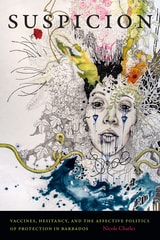
Suspicion
Vaccines, Hesitancy, and the Affective Politics of Protection in BarbadosNicole Charles
Duke University Press, 2021
Duke University Press Scholars of Color First Book Award recipient
Technologies of Suspicion and the Ethics of Obligation in Political Asylum
Bridget M. Haas
Ohio University Press, 2019
Across the globe, migration has been met with intensifying modes of criminalization and securitization, and claims for political asylum are increasingly met with suspicion. Asylum seekers have become the focus of global debates surrounding humanitarian obligations, on the one hand, and concerns surrounding national security and border control, on the other. In Technologies of Suspicion and the Ethics of Obligation in Political Asylum, contributors provide fine-tuned analyses of political asylum systems and the adjudication of asylum claims across a range of sociocultural and geopolitical contexts.
The contributors to this timely volume, drawing on a variety of theoretical perspectives, offer critical insights into the processes by which tensions between humanitarianism and security are negotiated at the local level, often with negative consequences for asylum seekers. By investigating how a politics of suspicion within asylum systems is enacted in everyday practices and interactions, the authors illustrate how asylum seekers are often produced as suspicious subjects by the very systems to which they appeal for protection.
Contributors: Ilil Benjamin, Carol Bohmer, Nadia El-Shaarawi, Bridget M. Haas, John Beard Haviland, Marco Jacquemet, Benjamin N. Lawrance, Rachel Lewis, Sara McKinnon, Amy Shuman, Charles Watters
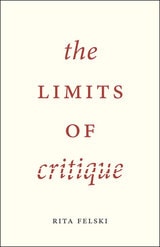
The Limits of Critique
Rita Felski
University of Chicago Press, 2015
Why must critics unmask and demystify literary works? Why do they believe that language is always withholding some truth, that the critic’s task is to reveal the unsaid or repressed? In this book, Rita Felski examines critique, the dominant form of interpretation in literary studies, and situates it as but one method among many, a method with strong allure—but also definite limits.
Felski argues that critique is a sensibility best captured by Paul Ricoeur’s phrase “the hermeneutics of suspicion.” She shows how this suspicion toward texts forecloses many potential readings while providing no guarantee of rigorous or radical thought. Instead, she suggests, literary scholars should try what she calls “postcritical reading”: rather than looking behind a text for hidden causes and motives, literary scholars should place themselves in front of it and reflect on what it suggests and makes possible.
By bringing critique down to earth and exploring new modes of interpretation, The Limits of Critique offers a fresh approach to the relationship between artistic works and the social world.
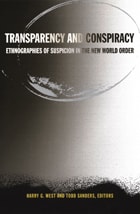
Transparency and Conspiracy
Ethnographies of Suspicion in the New World OrderHarry G. West and Todd Sanders, eds.
Duke University Press, 2003
In this collection leading anthropologists reveal the variations and commonalities in conspiratorial thinking or occult cosmologies around the globe—in Korea, Tanzania, Mozambique, New York City, Indonesia, Mongolia, Nigeria, and Orange County, California. The contributors chronicle how people express profound suspicions of the United Nations, the state, political parties, police, courts, international financial institutions, banks, traders and shopkeepers, media, churches, intellectuals, and the wealthy. Rather than focusing on the veracity of these convictions, Transparency and Conspiracy investigates who believes what and why. It makes a compelling argument against the dismissal of conspiracy theories and occult cosmologies as antimodern, irrational oversimplifications, showing how these beliefs render the world more complex by calling attention to its contradictions and proposing alternative ways of understanding it.
Contributors. Misty Bastian, Karen McCarthy Brown, Jean Comaroff, John Comaroff, Susan Harding, Daniel Hellinger, Caroline Humphrey, Laurel Kendall, Todd Sanders, Albert Schrauwers, Kathleen Stewart, Harry G. West