Results by title
4 books match the query 'Sustainable architecture'
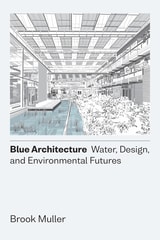
Blue Architecture
Water, Design, and Environmental FuturesBrook Muller
University of Texas Press, 2022
2023 Finalist, PROSE Award in Architecture and Urban Planning
A guide to water-focused and climate-resilient architectural and urban design.
Le Corbusier famously said, “A house is a machine for living in.” We now confront the litany of environmental challenges associated with the legacy of the architectural machine: a changing climate, massive species die-off, diminished air and water quality, and resource scarcities. Brook Muller offers an alternative: water-centric urban design that fosters sustainability, equity, and architectural creativity.
Inspired by the vernacular, such as the levadas of Madeira Island and both the arid and drenched places of the American West, Muller articulates a “hydro-logical” philosophy in which architects and planners begin by conceptualizing interactions between existing waterways and the spaces they intend to develop. From these interactions—and the new technologies and approaches enabling them—aesthetic, spatial, and experiential opportunities follow. Not content merely to work around sensitive ecology, Muller argues for genuinely climate-adapted urban landscapes in which buildings act as ecological infrastructure that actually improve watersheds while delivering functionality and beauty for diverse communities. Rich in images and practical examples, Blue Architecture will change the way we think about our designed world.
Some Assembly Required
Michael Sorkin
University of Minnesota Press, 2001
The long-awaited collection by one of architecture’s most exciting voices.
Michael Sorkin is widely hailed as one of the best architecture critics writing today. Iconoclastic and often controversial, he is a witty, entertaining, yet ultimately serious writer. In this new collection, Sorkin reviews the state of contemporary architecture and surveys the dramatic changes in the urban environment of the past decade. From New York to New Delhi, from Shanghai to Cairo, Sorkin offers a sweeping assessment of the impact of globalization, environmental degradation, electronic media, rapid growth, and the legacies of modernist planning. Whether laying out, manifesto-like, eleven necessary tasks for urban design, providing a fresh take on the Disneyfication of Times Square, grappling with sprawl, or blasting the nostalgic prescriptions of "new urbanist" communities (which he dubs "Reaganville"), Sorkin makes a compelling argument for an architecture and urbanism firmly grounded in both artistic expression and social purpose.
Technology and Place
Sustainable Architecture and the Blueprint FarmBy Steven A. Moore
University of Texas Press, 2001
Developing "sustainable" architectural and agricultural technologies was the intent behind Blueprint Farm, an experimental agricultural project designed to benefit farm workers displaced by the industrialization of agriculture in the Rio Grande Valley of Texas. Yet, despite its promise, the very institutions that created Blueprint Farm terminated the project after just four years (1987-1991).
In this book, Steven Moore demonstrates how the various stakeholders' competing definitions of "sustainability," "technology," and "place" ultimately doomed Blueprint Farm. He reconstructs the conflicting interests and goals of the founders, including Jim Hightower and the Texas Department of Agriculture, Laredo Junior College, and the Center for Maximum Potential Building Systems, and shows how, ironically, they unwittingly suppressed the self-determination of the very farm workers the project sought to benefit. From the instructive failure of Blueprint Farm, Moore extracts eight principles for a regenerative architecture, which he calls his "nonmodern manifesto."
Waterfront Porch
Reclaiming Detroit's Industrial Waterfront as a Gathering Place for AllJohn H. Hartig
Michigan State University Press, 2019