Results by title

4 books match the query 'Sustainable forestry'

cover of Amazonia at the Crossroads: The Challenge of Sustainable Development

Amazonia at the Crossroads

The Challenge of Sustainable Development

Edited by Anthony Hall

University of London Press, 2000

At the dawn of the 1990s, it seemed that Amazonia had become irrevocably trapped in a downward spiral of deforestation, environmental destruction and social conflict. Yet over the past ten years a more acute awareness has emerged at all levels, national and international, of the need to encourage more sustainable policies and practices. That is, measures that provide for the economic development needs of Amazonia's diverse population, while at the same time conserving and managing the region's natural resource base. At a major conference, organised in London in June 1998 by the Institute of Latin American Studies (Amazonia 2000: Development, Environment and Geopolitics), over twenty international scholars traced the evolution of this gradual shift in thinking. The present volume, based on that conference, examines past patterns of destructive resource extraction in Amazonia and, more importantly, critically analyses a series of newer initiatives that offer more sustainable options. These include, amongst others, new production strategies, such as agroforestry, innovative resource governance models such as inland fisheries co-management and agro-ecological zoning.
The challenge at this critical juncture is how to integrate such policies and practices into mainstream development within Amazonia. Contributors: David Cleary, Rene Dreifuss, Philip Fearnside, Jessica Groenendijk, Anthony Hall, Judith Kimerling, Tom Lovejoy, Dennis Mahar, David McGrath, Emilio Moran, Darrel Posey, Nigel Smith, and Wouter Veening.
[more]
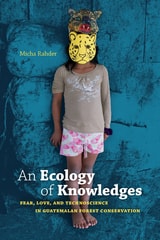
cover of An Ecology of Knowledges: Fear, Love, and Technoscience in Guatemalan Forest Conservation

An Ecology of Knowledges

Fear, Love, and Technoscience in Guatemalan Forest Conservation

Micha Rahder

Duke University Press, 2020
Guatemala's Maya Biosphere Reserve (MBR), the largest protected area in Central America, is characterized by rampant violence, social and ethnic inequality, and rapid deforestation. Faced with these threats, local residents, conservationists, scientists, and NGOs in the region work within what Micha Rahder calls “an ecology of knowledges,” in which interventions on the MBR landscape are tied to differing and sometimes competing forms of knowing. In this book, Rahder examines how technoscience, endemic violence, and an embodied love of wild species and places shape conservation practices in Guatemala. Rahder highlights how different forms of environmental knowledge emerge from encounters and relations between humans and nonhumans, institutions and local actors, and how situated ways of knowing impact conservation practices and natural places, often in unexpected and unintended ways. In so doing, she opens up new ways of thinking about the complexities of environmental knowledge and conservation in the context of instability, inequality, and violence around the world.
[more]
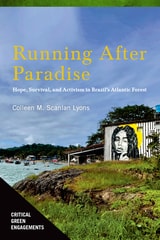
cover of Running After Paradise: Hope, Survival, and Activism in Brazil's Atlantic Forest

Running After Paradise

Hope, Survival, and Activism in Brazil's Atlantic Forest

Colleen M. Scanlan Lyons

University of Arizona Press, 2022

Brazil’s Atlantic Forest is a paradise to many. In Southern Bahia, surfers, billionaires, travelers, and hippies mingle with environmentalists, family farmers, quilombolas (descendants of formerly enslaved people), and nativos, or “locals.” Each of these groups has connections to the unique environment, culture, and character of this region as their home, their source of a livelihood, or perhaps their vacation escape. And while sometimes these connections converge—other times they clash.

The pressures on this tropical forest are palpable. So are people’s responses to these pressures. What was once the state’s economic mainstay, cacao production, is only now beginning to make a comeback after a disease decimated the crops of large and small farmers alike. Tourism, another economic hope, is susceptible to economic crises and pandemics. And the threat of a massive state-led infrastructure project involving mining, a railroad, and an international port has loomed over the region for well over a decade.

Southern Bahia is at a crossroads: develop a sustainable, forest-based economy or run the risk of losing the identity and soul of this place forevermore. Through the lives of environmentalists, farmers, quilombolas, and nativos—people who are in and of this place—this book brings alive the people who are grappling with this dilemma.

Anthropologist Colleen M. Scanlan Lyons brings the eye of a storyteller to present this complex struggle, weaving in her own challenges of balancing family and fieldwork alongside the stories of the people who live in this dynamic region. Intertwined tales, friendships, and hope emerge as people both struggle to sustain their lives in a biodiversity hotspot and strive to create their paradise.
 
[more]
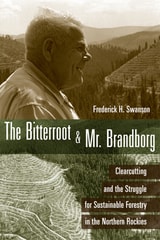
cover of The Bitterroot and Mr. Brandborg: Clearcutting and the Struggle for Sustainable Forestry in the Northern Rockies

The Bitterroot and Mr. Brandborg

Clearcutting and the Struggle for Sustainable Forestry in the Northern Rockies

Frederick H. Swanson

University of Utah Press, 2011

Winner of the Wallace Stegner Prize in American Environmental or Western History

Fredrick Swanson tells the story of Guy M. Brandborg and his impact on the practices of the U.S. Forest Service. As supervisor of Montana’s Bitterroot National Forest from 1935 to 1955, Brandborg engaged in a management style that promoted not only the well-being of the forest community but also the social and economic welfare of the local people. By relying on selective cutting, his goal was to protect the watersheds and wildlife habitats that are devastated by clear-cutting, and to prevent the job losses that follow such practices. Following his retirement, he became concerned that his agency was deviating from the practice of sustained-yield management of the forest’s timber lands, and led a highly visible public outcry that became known as the Bitterroot controversy. Brandborg’s behind-the-scenes lobbying contributed materially to the passage of the National Forest Management Act of 1976, the single most important law affecting public forestry since the creation of the Forest Service.

Meticulously written, The Bitterroot and Mr. Brandborg articulates Brandborg’s Progressive-era idealism and is based on extensive archival research in collections throughout the Rockies and the Northwest, including the Brandborg family papers. Swanson’s crisp narration of how one national forest supervisor understood the intricate connection between the grasslands and forests under his care and the communities that were so dependent on these invaluable resources, opens a much larger story about the meaning of public lands in a democratic society.

Winner of the Western Writers of America Spur Award for Best Western Nonfiction-Contemporary.
 
[more]