Results by title
2 books match the query 'Suter, Ann'
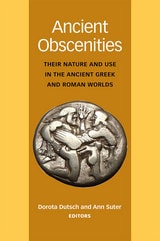
Ancient Obscenities
Their Nature and Use in the Ancient Greek and Roman WorldsDorota Dutsch and Ann Suter, editors
University of Michigan Press, 2015
Ancient Obscenities inquires into the Greco-Roman handling of explicit representations of the body in its excretory and sexual functions, taking as its point of departure the modern preoccupation with the obscene. The essays in this volume offer new interpretations of materials that have been perceived by generations of modern readers as “obscene”: the explicit sexual references of Greek iambic poetry and Juvenal’s satires, Aristophanic aischrologia, Priapic poetics, and the scatology of Pompeian graffiti. Other essays venture in an even more provocative fashion into texts that are not immediately associated with the obscene: the Orphic Hymn to Demeter, Herodotus, the supposedly prim scripts of Plautus and the Attic orators. The volume focuses on texts but also includes a chapter devoted to visual representation, and many essays combine evidence from texts and material culture. Of all these texts, artifacts, and practices we ask the same questions: What kinds of cultural and emotional work do sexual and scatological references perform? Can we find a blueprintfor the ancient usage of this material?
[more]

The Narcissus and the Pomegranate
An Archaeology of the Homeric Hymn to DemeterAnn Suter
University of Michigan Press, 2002
Offering a new understanding of the Hymn to Demeter, Ann Suter provides an analysis of methodological approaches, reconciling the seemingly disparate pieces of the complex narrative of the hymn. Examining evidence from other versions of the hymn's myths, as well as from Greek religion, linguistics, and archaeology, she lends a new understanding to the relationships among the hymn's personages--Persephone, Demeter, Hades, and Zeus--as they developed and crystallized, providing a new chronology for the cults of Demeter and Persephone at Eleusis.
The author analyzes the traditional language of the hymn and Persephone's retelling of her story to Demeter, arguing that the hymn involves an earlier tale of Demeter and Persephone that predates the seventh century. Suter uses anthropological applications to illustrate that the story of Persephone's abduction does not reflect a female initiation rite into adulthood, as has been argued, but rather an hieros gamos. These methodologies point to the conclusion that Persephone was once a powerful goddess in her own right, independent of Hades and of Demeter as well. To test the accuracy of these possibilities, the book next examines evidence from outside the hymn. Other versions of the two myths in the hymn support the idea that these myths--Persephone's abduction and Demeter's nursing of Demophoön--were once separate and were late combined to create a new story. Evidence from the chief archaeological sites, from vase painting and other artistic forms is provided to enhance the argument. Thus the evidence from outside the hymn supports the conclusions of the textual analyses, giving surprising substantiation that the hymn itself commemorates the early days of the worship of the goddesses as a mother/daughter pair.
This book will be of particular interest to scholars of religious history, art history, archaeology, and literature. It is also accessible to the general reader interested in Greek literature, myths, and religion.
Ann Suter is Associate Professor of Classical Studies, University of Rhode Island.
[more]