Results by title
2 books match the query 'Sutton-Smith, Brian'
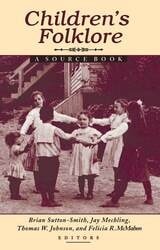
Children's Folklore
A Source BookBrian Sutton-Smith, Jay Mechling, Thomas W. Johnson, and Felicia R. McMahon
Utah State University Press, 1999
A collection of orginal essays by scholars from a variety of fields-- includng American studies, folklore, anthropology, pyschology, sociology, and education---Children's Folklore: A Source Book moves beyond traditional social-science views of child development. It reveals the complexity and artistry of interactions among children, challenging stereotypes of simple childhood innocence and conventional explanations of development that privilege sober and sensible adult outcomes. Instead, the play and lore of children is shown to be often disruptive, wayward, and irrational.
Jump-rope Rhymes
A DictionaryEdited by Roger D. Abrahams
University of Texas Press, 1969
I had a little brother.
His name was Tiny Tim.
I put him in the bathtub
To teach him how to swim.
He drank all the water.
He ate all the soap.
He died last night
With a bubble in his throat.
Jump-rope rhymes, chanted to maintain the rhythm of the game, have other, equally entertaining uses:
- You can dispatch bothersome younger siblings instantly—and temporarily.
- You can learn the name of your boyfriend through the magic words "Ice cream soda, Delaware Punch, Tell me the initials of my honey-bunch."
- You can perform the series of tasks set forth in "Teddy Bear, Teddy Bear, turn around" and find out who, really, is the most nimble.
- You can even, with impunity, "conk your teacher on the bean with a rotten tangerine. "
This collection of over six hundred jump-rope rhymes, originally published in 1969, is an introduction into the world of children—their attitudes, their concerns, their humor. Like other children's folklore, the rhymes are both richly inventive and innocently derivative, ranging from on-the-spot improvisations to old standards like "Bluebells, cockleshells," with a generous sprinkling of borrowings from other play activities—nursery rhymes, counting-out rhymes, and taunts. Even adult attitudes of the time are appropriated, but expressed with the artless candor of the child:
Eeny, meeny, miny, moe.
Catch Castro by the toe.
If he hollers make him say
"I surrender, U.S.A."
Though aware that children's play serves social and psychological functions, folklorists had long neglected analytical study of children's lore because primary data was not available in organized form. Roger Abraham's Dictionary has provided such a bibliographical tool for one category of children's lore and a model for future compendia in other areas. The alphabetically arranged rhymes are accompanied by notes on sources, provenience, variants, and connection with other play activities.