Results by title
5 books match the query 'Svoboda, Terese'
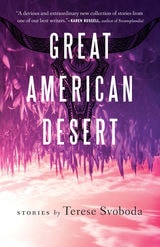
Great American Desert
StoriesTerese Svoboda
The Ohio State University Press, 2019
In her arresting and inimitable style, Svoboda’s delicate handling of the complex dynamics of family and self seeps into every sentence of these first-rate short stories about what we do to the world around us—and what it can do to us.

Laughing Africa
Terese Svoboda
University of Iowa Press, 1990
There is a large intelligence present in Terese Svoboda's poetry and not a shred of sentimentality. From the dramatic coming-of-age in the title poem to the question posed in the last section, "What will I say to my child as it snows / that last winter's papery afterglow?" she continually searches for a responsible, compassionate world, one in which the only illusion is art.
The mythological central poem, "The Ranchhand's Daughter," shows the gods of isolation and incest warring against each other, destroying a triangle of love and cut into the granite-faced Badlands. It is only in the sensuous landscape of the domestic that possible redemption occurs: the father who dreams of running for president, the mother who signs in the mirror, the couple in the shower with "confidence rising between them." Faced with the inevitable losses, Svoboda strives for meaning and beauty.
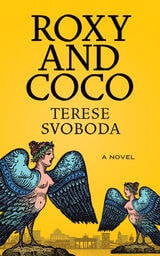
Roxy and Coco
A NovelTerese Svoboda
West Virginia University Press, 2024
“[A] wry and rambunctious fable….The book offers brief and staggered visions of family, in all its complex permutations. Here, flocks settle into wonderfully unlikely formations. It’s possible that the most dangerous thing for anyone, harpy or human, is the decision to fly alone.” — Hilary Leichter, New York Times Book Review
Sisters Roxy and Coco are two glamorous harpies—mythical bird women—attempting to outrun extinction and fix the planet by preventing child abuse, one child at a time.
When Roxy is suddenly attracted to her human supervisor at a social work agency a hundred years too early, Coco is very suspicious. Luring Roxy with his scent, Tim is also on the payroll of a fake conservationist intent on her less-than-legal collection. Coco swoops in to vet Tim, but Interpol is hot on her trail for a series of curious homicides. (Surveillance has a very hard time convincing his boss of what he’s monitoring.) When the sisters find themselves trapped, Chris, a bipolar skateboarding truant, tries his best to rescue them but it’s Stewie, Coco’s colleague, who turns the story inside out. Roxy and Coco climaxes at a gala of egg fanciers who scramble to escape the harpies’ talons.
Action figure–worthy, for readers of Neil Gaiman and Karen Russell, this modern take on these fabled women touches on mental illness, racism, animal rights, and the rights of children.
The Long Swim
StoriesTerese Svoboda
University of Massachusetts Press, 2024
A runaway circus lion haunts a small town where two lovers risk more than their respective marriages. A junket to Cuba and an ambassador’s dalliance with a niece hide dark secrets and political revolution. “I’ve always had a knife,” says the unstable stepson to his parents. Inventive, dark, and absurd, the stories in The Long Swim capture Terese Svoboda’s clear-eyed, wry angle on the world: a place of violence and uncertainty but also wild beauty, adventure, and love both lasting and ephemeral. Her characters strive for escape—through romance, travel, or more self-destructive pursuits—and collide with the constraints of family and home, their longing for freedom and autonomy often at odds with the desire for safety and harmony.
Cynical, irreverent, and formally daring, Svoboda’s stories in The Long Swim are a deft exploration of womanhood and humanity. Waves of provocation and wonder toss the reader and leave them wanting more.
Weapons Grade
PoemsTerese Svoboda
University of Arkansas Press, 2009