Results by title

3 books match the query 'Swart, Sandra'
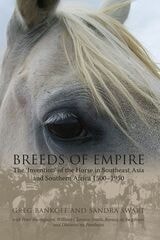
cover of Breeds of Empire: The Invention of the Horse in Southeast Asia and Southern Africa 1500-1950

Breeds of Empire

The Invention of the Horse in Southeast Asia and Southern Africa 1500-1950

Edited by Greg Bankoff and Sandra Swart

National University of Singapore Press, 2007

Ships of empire carried not just merchandise, soldiers and administrators but also equine genes from as far afield as Europe, Arabia, the Americas, China and Japan. In the process, they introduced horses into parts of the world not native to that animal in historical times. As a result, horses in Thailand, the Philippine Horses, the Cape Horse in South Africa and the Basotho Pony in the mountain kingdom of Lesotho share a genetic lineage with the horse found in the Indonesian archipelago.This book explores the 'invention' of specific breeds of horse in the context of imperial design and colonial trade routes. Here, it focuses on the introduction, invention and use of the horse in Thailand, the Philippines and southern Africa as well as examining its roots and evolution within Indonesia. In addition, it examines the colonial trade in horses within the Indian Ocean and discusses the historiographical and methodological problems associated with writing a more species- or horse-centric history. This is a fascinating study that will appeal not only to scholars but also to the broad horse-reading public interested in all things equine.
[more]
cover of Gender and Animals in History: Yearbook of Women’s History 42 (2023)

Gender and Animals in History

Yearbook of Women’s History 42 (2023)

Sandra Swart

Amsterdam University Press, 2024

The category of species has remained largely understudied in mainstream gender scholarship. This edition of the Yearbook of Women’s History attempts to show how gender history can be enriched through the study of animals. It highlights that the inclusion of nonhuman animals in historical work has the potential to revolutionize the ways we think about gender history. This volume is expansive in more than one way. First, it is global and transhistorical in its outlook, bringing together perspectives from the Global North and the Global South, and moving from the Middle Ages to the contemporary world. Even more importantly for its purposes, a range of animals appear in the contributions: from the smallest insects to great apes, and from ‘cute’ kittens to riot dogs and lions. The articles collected here reflect the variety of the animal kingdom and of the creative approaches enabled by animal history.
[more]
cover of The Lion's Historian: Africa's Animal Past

The Lion's Historian

Africa's Animal Past

Sandra Swart

Ohio University Press, 2025

“Until the lion has a historian of his own, the tale of the hunt will always glorify the hunter.” Sandra Swart takes up the challenge of that African proverb and, with this book, becomes the lion’s historian. As a species, humans are not alone; but our history has been written as though we were. Swart insists on a multispecies retelling of our more-than-human past as she reconstructs a shifting series of significant interspecies relationships, from quirky, idiosyncratic connections to others that triggered major changes. Embracing a radical interdisciplinarity informed by a background in history and environmental studies, Swart combines the natural sciences with the social sciences, oral history, indigenous knowledge, and archival research. She blends current thinking about animal sentience, agency, cognition, and emotion to offer a new way to understand animals’ role in our shared history. The animals in this book—baboons, cows, elephants, hippos, horses, jackals, lions, Nazi cattle, okapi, police dogs, quagga, sheep, and white ants—exemplify different facets of our shared past. With this animal-centric lens, decades of research are brought together in a collection that takes animals seriously. It is a book with claws and fangs, tearing through conventional narratives to ask, Are we prepared to move beyond the convention that “history” is the story of only our own species? The entanglements between humans and other animals have shaped our past, but they suggest something more. The possibility of our shared future pivots on a reckoning with our shared pasts. Swart shows what human-animal history can do, not only to understand our place in the world better but to make our world—however slightly—a better place.

[more]