Results by title

8 books match the query 'Sword'
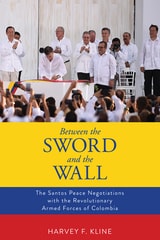
cover of Between the Sword and the Wall: The Santos Peace Negotiations with the Revolutionary Armed Forces of Colombia

Between the Sword and the Wall

The Santos Peace Negotiations with the Revolutionary Armed Forces of Colombia

Harvey F. Kline

University of Alabama Press, 2020

Chronicles the peace process negotiations between Colombian president Juan Manuel Santos and the Marxist Revolutionary Armed Forces of Colombia

In Between the Sword and the Wall: The Santos Peace Negotiations with the Revolutionary Armed Forces of Colombia, Harvey Kline, a noted expert on contemporary Colombian politics, brings to a close his multivolume chronicle of the incessant violence that has devastated Colombia’s population, politics, and military for decades. This, his newest work on the subject, recounts and analyzes the negotiations between Colombian president Juan Manuel Santos and the Marxist Revolutionary Armed Forces of Colombia (FARC), which ended with a peace agreement in 2016.

The FARC insurgency began in 1964, and every Colombian president after 1980 unsuccessfully tried to negotiate a peace agreement with the group. Kline analyzes how the Santos administration was ultimately able to negotiate peace with the FARC. The agreement failed to receive the approval of the Colombian people in an October 2016 plebiscite, but a renegotiated version was later approved by the congress in the same year. Afterward, more than 7,000 rebels turned over their weapons to the UN mission in Colombia. The former combatants were then to be judged by a special court empowered to punish but not imprison those who had violated human rights. Throughout the book, Kline emphasizes the dual nature of the Santos negotiations, first with the FARC and second with the democratic opposition to the agreement led by former president Álvaro Uribe Vélez.

Kline provides readers with a well-researched analysis based on a variety of resources, including media articles and primary documents from the government, international organizations, and the FARC. He also conducted extensive interviews with twenty-eight government officials and Colombian experts from all ideological persuasions.
[more]
cover of No Sword To Bury: Japanese Americans In Hawaii

No Sword To Bury

Japanese Americans In Hawaii

Franklin S. Odo

Temple University Press, 2004
When bombs rained down on Pearl Harbor in 1941, Japanese American college students were among the many young men enrolled in ROTC and immediately called upon to defend the Hawaiian islands against invasion. In a few weeks, however, the military government questioned their loyalty and disarmed them. In No Sword to Bury, Franklin Odo places the largely untold story of the wartime experience of these young men in the context of the community created by their immigrant families and its relationship to the larger, white-dominated society. At the heart of the book are vivid oral histories that recall their service on the home front in the Varsity Victory Volunteers, a non-military group dedicated to public works, as well as in the segregated 442nd Regimental Combat Team. Illuminating a critical moment in ethnic identity formation among this first generation of Americans of Japanese descent (the nisei), Odo shows how the war-time service and the post-war success of these men contributed to the simplistic view of Japanese Americans as a model minority in Hawai`i.
[more]
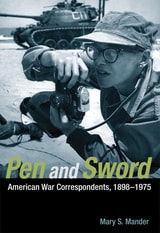
cover of Pen and Sword: American War Correspondents, 1898-1975

Pen and Sword

American War Correspondents, 1898-1975

Mary S. Mander

University of Illinois Press, 2010

Addressing the ever-changing, overlapping trajectories of war and journalism, this introduction to the history and culture of modern American war correspondence considers a wealth of original archival material. In powerful analyses of letters, diaries, journals, television news archives, and secondary literature related to the U.S.'s major military conflicts of the twentieth century, Mary S. Mander highlights the intricate relationship of the postmodern nation state to the free press and to the public. Pen and Sword: American War Correspondents, 1898-1975 situates war correspondence within the larger framework of the history of the printing press to make perceptive new points about the nature of journalism and censorship, the institution of the press as a source of organized dissent, and the relationship between the press and the military. Fostering a deeper understanding of the occupational culture of war correspondents who have accompanied soldiers into battle, Mander offers interpretive analysis of the reporters' search for meaning while embedded with troops in war-torn territories. Broadly encompassing the history of Western civilization and modern warfare, Pen and Sword prompts new ways of thinking about contemporary military conflicts and the future of journalism.
[more]
cover of Plough, Sword, and Book: The Structure of Human History

Plough, Sword, and Book

The Structure of Human History

Ernest Gellner

University of Chicago Press, 1990

"Philosophical anthropology on the grandest scale. . . .Gellner has produced a sharp challenge to his colleagues and a thrilling book for the non-specialist. Deductive history on this scale cannot be proved right or wrong, but this is Gellner writing, incisive, iconoclastic, witty and expert. His scenario compels our attention."—Adam Kuper, New Statesman

"A thoughtful and lively meditation upon probably the greatest transformation in human history, upon the difficult problems it poses and the scant resources it has left us to solve them."—Charles Larmore, New Republic

[more]
cover of Politics of the Sword: Dueling, Honor, and Masculinity in Modern Italy

Politics of the Sword

Dueling, Honor, and Masculinity in Modern Italy

Steven C. Hughes

The Ohio State University Press, 2007

            Following its creation as a country in 1861, Italy experienced a wave of dueling that led commentators to bemoan a national “duellomania” evidenced by the sad spectacle of a duel a day. Pamphlets with titles like “Down with the Duel” and “The Shame of the Duel” all communicated the passion of those who could not believe that a people supposedly just returned to the path of progress and civilization had wholeheartedly embraced such a “barbaric” custom. Yet these critics were consistently countered by sober-minded men of rank and influence who felt that the duel was necessary for the very health of the new nation.
            Steven C. Hughes argues that this extraordinary increase in chivalric combat occurred because the duel played an important role in the formation, consolidation, and functioning of united Italy. The code of honor that lay at the heart of the dueling ethic offered a common model and bond of masculine identity for those patriotic elites who, having created a country of great variety and contrast for often contradictory motives, had to then deal with the consequences. Thus dueling became an iconic weapon of struggle during the Risorgimento, and, as Italy performed poorly on the stage of great power politics, it continued to offer images of martial valor and manly discipline. It also enhanced the social and political power of the new national elites, whose monopoly over chivalric honor helped reinforce the disenfranchisement of the masses. Eventually, the duel fed into the hypermasculinity and cult of violence that marked the early fascist movement, but in the end it would prove too individualistic in its definition of honor to stand up to the emerging totalitarian state. Although Mussolini would himself fight five duels at the start of his career, the duel would disappear along with the liberal regime that had embraced it.
[more]
cover of St. Austin Review, Dungeon, Fire & Sword: The English Reformation, March/April 2013, Vol.13, No. 2

St. Austin Review, Dungeon, Fire & Sword

The English Reformation, March/April 2013, Vol.13, No. 2

Joseph Pearce

St. Augustine's Press, 2013

[more]
cover of The Sword & the Pen: A Life of Lew Wallace

The Sword & the Pen

A Life of Lew Wallace

Ray E. Boomhower

Indiana Historical Society Press, 2005
[more]
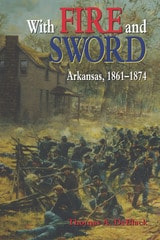
cover of With Fire and Sword: Arkansas, 1861-1874

With Fire and Sword

Arkansas, 1861-1874

Thomas A. Deblack

University of Arkansas Press, 2003

When Arkansas seceded from the Union in 1861, it was a thriving state. But the Civil War and Reconstruction left it reeling, impoverished, and so deeply divided that it never regained the level of prosperity it had previously enjoyed. Although most of the major battles of the war occurred elsewhere, Arkansas was critical to the Confederate war effort in the vast Trans-Mississippi region, and Arkansas soldiers served—some for the Union and more for the Confederacy—in every major theater of the war. And the war within the state was devastating. Union troops occupied various areas, citizens suffered greatly from the war’s economic disruption, and guerilla conflict and factional tensions left a bitter legacy. Reconstruction was in many ways a continuation of the war as the prewar elite fought to regain economic and political power.

In this, the fourth volume in the Histories of Arkansas series, Thomas DeBlack not only describes the major players and events in this dramatic and painful story, but also explores the experiences of ordinary people. Although the historical evidence is complex—and much of the secondary literature is extraordinarily partisan—DeBlack offers a balanced, vivid overview of the state’s most tumultuous period.

[more]