Results by title
5 books match the query 'Symbolic anthropology'
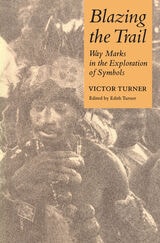
Blazing the Trail
Waymarks in the Exploration of SymbolsVictor Turner
University of Arizona Press, 1992
"The essays reveal a passionate struggle between a committed conceptualization and a dedication to the telling detail. Turner is willing to address the moral and spiritual dimensions of being human, which are all too easily set aside by much social science."—Anthropos
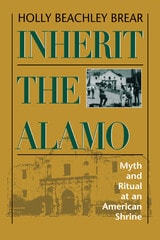
Inherit the Alamo
Myth and Ritual at an American ShrineBy Holly Beachley Brear
University of Texas Press, 1994
Long overshadowed by the towering buildings of downtown San Antonio, the modest little Alamo still evokes tremendous feeling among Texans and, indeed, many other Americans. For Anglo Texans, the Alamo is the "Cradle of Texas Liberty" and a symbolic confirmation of Manifest Destiny. For Hispanic Texans, however, the Alamo has increasingly become a stolen symbol, its origin as a Spanish mission forgotten, its famous defeat used to exclude Hispanics from an honorable place in Texas history.
In this important new book, Holly Beachley Brear explores in fascinating detail what the Alamo means to the numerous groups that lay claim to its heritage. She shows how Alamo myths often diverge from the historical facts—and why. She decodes the agendas of various groups, including the Daughters of the Republic of Texas (who maintain the Alamo buildings and grounds), the Order of the Alamo, the Texas Cavaliers, and LULAC. And she probes attempts by individuals and groups to rewrite the Alamo myth to include more positive roles for themselves, as she explains the value in laying claim to the Alamo's past.
With new perspectives on all the sacred icons of the Alamo and the Fiesta that celebrates (one version of) its history each year, Inherit the Alamo is guaranteed to challenge stereotypes and offer new understanding of the Alamo's ongoing role in shaping Texas and American history and mythology. It will be of interest to a wide popular and scholarly audience.
The Anthropology of Experience
Edited by Victor W. Turner and Edward M. Bruner
University of Illinois Press, 1986
explore how people actually experience their culture and how those experiences are expressed in forms as varied as narrative, literary work, theater, carnival, ritual, reminiscence, and life review. Their studies will be
of special interest for anyone working in anthropological theory, symbolic
anthropology, and contemporary social and cultural anthropology, and useful as well for other social scientists, folklorists, literary theorists, and philosophers.
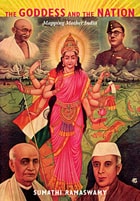
The Goddess and the Nation
Mapping Mother IndiaSumathi Ramaswamy
Duke University Press, 2010
By exploring the mutual entanglement of the scientifically mapped image of India and a (Hindu) mother/goddess, Sumathi Ramaswamy reveals Mother India as a figure who relies on the British colonial mapped image of her dominion to distinguish her from the other goddesses of India, and to guarantee her novel status as embodiment, sign, and symbol of national territory. Providing an exemplary critique of ideologies of gender and the science of cartography, Ramaswamy demonstrates that images do not merely reflect history; they actively make it. In The Goddess and the Nation, she teaches us about pictorial ways of learning the form of the nation, of how to live with it—and ultimately to die for it.
Vital Voids
Cavities and Holes in Mesoamerican Material CultureBy Andrew Finegold
University of Texas Press, 2021
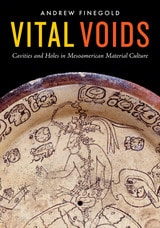
The Resurrection Plate, a Late Classic Maya dish, is decorated with an arresting scene. The Maize God, assisted by two other deities, emerges reborn from a turtle shell. At the center of the plate, in the middle of the god’s body and aligned with the point of emergence, there is a curious sight: a small, neatly drilled hole.
Art historian Andrew Finegold explores the meanings attributed to this and other holes in Mesoamerican material culture, arguing that such spaces were broadly understood as conduits of vital forces and material abundance, prerequisites for the emergence of life. Beginning with, and repeatedly returning to, the Resurrection Plate, this study explores the generative potential attributed to a wide variety of cavities and holes in Mesoamerica, ranging from the perforated dishes placed in Classic Maya burials, to caves and architectural voids, to the piercing of human flesh. Holes are also discussed in relation to fire, based on the common means through which both were produced: drilling. Ultimately, by attending to what is not there, Vital Voids offers a fascinating approach to Mesoamerican cosmology and material culture.