Results by title
6 books match the query 'Symbolism in architecture'
Historic Zuni Architecture and Society
An Archaeological Application of Space SyntaxT. J. Ferguson
University of Arizona Press, 1996
The historic architecture and settlements of the Zuni Indian Tribe in western New Mexico provide an unusual opportunity to investigate social change. In this monograph, the development of historic Zuni society is analyzed by delineating systematic links between the structure of Zuni society and the structure of architectural forms that the Zuni people built to facilitate their activities. Ferguson shows how the structure of open space within Zuni settlements was linked to defense. As long as the Zunis were subject to attack by Spaniards or Navajos, they built settlements that were difficult for outsiders to get into or move around in. As the need for defense waned, settlements became more open and accessible. He also shows how the internal spaces of traditional Zuni houses are oriented around the activities of the women--matriarchs of their families and clans. Federal housing projects tended to spatially isolate the activities of women from interaction with the rest of the household, thus instituting unexpected social change.
Historic Zuni Architecture and Society utilizes an interdisciplinary approach, analyzing archaeological data using method, theory, and techniques from the fields of architecture, planning, and ethnology. Archaeologists will find in the book an innovative application of space syntax to archaeological problems, and cultural anthropologists and others interested in the history of the Zuni Indians will value its observations about changes that are currently taking place in Zuni social organization.
Historic Zuni Architecture and Society utilizes an interdisciplinary approach, analyzing archaeological data using method, theory, and techniques from the fields of architecture, planning, and ethnology. Archaeologists will find in the book an innovative application of space syntax to archaeological problems, and cultural anthropologists and others interested in the history of the Zuni Indians will value its observations about changes that are currently taking place in Zuni social organization.
[more]
Holocaust Memory Reframed
Museums and the Challenges of RepresentationHansen-Glucklich, Jennifer
Rutgers University Press, 2014
Holocaust memorials and museums face a difficult task as their staffs strive to commemorate and document horror. On the one hand, the events museums represent are beyond most people’s experiences. At the same time they are often portrayed by theologians, artists, and philosophers in ways that are already known by the public. Museum administrators and curators have the challenging role of finding a creative way to present Holocaust exhibits to avoid clichéd or dehumanizing portrayals of victims and their suffering.
In Holocaust Memory Reframed, Jennifer Hansen-Glucklich examines representations in three museums: Israel’s Yad Vashem in Jerusalem, Germany’s Jewish Museum in Berlin, and the United States Holocaust Memorial Museum in Washington, D.C. She describes a variety of visually striking media, including architecture, photography exhibits, artifact displays, and video installations in order to explain the aesthetic techniques that the museums employ. As she interprets the exhibits, Hansen-Glucklich clarifies how museums communicate Holocaust narratives within the historical and cultural contexts specific to Germany, Israel, and the United States. In Yad Vashem, architect Moshe Safdie developed a narrative suited for Israel, rooted in a redemptive, Zionist story of homecoming to a place of mythic geography and renewal, in contrast to death and suffering in exile. In the Jewish Museum in Berlin, Daniel Libeskind’s architecture, broken lines, and voids emphasize absence. Here exhibits communicate a conflicted ideology, torn between the loss of a Jewish past and the country’s current multicultural ethos. The United States Holocaust Memorial Museum presents yet another lens, conveying through its exhibits a sense of sacrifice that is part of the civil values of American democracy, and trying to overcome geographic and temporal distance. One well-know example, the pile of thousands of shoes plundered from concentration camp victims encourages the visitor to bridge the gap between viewer and victim.
Hansen-Glucklich explores how each museum’s concept of the sacred shapes the design and choreography of visitors’ experiences within museum spaces. These spaces are sites of pilgrimage that can in turn lead to rites of passage.
[more]
Symbolic Space
French Enlightenment Architecture and Its LegacyRichard A. Etlin
University of Chicago Press, 1994
Richard A. Etlin explores the social and cultural hierarchies established in eighteenth-century France to illustrate how the conceptual basis of the modern house and the physical layout of the modern city emerged from debates among theoretically innovative French architects of the eighteenth-century. Examining a broad range of topics from architecture and urbanism to gardening and funerary monuments, he shows how the work of these architects was informed by considerations of symbolic space.
For Etlin, the eighteenth-century city was a place in which actual physical space was subjected to a complex mental layering of conceptual spaces. He focuses on the design theory of Boullée and Durand and charts their legacy through the architecture of Paul Philippe Cret, Frank Lloyd Wright, and Louis Kahn. He defines the distinctive features of neoclassicism and outlines the new grammar for classical architecture articulated by theorists and architects such as Laugier, Leroy, and Ledoux.
After discussing the eighteenth-century hôtel, revolutionary space, and the transformation of the image of the cemetery, Etlin examines the space of absence as embodied in commemorative architecture from Boullée and Gilly to Cret, Wright, and Terragni. His book provides an accessible introduction to a century of architecture that transformed the classical forms of the Renaissance and Baroque periods into building types still familiar today.
[more]
The Architecture of Aftermath
Terry Smith
University of Chicago Press, 2006
The September 11 terrorist attacks targeted, in Osama bin Laden’s words, “America’s icons of military and economic power.” In The Architecture of Aftermath, Terry Smith argues that it was no accident that these targets were buildings: architecture has long served as a symbol of proud, defiant power—and never more so than in the late twentieth century.
But after September 11, Smith asserts, late modern architecture suddenly seemed an indulgence. With close readings of key buildings—including Jørn Utzon’s Sydney Opera House, Minoru Yamasaki’s World Trade Center, Frank Gehry’s Guggenheim Museum Bilbao, and Richard Meier’s Getty Center—Smith traces the growth of the spectacular architecture of modernity and then charts its aftermath in the conditions of contemporaneity. Indeed, Smith focuses on the very culture of aftermath itself, exploring how global politics, clashing cultures, and symbolic warfare have changed the way we experience destination architecture.
Like other artists everywhere, architects are responding to the idea of aftermath by questioning the viability of their forms and the validity of their purposes. With his richly illustrated The Architecture of Aftermath, Smith has done so as well.
[more]
The Hindu Temple
An Introduction to Its Meaning and FormsGeorge Michell
University of Chicago Press, 1988
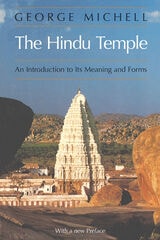
For more than 1500 years, from the Indian subcontinent to the islands of the Indonesian archipelago, the temple has embodied and symbolized the Hindu worldview at its deepest level and inspired the greatest architectural and artistic achievements in Hindu Asia. In The Hindu Temple, considered the standard introduction to the subject, George Michell explains the cultural, religious, and architectural significance of the temple. He illustrates his points with a profusion of photographs, building plans, and drawings of architectural details, making the book a useful guide for travelers to Asia as well as an illuminating text for students of architecture, religion, and Asian civilizations.
Michell's discussion of the meaning and forms of the temple in Hindu society encompasses the awe-inspiring rock-cut temples at Ellora and Elephanta, the soaring superstructures and extraordinary sexual exhibitionism of the sculptures at Khajuraho, and the colossal mortuary temple of Angkor Vat, as well as the tiny iconic shrines that many Hindus wear around their necks and the simple shrines found under trees or near ponds.
Michell's discussion of the meaning and forms of the temple in Hindu society encompasses the awe-inspiring rock-cut temples at Ellora and Elephanta, the soaring superstructures and extraordinary sexual exhibitionism of the sculptures at Khajuraho, and the colossal mortuary temple of Angkor Vat, as well as the tiny iconic shrines that many Hindus wear around their necks and the simple shrines found under trees or near ponds.
[more]
When Buildings Speak
Architecture as Language in the Habsburg Empire and Its Aftermath, 1867-1933Anthony Alofsin
University of Chicago Press, 2006
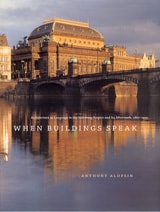
In When Buildings Speak,Anthony Alofsin explores the rich yet often overlooked architecture of the late Austro-Hungarian Empire and its successor states. He shows that several different styles emerged in this milieu during the late nineteenth and early twentieth centuries. Moreover, he contends that each of these styles communicates to us in a manner resembling language and its particular means of expression.
Covering a wide range of buildings—from national theaters to crematoria, apartment buildings to warehouses, and sanatoria to postal savings banks—Alofsin proposes a new way of interpreting this language. He calls on viewers to read buildings in two ways: through their formal elements and through their political, social, and cultural contexts. By looking through Alofsin’s eyes, readers can see how myriad nations sought to express their autonomy by tapping into the limitless possibilities of art and architectural styles. And such architecture can still speak very powerfully to us today about the contradictory issues affecting parts of the former Habsburg Empire.
“The book itself as a production is spectacular.”—David Dunster, Architectural Review
“The book itself as a production is spectacular.”—David Dunster, Architectural Review
[more]