Results by title
3 books match the query 'Symmetry'
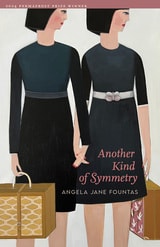
Another Kind of Symmetry
Angela Jane Fountas
University of Alaska Press, 2026
Agni and Effie, identical twins, are inseparable until Agni is sent to Greece one summer to visit their grandmother after their grandfather’s sudden death. Until now the more conventional and accommodating of the two, Agni refuses to return to college, choosing instead to remain in their family’s Greek village.
She is drawn into the daily routines and rural traditions that her parents left behind in exchange for the American dream. But the haunting presence of her grandfather’s ghost is a sign of unresolved family grief.
Without her sister’s companionship, Effie abruptly abandons the stability of her life so far and moves to the East Village to live as an artist. But when Agni’s absence become unbearable for her, a personal crisis brings the sisters together again, this time even closer than before.
Alternating between the sisters’ points of view, letters between them, and stories Agni writes in secret, Another Kind of Symmetry explores the sometimes uneasy relationship that children of immigrants have with their parents’ version of the American dream. It reflects on the challenges of living with cross-cultural traditions and how individuals’ different responses to them can disrupt even the closest of relationships.
Symmetry
Marc Straus
Northwestern University Press, 2000
Symmetry and Sense
The Poetry of Sir Philip SidneyBy Robert L. Montgomery
University of Texas Press, 1961
Few Elizabethans left the image of their personalities cut so deeply into the Renaissance imagination as did Sir Philip Sidney. Widely admired in his own time, Sidney must seem to the modern reader almost universally accomplished. His talents as courtier, diplomat, soldier, scholar, novelist, and poet are history.
Almost immediately after Sidney's death in battle against the Spaniards in the Low Countries, the process of legend began, and the legend has survived, sometimes obscuring the facts. The versatile "Renaissance man" has become, in the eyes of some critics, the romantic lover whose frustrations and despair found release in the "confessional" form of the sonnet sequence, Astrophel and Stella, and in other poems. To show these poems to be consciously constructed works of art, not simply passionate outbursts of romantic emotion, is one aim of this study.
The author examines Sidney as poet and critic, concentrating his study on rhetorical technique and poetic rhythm and form. He shows Sidney experimenting with the symmetrical possibilities of rhythm and phrase; practicing the ornateness current and acceptable in his day. He examines Sidney's comment on such a style in The Defense of Poesy and the ways in which the poet's own work agreed with or departed from his expressed opinions. He also balances Sidney's poetry against the powerful tradition of Petrarchan love literature and the equally powerful Renaissance impulse to subject passion to the rule of reason. Finally, in an extended analysis of Astrophel and Stella, he shows Sidney as the master of a plainer, wittier, more subtly fashioned style and a complex, more dramatically immediate form. What emerges from the study is not the personality of the poet, but the principles of his art and the value of his achievement in the mainstream of English Renaissance verse.