Results by title
12 books match the query 'System Theory'
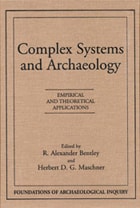
Complex Systems and Archaeology
Bentley, Alexander & Maschner, Herbert
University of Utah Press, 2003
Complexity science transects many fields ranging from physics to economics to biology. Its focus is the study of systems of interacting factors, which has lately been extended to include behavior in human societies. In prehistoric societies, whether these agents are defined at the scale of individuals, groups, households, or villages all agents are connected in such a way that change in the actions of one affects many others.
Complex Systems and Archaeology presents a useful introduction to complexity theory followed by a series of case studies in which human societies and environments are viewed as open systems into and out of which matter or energy can flow. Examples of such systems include the introduction of new crops, the creation of new artifacts, or the flux of products in a market.
This volume will have important implications for how archaeologists understand the dynamics of culture change and how they think about chronological stages, unique events, and the role of human agents.
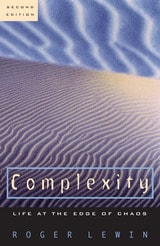
Complexity
Life at the Edge of ChaosRoger Lewin
University of Chicago Press, 2000
"[Complexity] is that curious mix of complication and organization that we find throughout the natural and human worlds: the workings of a cell, the structure of the brain, the behavior of the stock market, the shifts of political power. . . . It is time science . . . thinks about meaning as well as counting information. . . . This is the core of the complexity manifesto. Read it, think about it . . . but don't ignore it."—Ian Stewart, Nature
This second edition has been brought up to date with an essay entitled "On the Edge in the Business World" and an interview with John Holland, author of Emergence: From Chaos to Order.
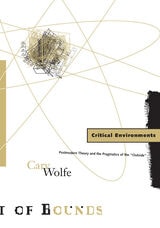
Critical Environments
Postmodern Theory and the Pragmatics of the “Outside”Cary Wolfe
University of Minnesota Press, 1998
Argues for a pragmatist orientation for postmodern theory.
Taking up the problem that has stalled contemporary theory—its treatment of the object of knowledge, the “outside,” as nothing but what a particular discourse makes of it—this book suggests a solution: a reinvigorated, posthumanist form of pragmatism.
Author Cary Wolfe investigates three of the most significant strains of postmodern theory (pragmatism, systems theory, and poststructuralism) and shows how each confronts the specter of an “outside” not wholly constituted by discourses, language games, and interpretive communities. He then assesses these confrontations in light of an essentially pragmatic view of theory, one that constantly asks what practical and material difference it makes, and to whom, how these issues are negotiated. Wolfe concludes by comparing the pragmatist view of the relation of theory to politics with important work in contemporary post-Marxism. In arguing for a pragmatist orientation for postmodern theory, Wolfe deploys continental critical theory to avoid the nativism and “American exceptionalism” that has traditionally accompanied pragmatist philosophy. Unique in its collation of major theorists rarely considered together, Critical Environments incorporates detailed discussions of the work of Richard Rorty, Walter Benn Michaels, Stanley Cavell, Humberto Maturana, Francisco Varela, Niklas Luhmann, Michel Foucault, Gilles Deleuze, Fredric Jameson, and others, and ranges across fields from feminist philosophy of science to the theory of ideology. Wolfe draws on recent work in systems theory to articulate a properly postmodern pragmatism. In doing so, he offers American readers a detailed introduction to systems theory, which he situates and critiques in the broader context of philosophical pragmatism, the theory of democratic social antagonism, and materialist theories of ideology, knowledge, and power. An answer to the widespread charge of relativism leveled against postmodern theory, his work will enhance and inspire new kinds of critical thought.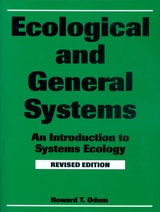
Ecological and General Systems
An Introduction to Systems Ecology, Revised EditionHoward T. Odum
University Press of Colorado, 1994
First published as Systems Ecology in 1983, Ecological and General Systems proposes principles of self-organization and the designs that prevail by maximizing power and efficiency. Comparisons to fifty other systems languages are provided. Innovative presentations are given on earth homeostasis (Gaia); the inadequacy of presenting equations without network relationships and energy constraints; the alternative interpretation of high entropy complexity as adaptive structure; basic equations of ecological economics; and the energy basis of scientific hierarchy.
Part I introduces energetics, hierarchy, and systems modeling. Part II features design elements: intersections, autocatalytic modules, loops, series, parallel elements, and webs. Part III includes embodied energy, spectra of energy quality, temperature, complexity, spatial distribution, and diversity. Part IV discusses production, consumption, ecosystems, succession, economic systems, anthropological models, urban and regional models, global biogeochemistry, and the universe.
Emergence and Embodiment
New Essays on Second-Order Systems TheoryBruce Clarke and Mark B. N. Hansen, eds.
Duke University Press, 2009
In response to the apparent dissolution of boundaries at work in the contemporary technosciences of emergence, neocybernetics observes that cognitive systems are operationally bounded, semi-autonomous entities coupled with their environments and other systems. Second-order systems theory stresses the recursive complexities of observation, mediation, and communication. Focused on the neocybernetic contributions of von Foerster, Francisco Varela, and Niklas Luhmann, this collection advances theoretical debates about the cultural, philosophical, and literary uses of their ideas. In addition to the interview with von Foerster, Emergence and Embodiment includes essays by Varela and Luhmann. It engages with Humberto Maturana’s and Varela’s creation of the concept of autopoiesis, Varela’s later work on neurophenomenology, and Luhmann’s adaptations of autopoiesis to social systems theory. Taken together, these essays illuminate the shared commitments uniting the broader discourse of neocybernetics.
Contributors. Linda Brigham, Bruce Clarke, Mark B. N. Hansen, Edgar Landgraf, Ira Livingston, Niklas Luhmann, Hans-Georg Moeller, John Protevi, Michael Schiltz, Evan Thompson, Francisco J. Varela, Cary Wolfe

Evolution's Eye
A Systems View of the Biology-Culture DivideSusan Oyama
Duke University Press, 2000
While acknowledging that, in an uncertain world, it is easy to “blame it on the genes,” Oyama claims that the renewed trend toward genetic determinism colors the way we think about everything from human evolution to sexual orientation and personal responsibility. She presents instead a view that focuses on how a wide variety of developmental factors interact in the multileveled developmental systems that give rise to organisms. Shifting attention away from genes and the environment as causes for behavior, she convincingly shows the benefits that come from thinking about life processes in terms of developmental systems that produce, sustain, and change living beings over both developmental and evolutionary time.
Providing a genuine alternative to genetic and environmental determinism, as well as to unsuccessful compromises with which others have tried to replace them, Evolution’s Eye will fascinate students and scholars who work in the fields of evolution, psychology, human biology, and philosophy of science. Feminists and others who seek a more complex view of human nature will find her work especially congenial.

Formalizing the Dynamics of Information
Edited by Martina Faller, Stefan Kaufmann, and Marc Pauly
CSLI, 2000
Gaian Systems
Lynn Margulis, Neocybernetics, and the End of the AnthropoceneBruce Clarke
University of Minnesota Press, 2020
A groundbreaking look at Gaia theory’s intersections with neocybernetic systems theory
Often seen as an outlier in science, Gaia has run a long and varied course since its formulation in the 1970s by atmospheric chemist James Lovelock and microbiologist Lynn Margulis. Gaian Systems is a pioneering exploration of the dynamic and complex evolution of Gaia’s many variants, with special attention to Margulis’s foundational role in these developments.
Bruce Clarke assesses the different dialects of systems theory brought to bear on Gaia discourse. Focusing in particular on Margulis’s work—including multiple pieces of her unpublished Gaia correspondence—he shows how her research and that of Lovelock was concurrent and conceptually parallel with the new discourse of self-referential systems that emerged within neocybernetic systems theory. The recent Gaia writings of Donna Haraway, Isabelle Stengers, and Bruno Latour contest its cybernetic status. Clarke engages Latour on the issue of Gaia’s systems description and extends his own systems-theoretical synthesis under what he terms “metabiotic Gaia.” This study illuminates current issues in neighboring theoretical conversations—from biopolitics and the immunitary paradigm to NASA astrobiology and the Anthropocene. Along the way, he points to science fiction as a vehicle of Gaian thought.
Delving into many issues not previously treated in accounts of Gaia, Gaian Systems describes the history of a theory that has the potential to help us survive an environmental crisis of our own making.

In the Wake of Chaos
Unpredictable Order in Dynamical SystemsStephen H. Kellert
University of Chicago Press, 1993
Observing Complexity
Systems Theory and PostmodernityWilliam Rasch
University of Minnesota Press, 2000
Shakes up postmodern criticism with paradigms from the social and techno-sciences.
Shakes up postmodern criticism with paradigms from the social and techno-sciences.
The rubric of systems theory brings together conceptual models and approaches in the sciences and social sciences that study complexity. It attempts to provide a coherent means of describing all systems, whether organic or inorganic, and offers a theory of knowledge that can account for the integration of humans in the social, informational, and ecological systems in which we are enmeshed. Observing Complexity brings the major concepts and foremost thinkers of systems theory into interaction with the major figures of postmodern theory. The format is multiplex and open-a rich montage, including interviews, exemplary essays, and staged dialogues. The writers’ aim is not to solidify theory but to provide a thorough explication and an open-ended exploration of how systems theory can address, in a fresh and productive way, theoretical questions that too often have led to impasses between different schools of postmodern theory. Contributors: Drucilla Cornell, Rutgers U; Jonathan Elmer, Indiana U; N. Katherine Hayles, UCLA; Peter Uwe Hohendahl, Cornell U; Eva Knodt; Marjorie Levinson, U of Michigan; Niklas Luhmann; Brian Massumi, SUNY, Albany.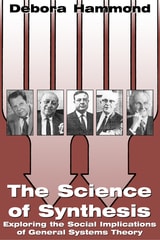
Science Of Synthesis
Debora Hammond
University Press of Colorado, 2003
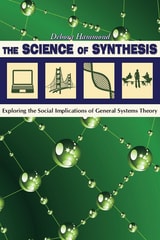
The Science of Synthesis
Exploring the Social Implications of General Systems TheoryDebora Hammond
University Press of Colorado, 2003
Both metaphor and framework, the systems concept as articulated by its earliest proponents highlights relationship and interconnectedness among the biological, ecological, social, psychological, and technological dimensions of our increasingly complex lives. Seeking to transcend the reductionism and mechanism of classical science-which they saw as limited by its focus on the discrete, component parts of reality-the general systems community hoped to complement this analytic approach with a more holistic orientation. As one of many systems traditions, the general systems group was specifically interested in fostering collaboration and integration among different disciplinary perspectives, with an emphasis on nurturing more participatory and truly democratic forms of social organization.
The Science of Synthesis documents a unique episode in the history of modern thought, one that remains relevant today. This book will be of interest to historians of science, system thinkers, scholars and practicioners in the social sciences, management, organization development and related fields, as well as the general reader interested in the history of ideas that have shaped critical developments in the second half of the twentieth century.