Results by title
3 books match the query 'Tagg, John'
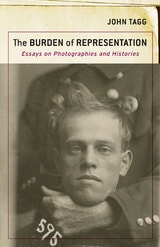
The Burden of Representation
Essays on Photographies and HistoriesJohn Tagg
University of Minnesota Press, 2021
A powerhouse in photographic theory—updated and with a new essay
Every day, photographic images are relied upon as documents, evidence, and records in courtrooms, hospitals, and police work. But how did such usages come to be established, and when? What agencies and institutions had the power to give them this status? And what are the consequences of photographic representation? Drawing on semiotics, cultural theory, and the work of Foucault and Althusser, John Tagg rejects the idea of photography as a record of reality and traces a history that has profound implications not only for the theory of photography but also for understanding the role of new means of representation in modern social regulation. Now with a new essay situating this volume in the changed horizon of cultural politics, The Burden of Representation argues for a rigorous analysis of the meaning, status, and effects of photographs, rooted in a historical grasp of the growth of the modern state.
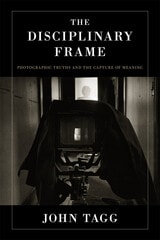
The Disciplinary Frame
Photographic Truths and the Capture of MeaningJohn Tagg
University of Minnesota Press, 2009
The meaning and power of photographs, Tagg asserts, are discursive effects of the regimens that produce them as official record, documentary image, historical evidence, or art. Teasing out the historical processes involved, he examines a series of revealing case studies from nineteenth-century European and American photographs to Depression-era works by Walker Evans, Dorothea Lange, and Margaret Bourke-White to the conceptualist photography of John Baldessari.
Central to this transformative work are questions of cultural strategy, the growth of the state, and broad issues of power and representation: how the discipline of the frame holds both photographic image and viewer in place, without erasing the possibility for evading, and even resisting, capture. Photographs, Tagg ultimately finds, are at once too big and too small for the frames in which they are enclosed—always saying more than is wanted and less than is desired.
The Instruction Myth
Why Higher Education is Hard to Change, and How to Change ItJohn Tagg
Rutgers University Press, 2019
The Instruction Myth argues that yes, higher education can be reformed and reinvigorated, but it will not be an easy process. In fact, it will require universities to abandon their central operating principle, the belief that education revolves around instruction, easily measurable in course syllabi, credits, and enrollments. Acclaimed education scholar John Tagg presents a powerful case that instruction alone is worthless and that universities should instead be centered upon student learning, which is far harder to quantify and standardize. Yet, as he shows, decades of research have indicated how to best promote student learning, but few universities have systematically implemented these suggestions.
This book demonstrates why higher education must undergo radical change if it hopes to survive. More importantly, it offers specific policy suggestions for how universities can break their harmful dependence on the instruction myth. In this extensively researched book, Tagg offers a compelling diagnosis of what’s ailing American higher education and a prescription for how it might still heal itself.