Results by title
3 books match the query 'Tame'
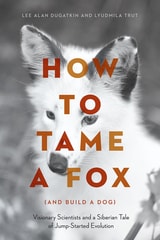
How to Tame a Fox (and Build a Dog)
Visionary Scientists and a Siberian Tale of Jump-Started EvolutionLee Alan Dugatkin and Lyudmila Trut
University of Chicago Press, 2017
Tucked away in Siberia, there are furry, four-legged creatures with wagging tails and floppy ears that are as docile and friendly as any lapdog. But, despite appearances, these are not dogs—they are foxes. They are the result of the most astonishing experiment in breeding ever undertaken—imagine speeding up thousands of years of evolution into a few decades. In 1959, biologists Dmitri Belyaev and Lyudmila Trut set out to do just that, by starting with a few dozen silver foxes from fox farms in the USSR and attempting to recreate the evolution of wolves into dogs in real time in order to witness the process of domestication. This is the extraordinary, untold story of this remarkable undertaking.
Most accounts of the natural evolution of wolves place it over a span of about 15,000 years, but within a decade, Belyaev and Trut’s fox breeding experiments had resulted in puppy-like foxes with floppy ears, piebald spots, and curly tails. Along with these physical changes came genetic and behavioral changes, as well. The foxes were bred using selection criteria for tameness, and with each generation, they became increasingly interested in human companionship. Trut has been there the whole time, and has been the lead scientist on this work since Belyaev’s death in 1985, and with Lee Dugatkin, biologist and science writer, she tells the story of the adventure, science, politics, and love behind it all. In How to Tame a Fox, Dugatkin and Trut take us inside this path-breaking experiment in the midst of the brutal winters of Siberia to reveal how scientific history is made and continues to be made today.
To date, fifty-six generations of foxes have been domesticated, and we continue to learn significant lessons from them about the genetic and behavioral evolution of domesticated animals. How to Tame a Fox offers an incredible tale of scientists at work, while also celebrating the deep attachments that have brought humans and animals together throughout time.
[more]
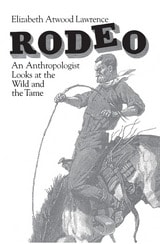
Rodeo
An Anthropologist Looks at the Wild and the TameElizabeth Atwood Lawrence
University of Chicago Press, 1984
Rodeo people call their sport "more a way of life than a way to make a living." Rodeo is, in fact, a rite that not only expresses a way of life but perpetuates it, reaffirming in a ritual contest between man and animal the values of American ranching society. Elizabeth Atwood Lawrence uses an interpretive approach to analyze rodeo as a symbolic pageant that reenacts the "winning of the West" and as a stylized expression of frontier attitudes toward man and nature. Rodeo constestants are the modern counterparts of the rugged and individualistic cowboys, and the ethos they inherited is marked by ambivalence: they admire the wild and the free yet desire to tame and conquer.
Based on extensive field work and drawing on comparative materials from other stock-tending societies, Rodeo is a major contribution to an understanding of the role of performance in society, the culturally constructed view of man's place in nature, and the structure and meaning of social relationships and their representations.
Based on extensive field work and drawing on comparative materials from other stock-tending societies, Rodeo is a major contribution to an understanding of the role of performance in society, the culturally constructed view of man's place in nature, and the structure and meaning of social relationships and their representations.
[more]
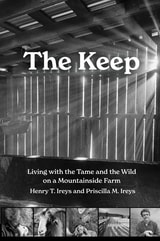
The Keep
Living with the Tame and the Wild on a Mountainside FarmHenry T. Ireys
West Virginia University Press, 2025
When a mid-life couple finds an old farm that promises refuge from hectic lives and encroaching illness, their world opens up to unexpected adventures: breeding heritage goats, hogs, and cattle; managing a half-dozen large guardian dogs; dealing with barn fires, rapacious logging, and the death of treasured animals. The farm and the surrounding forest also lead to surprising moments of beauty—from sublime sunsets and powerful connections with animals to an outpouring of help from neighbors.
Written separately by wife and husband with distinctly separate voices, the book’s essays illustrate different perspectives of life on a farm dedicated to the compassionate treatment of livestock and a deep appreciation of nature’s complexities. Priscilla embraces the intensity of loving animals; Henry explores the mysteries of living in a beautiful place. And, in telling their tales, the authors provide a glimpse into their own marriage—as complicated, improbable, and enduring as life itself. The Keep—the term for “the strongest or central tower of a castle, acting as a final refuge”—is a love letter to an unexpected place and adopted lifestyle.
Written separately by wife and husband with distinctly separate voices, the book’s essays illustrate different perspectives of life on a farm dedicated to the compassionate treatment of livestock and a deep appreciation of nature’s complexities. Priscilla embraces the intensity of loving animals; Henry explores the mysteries of living in a beautiful place. And, in telling their tales, the authors provide a glimpse into their own marriage—as complicated, improbable, and enduring as life itself. The Keep—the term for “the strongest or central tower of a castle, acting as a final refuge”—is a love letter to an unexpected place and adopted lifestyle.
[more]