Results by title
3 books match the query 'Tamez, Margo'
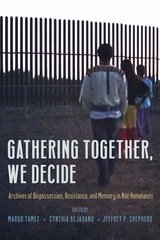
Gathering Together, We Decide
Archives of Dispossession, Resistance, and Memory in Ndé HomelandsEdited by Margo Tamez, Cynthia Bejarano, and Jeffrey P. Shepherd
University of Arizona Press, 2025
In 2007, the Department of Homeland Security began condemnation proceedings on the property of Dr. Eloisa Tamez, a Lipan Apache (Ndé) professor, veteran, and title holder to land in South Texas deeded to her ancestors under the colonial occupation and rule of King Charles III of Spain in 1761, during a time when Indigenous lands were largely taken and exploited by Spanish colonizers. Crown grants of lands to Indigenous peoples afforded them the opportunity to reclaim Indigenous title and control. The federal government wanted Tamez’s land to build a portion of the “border wall” on the U.S.-Mexico border. She refused. In 2008, the Department of Homeland Security sued her, but she countersued based on Aboriginal land rights, Indigenous inherent rights, the land grant from Spain, and human rights. This standoff continued for years, until the U.S. government forced Tamez to forfeit land for the wall.
In response, Dr. Eloisa Tamez and her daughter, Dr. Margo Tamez, organized a gathering of Lipan tribal members, activists, lawyers, and allies to meet in El Calaboz, South Texas. This gathering was a response to the appropriation of the Tamez family land, but it also provided an international platform to dispute the militarization of Indigenous territory throughout the U.S.-Mexico bordered lands. The gathering and years of ensuing resistance and activism produced an archive of scholarly analyses, testimonios, artwork, legal briefs, poetry, and other cultural productions.
This unique collection spotlights powerful voices and perspectives from Ndé leaders, Indigenous elders, settler-allies, Native youth, and others associated with the Tamez family, the Ndé defiance, and the larger Indigenous rights movement to document their resistance; expose, confront, and end racism and militarization; and to foreground Indigenous women–led struggles for justice.
[more]
Naked Wanting
Margo Tamez
University of Arizona Press, 2003
Come, step outside your human skin for just a little while.
Margo Tamez’s voice is that of the cicada and the cricket, the raven and the crane. In this volume of poetry, she shows us that the earth is an erotic current linking all beings, a vibrant network of birth, death, and rebirth. A sacred intertwining from which we as humans have become disconnected. Tamez shares the perspective of other creatures in images that remind us of Nature's beauty and fragility. An invocation of birds: “Sudden hum / wings touching / wings in swift turn / hush / a fast red out of the flux.” An appreciation for the delicacy of insects, for spiderwebs “like a hundred needle-thin tubes of blown glass.”
Here too are reflections on childbirth and children—and on miscarriage, when damage inflicted on the environment by herbicides comes back to haunt all of us in our skin and bones, our very wombs. Warning of “the chemical cocktail seeping into the air ducts,” she brings the voice of someone who has experienced firsthand what happens when our land and water are compromised. For Tamez, earth, food, and family are the essentials of life, and we ignore them at our own peril. “If a person / does not admit the peril . . . that becomes a dangerous / form of existence.”
Written with the wisdom of one who knows and loves the land, her lyrical meditations speak to the naked wanting in us all.
[more]

Raven Eye
Margo Tamez
University of Arizona Press, 2007
Written from thirteen years of journals, psychic and earthly, this poetry maps an uprising of a borderland indigenous woman battling forces of racism and sexual violence against Native women and children. This lyric collection breaks new ground, skillfully revealing an unseen narrative of resistance on the Mexico–U.S. border. A powerful blend of the oral and long poem, and speaking into the realm of global movements, these poems explore environmental injustice, sexualized violence, and indigenous women’s lives.
These complex and necessary themes are at the heart of award-winning poet Margo Tamez’s second book of poetry. Her poems bring forth experiences of a raced and gendered life along the border. Tamez engages the experiences of an indigenous life, refusing labels of Mexican or Native American as social constructs of a colonized people. This book is a challenging cartography of colonialism, poverty, and issues of Native identity and demonstrates these as threats to the environment, both ecological and social, in the borderlands. Each poem is crafted as if it were a minute prayer, dense with compassion and unerring optimism.
But the hope that Tamez serves is not blind. In poem after poem, she draws us into a space ruled by mythic symbolism and the ebb and flow of the landscape—a place where comfort is compromised and where we must work to relearn the nature of existence and the value of life.
[more]