Results by title
7 books match the query 'Taming'
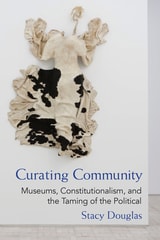
Curating Community
Museums, Constitutionalism, and the Taming of the PoliticalStacy Douglas
University of Michigan Press, 2017
Curating Community is a book for academics, artists, curators, and constitutional designers interested in legacies of violence, transitional justice, and democracy.

Deepwater Alchemy
Extractive Mediation and the Taming of the SeafloorLisa Yin Han
University of Minnesota Press, 2024
How underwater mediation has transformed deep-sea spaces into resource-rich frontiers
Green energy technologies such as windmills, solar panels, and electric vehicles may soon depend on material found at the seabed. How did a space once imagined to be empty and unfathomable come to be thought of as a treasure trove of resources? Lisa Yin Han traces how contemporary developments in underwater sensing and imaging materially and imaginatively transmogrify the ocean bottom into a resource frontier capable of sustaining a digitally connected global future.
Set against the backdrop of climate change, energy transition, and the expansion of industrial offshore extractions, Deepwater Alchemy looks at oceanic media and its representation of the seabed in terms of valuable resources. From high-tech simulations to laboratories and archives that collect and analyze sediments, Han explores the media technologies that survey, visualize, and condition the possibility for industrial resource extraction, introducing the concept of extractive mediation to describe the conflations between resource prospecting and undersea knowledge production. Moving away from anthropocentric frameworks, she argues that we must equalize access to deep ocean mediation and include the submerged perspectives of multispecies communities.
From the proliferation of petroleum seismology to environmental-impact research on seabed mining to the development of internet-enabled seafloor observatories, Deepwater Alchemy shows us that deepwater mediation is entangled in existential hopes and fears for our planetary future. As the ocean bottom becomes increasingly accessible to people, Han prompts us to ask not whether we can tame the seafloor, but, rather, why and for whom are we taming it?

Taming of the Shrew
William Shakespeare
Arizona Center for Medieval and Renaissance Studies, 2022
While beloved for its sharp dialogue and witty banter, The Taming of the Shrew offers a problematic storyline that many have deemed misogynistic. The play contains insensitive gags and uneasy politics, making it difficult for modern audiences to connect with the text. Amy Freed’s new translation reactivates the original story, blowing away the dust and cobwebs. As Freed’s text reminds us, at its heart The Taming of the Shrew is a story about courage and authenticity.
This translation of The Taming of the Shrew was written as part of the Oregon Shakespeare Festival’s Play On! project, which commissioned new translations of thirty-nine Shakespeare plays. These translations present work from “The Bard” in language accessible to modern audiences while never losing the beauty of Shakespeare’s verse. Enlisting the talents of a diverse group of contemporary playwrights, screenwriters, and dramaturges from diverse backgrounds, this project reenvisions Shakespeare for the twenty-first century. These volumes make these works available for the first time in print—a new First Folio for a new era.
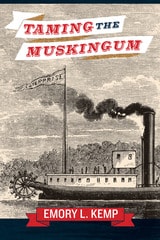
Taming the Muskingum
EMORY L. KEMP
West Virginia University Press, 2014
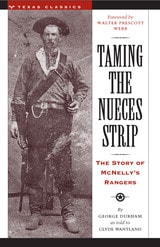
Taming the Nueces Strip
The Story of McNelly's RangersBy George Durham as told to Clyde Wantland
University of Texas Press, 1962
Only an extraordinary Texas Ranger could have cleaned up bandit-plagued Southwest Texas, between the Nueces River and the Rio Grande, in the years following the Civil War. Thousands of raiders on horseback, some of them Anglo-Americans, regularly crossed the river from Mexico to pillage, murder, and rape. Their main objective? To steal cattle, which they herded back across the Rio Grande to sell. Honest citizens found it almost impossible to live in the Nueces Strip.
In desperation, the governor of Texas called on an extraordinary man, Captain Leander M. McNelly, to take command of a Ranger company and stop these border bandits. One of McNelly's recruits for this task was George Durham, a Georgia farmboy in his teens when he joined the "Little McNellys," as the Captain's band called themselves. More than half a century later, it was George Durham, the last surviving "McNelly Ranger," who recounted the exciting tale of taming the Nueces Strip to San Antonio writer Clyde Wantland.
In Durham's account, those long-ago days are brought vividly back to life. Once again the daring McNelly leads his courageous band across Southwest Texas to victories against incredible odds. With a boldness that overcame their dismayingly small number, the McNellys succeeded in bringing law and order to the untamed Nueces Strip—succeeded so well that they antagonized certain "upright" citizens who had been pocketing surreptitious dollars from the bandits' operations.

Taming the Revolution
Andrea Acle-Kreysing
Campus Verlag, 2022
Jaime Balmes and Juan Donoso Cortés–the two most important conservative thinkers in nineteenth-century Spain–actively sought to preserve the centrality of church and monarchy in the wake of the rise of liberalism, while at the same time discrediting the stereotypical view of Spain as a backward and isolated country. Although they pursued a similar goal, their positions differed: while Balmes’ works anticipated a socially oriented Catholicism, Donoso presented Christianity as the supreme social good, incompatible with modern liberalism. In Taming the Revolution, Andrea Acle-Kreysing highlights the unresolved tensions in their works, escaping the dualistic interpretations of this period that defines tradition from modernity. This work endeavors to show how Spanish political thought was a compelling variation–rather than an aberration–of contemporary European debates.
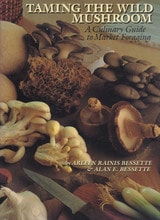
Taming the Wild Mushroom
A Culinary Guide to Market ForagingBy Arleen Rainis Bessette and Alan E. Bessette
University of Texas Press, 1993
Many mushroom hunters prefer to do their foraging in the marketplace, where all the mushrooms are clearly labeled and safely edible. With this fact in mind, Arleen and Alan Bessette have written Taming the Wild Mushroom, one of the first cooking guides devoted exclusively to choosing and preparing the mushroom species now available in many grocery stores, supermarkets, and natural and whole foods markets.
A dozen wild and cultivated species are covered in the book, including White Button, King Bolete, Oyster, Chanterelle, Morel, Paddy Straw, Wood Ear, Shiitake, Enokitake, White Matsutake, Black Truffle, and Wine-cap Stropharia. Easy-to-understand descriptions and excellent color photographs of each species help market foragers choose mushrooms in peak condition. Fifty-seven original, species-specific recipes, from appetizers, soups, and salads to meat and vegetarian entrees to sauces and accompaniments, offer dozens of ways to savor the familiar and exotic flavors of these mushrooms. A mouth-watering photograph accompanies each recipe.