Results by title
7 books match the query 'Taoism'
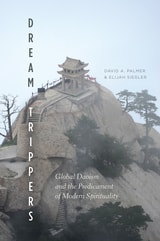
Dream Trippers
Global Daoism and the Predicament of Modern SpiritualityDavid A. Palmer and Elijah Siegler
University of Chicago Press, 2017
Over the past few decades, Daoism has become a recognizable part of Western “alternative” spiritual life. Now, that Westernized version of Daoism is going full circle, traveling back from America and Europe to influence Daoism in China.
Dream Trippers draws on more than a decade of ethnographic work with Daoist monks and Western seekers to trace the spread of Westernized Daoism in contemporary China. David A. Palmer and Elijah Siegler take us into the daily life of the monastic community atop the mountain of Huashan and explore its relationship to the socialist state. They follow the international circuit of Daoist "energy tourism," which connects a number of sites throughout China, and examine the controversies around Western scholars who become practitioners and promoters of Daoism. Throughout are lively portrayals of encounters among the book’s various characters—Chinese hermits and monks, Western seekers, and scholar-practitioners—as they interact with each other in obtuse, often humorous, and yet sometimes enlightening and transformative ways. Dream Trippers untangles the anxieties, confusions, and ambiguities that arise as Chinese and American practitioners balance cosmological attunement and radical spiritual individualism in their search for authenticity in a globalized world.
Dream Trippers draws on more than a decade of ethnographic work with Daoist monks and Western seekers to trace the spread of Westernized Daoism in contemporary China. David A. Palmer and Elijah Siegler take us into the daily life of the monastic community atop the mountain of Huashan and explore its relationship to the socialist state. They follow the international circuit of Daoist "energy tourism," which connects a number of sites throughout China, and examine the controversies around Western scholars who become practitioners and promoters of Daoism. Throughout are lively portrayals of encounters among the book’s various characters—Chinese hermits and monks, Western seekers, and scholar-practitioners—as they interact with each other in obtuse, often humorous, and yet sometimes enlightening and transformative ways. Dream Trippers untangles the anxieties, confusions, and ambiguities that arise as Chinese and American practitioners balance cosmological attunement and radical spiritual individualism in their search for authenticity in a globalized world.
[more]
Taoist Meditation and Longevity Techniques
Edited by Livia Kohn, in cooperation with Yoshinobu Sakade
University of Michigan Press, 1989
Taoist Meditation and Longevity Techniques covers the major areas of Taoist meditation and longevity techniques in roughly chronological order. The book addresses itself to the China area specialist or the scholar of religion and the history of science who wishes to know more about (and perhaps even must teach) aspects of Chinese culture that involve Taoism and traditional medicine. [viii, ix]
Other topics include Japanese interpretations of longevity techniques, drugs and immortality, visualization and ecstatic experience, and qigong and gymnastics.
[more]

The Taoist Canon, Volume 1 (Replacement Volume)
A Historical Companion to the DaozangEdited by Kristofer Schipper and Franciscus Verellen
University of Chicago Press, 2005
Taoism remains the only major religion whose canonical texts have not been systematically arranged and made available for study. This long-awaited work, a milestone in Chinese studies, catalogs and describes all existing texts within the Taoist canon. The result will not only make the entire range of existing Taoist texts accessible to scholars of religion, it will open up a crucial resource in the study of the history of China.
The vast literature of the Taoist canon, or Daozang, survives in a Ming Dynasty edition of some fifteen hundred different texts. Compiled under imperial auspices and completed in 1445—with a supplement added in 1607—many of the books in the Daozang concern the history, organization, and liturgy of China's indigenous religion. A large number of works deal with medicine, alchemy, and divination.
If scholars have long neglected this unique storehouse of China's religious traditions, it is largely because it was so difficult to find one's way within it. Not only was the rationale of its medieval classification system inoperable for the many new texts that later entered the Daozang, but the system itself was no longer understood by the Ming editors; hence the haphazard arrangement of the canon as it has come down to us.
This new work sets out the contents of the Daozang chronologically, allowing the reader to follow the long evolution of Taoist literature. Lavishly illustrated, the first volume ranges from antiquity through the Middle Ages, while the second spans the modern period. Within this frame, texts are grouped by theme and subject. Each one is the subject of a historical abstract that identifies the text's contents, date of origin, and author. Throughout the first two volumes, introductions outline the evolution of Taoism and its spiritual heritage. A third volume offering biographical sketches of frequently mentioned Taoists, multiple indexes, and an extensive bibliography provides critical tools for navigating this guide to one of the fundamental aspects of Chinese culture.
[more]
The Taoist Canon, Volume 2 (Replacement Volume)
A Historical Companion to the DaozangEdited by Kristofer Schipper and Franciscus Verellen
University of Chicago Press, 2005
Taoism remains the only major religion whose canonical texts have not been systematically arranged and made available for study. This long-awaited work, a milestone in Chinese studies, catalogs and describes all existing texts within the Taoist canon. The result will not only make the entire range of existing Taoist texts accessible to scholars of religion, it will open up a crucial resource in the study of the history of China.
The vast literature of the Taoist canon, or Daozang, survives in a Ming Dynasty edition of some fifteen hundred different texts. Compiled under imperial auspices and completed in 1445—with a supplement added in 1607—many of the books in the Daozang concern the history, organization, and liturgy of China's indigenous religion. A large number of works deal with medicine, alchemy, and divination.
If scholars have long neglected this unique storehouse of China's religious traditions, it is largely because it was so difficult to find one's way within it. Not only was the rationale of its medieval classification system inoperable for the many new texts that later entered the Daozang, but the system itself was no longer understood by the Ming editors; hence the haphazard arrangement of the canon as it has come down to us.
This new work sets out the contents of the Daozang chronologically, allowing the reader to follow the long evolution of Taoist literature. Lavishly illustrated, the first volume ranges from antiquity through the Middle Ages, while the second spans the modern period. Within this frame, texts are grouped by theme and subject. Each one is the subject of a historical abstract that identifies the text's contents, date of origin, and author. Throughout the first two volumes, introductions outline the evolution of Taoism and its spiritual heritage. A third volume offering biographical sketches of frequently mentioned Taoists, multiple indexes, and an extensive bibliography provides critical tools for navigating this guide to one of the fundamental aspects of Chinese culture.
The vast literature of the Taoist canon, or Daozang, survives in a Ming Dynasty edition of some fifteen hundred different texts. Compiled under imperial auspices and completed in 1445—with a supplement added in 1607—many of the books in the Daozang concern the history, organization, and liturgy of China's indigenous religion. A large number of works deal with medicine, alchemy, and divination.
If scholars have long neglected this unique storehouse of China's religious traditions, it is largely because it was so difficult to find one's way within it. Not only was the rationale of its medieval classification system inoperable for the many new texts that later entered the Daozang, but the system itself was no longer understood by the Ming editors; hence the haphazard arrangement of the canon as it has come down to us.
This new work sets out the contents of the Daozang chronologically, allowing the reader to follow the long evolution of Taoist literature. Lavishly illustrated, the first volume ranges from antiquity through the Middle Ages, while the second spans the modern period. Within this frame, texts are grouped by theme and subject. Each one is the subject of a historical abstract that identifies the text's contents, date of origin, and author. Throughout the first two volumes, introductions outline the evolution of Taoism and its spiritual heritage. A third volume offering biographical sketches of frequently mentioned Taoists, multiple indexes, and an extensive bibliography provides critical tools for navigating this guide to one of the fundamental aspects of Chinese culture.
[more]
The Taoist Canon, Volume 3 (Replacement Volume)
A Historical Companion to the DaozangEdited by Kristofer Schipper and Franciscus Verellen
University of Chicago Press, 2005
Taoism remains the only major religion whose canonical texts have not been systematically arranged and made available for study. This long-awaited work, a milestone in Chinese studies, catalogs and describes all existing texts within the Taoist canon. The result will not only make the entire range of existing Taoist texts accessible to scholars of religion, it will open up a crucial resource in the study of the history of China.
The vast literature of the Taoist canon, or Daozang, survives in a Ming Dynasty edition of some fifteen hundred different texts. Compiled under imperial auspices and completed in 1445—with a supplement added in 1607—many of the books in the Daozang concern the history, organization, and liturgy of China's indigenous religion. A large number of works deal with medicine, alchemy, and divination.
If scholars have long neglected this unique storehouse of China's religious traditions, it is largely because it was so difficult to find one's way within it. Not only was the rationale of its medieval classification system inoperable for the many new texts that later entered the Daozang, but the system itself was no longer understood by the Ming editors; hence the haphazard arrangement of the canon as it has come down to us.
This new work sets out the contents of the Daozang chronologically, allowing the reader to follow the long evolution of Taoist literature. Lavishly illustrated, the first volume ranges from antiquity through the Middle Ages, while the second spans the modern period. Within this frame, texts are grouped by theme and subject. Each one is the subject of a historical abstract that identifies the text's contents, date of origin, and author. Throughout the first two volumes, introductions outline the evolution of Taoism and its spiritual heritage. A third volume offering biographical sketches of frequently mentioned Taoists, multiple indexes, and an extensive bibliography provides critical tools for navigating this guide to one of the fundamental aspects of Chinese culture.
The vast literature of the Taoist canon, or Daozang, survives in a Ming Dynasty edition of some fifteen hundred different texts. Compiled under imperial auspices and completed in 1445—with a supplement added in 1607—many of the books in the Daozang concern the history, organization, and liturgy of China's indigenous religion. A large number of works deal with medicine, alchemy, and divination.
If scholars have long neglected this unique storehouse of China's religious traditions, it is largely because it was so difficult to find one's way within it. Not only was the rationale of its medieval classification system inoperable for the many new texts that later entered the Daozang, but the system itself was no longer understood by the Ming editors; hence the haphazard arrangement of the canon as it has come down to us.
This new work sets out the contents of the Daozang chronologically, allowing the reader to follow the long evolution of Taoist literature. Lavishly illustrated, the first volume ranges from antiquity through the Middle Ages, while the second spans the modern period. Within this frame, texts are grouped by theme and subject. Each one is the subject of a historical abstract that identifies the text's contents, date of origin, and author. Throughout the first two volumes, introductions outline the evolution of Taoism and its spiritual heritage. A third volume offering biographical sketches of frequently mentioned Taoists, multiple indexes, and an extensive bibliography provides critical tools for navigating this guide to one of the fundamental aspects of Chinese culture.
[more]
The Taoist Canon
A Historical Companion to the DaozangEdited by Kristofer Schipper and Franciscus Verellen
University of Chicago Press, 2005
Taoism remains the only major religion whose canonical texts have not been systematically arranged and made available for study. This long-awaited work, a milestone in Chinese studies, catalogs and describes all existing texts within the Taoist canon. The result will not only make the entire range of existing Taoist texts accessible to scholars of religion, it will open up a crucial resource in the study of the history of China.
The vast literature of the Taoist canon, or Daozang, survives in a Ming Dynasty edition of some fifteen hundred different texts. Compiled under imperial auspices and completed in 1445—with a supplement added in 1607—many of the books in the Daozang concern the history, organization, and liturgy of China's indigenous religion. A large number of works deal with medicine, alchemy, and divination.
If scholars have long neglected this unique storehouse of China's religious traditions, it is largely because it was so difficult to find one's way within it. Not only was the rationale of its medieval classification system inoperable for the many new texts that later entered the Daozang, but the system itself was no longer understood by the Ming editors; hence the haphazard arrangement of the canon as it has come down to us.
This new work sets out the contents of the Daozang chronologically, allowing the reader to follow the long evolution of Taoist literature. Lavishly illustrated, the first volume ranges from antiquity through the Middle Ages, while the second spans the modern period. Within this frame, texts are grouped by theme and subject. Each one is the subject of a historical abstract that identifies the text's contents, date of origin, and author. Throughout the first two volumes, introductions outline the evolution of Taoism and its spiritual heritage. A third volume offering biographical sketches of frequently mentioned Taoists, multiple indexes, and an extensive bibliography provides critical tools for navigating this guide to one of the fundamental aspects of Chinese culture.
The vast literature of the Taoist canon, or Daozang, survives in a Ming Dynasty edition of some fifteen hundred different texts. Compiled under imperial auspices and completed in 1445—with a supplement added in 1607—many of the books in the Daozang concern the history, organization, and liturgy of China's indigenous religion. A large number of works deal with medicine, alchemy, and divination.
If scholars have long neglected this unique storehouse of China's religious traditions, it is largely because it was so difficult to find one's way within it. Not only was the rationale of its medieval classification system inoperable for the many new texts that later entered the Daozang, but the system itself was no longer understood by the Ming editors; hence the haphazard arrangement of the canon as it has come down to us.
This new work sets out the contents of the Daozang chronologically, allowing the reader to follow the long evolution of Taoist literature. Lavishly illustrated, the first volume ranges from antiquity through the Middle Ages, while the second spans the modern period. Within this frame, texts are grouped by theme and subject. Each one is the subject of a historical abstract that identifies the text's contents, date of origin, and author. Throughout the first two volumes, introductions outline the evolution of Taoism and its spiritual heritage. A third volume offering biographical sketches of frequently mentioned Taoists, multiple indexes, and an extensive bibliography provides critical tools for navigating this guide to one of the fundamental aspects of Chinese culture.
[more]
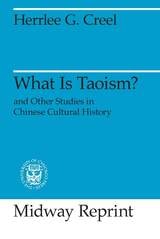
What Is Taoism?
and Other Studies in Chinese Cultural HistoryHerrlee Glessner Creel
University of Chicago Press, 1982
What Is Taoism? traces, in nontechnical language, the history of the development of this often baffling doctrine. Creel shows that there has not been one "Taoism," but at least three, in some respects incompatible and often antagonistic. In eight closely related papers, Creel explicates the widely used concepts he originally introduced of "contemplative Taoism," "purposive Taoism," and "Hsien Taoism." He also discusses Shen Pu-hai, a political philosopher of the fourth century B.C.; the curious interplay between Confucianism, Taoism, and "Legalism" in the second century B.C.; and the role of the horse in Chinese history.
[more]