Results by title
5 books match the query 'Tarahumara Indians'
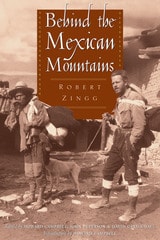
Behind the Mexican Mountains
By Robert Zingg
University of Texas Press, 2001
In 1930, anthropologists Robert Zingg and Wendell Bennett spent nine months among the Tarahumara of Chihuahua, Mexico, one of the least acculturated indigenous societies in North America. Their fieldwork resulted in The Tarahumara: An Indian Tribe of Northern Mexico (1935), a classic ethnography still familiar to anthropologists. In addition to this formal work, Zingg also penned a personal, unvarnished travelogue of his sojourn among the Tarahumara. Unpublished in his lifetime, Behind the Mexican Mountains is now available in print for the first time.
This colorful account provides a compelling description of the landscape, people, traditions, language, and archaeology of the Tarahumara region. Abandoning the scientific detachment of the observer, Zingg frankly records his reactions to the people and their customs as he vividly evokes the daily experience of doing fieldwork. In the introduction, Howard Campbell examines Zingg's writing in light of current critiques of anthropology as literature. He makes a strong case that although earlier anthropological writing reveals unacceptable cultural biases, it also demonstrates the ongoing importance and vitality of field research.

In the Sierra Madre
Jeff Biggers
University of Illinois Press, 2006
A stunning history of legendary treasure seekers and enigmatic natives in Mexico's Copper Canyon
Based on his one-year sojourn in Copper Canyon among the Raramuri/Tarahumara, award-winning journalist Jeff Biggers offers a rare look into the ways of the most resilient indigenous culture in the Americas, the exploits of Mexican mountaineers, and the fascinating parade of argonauts and accidental travelers who have journeyed into the Sierra Madre over centuries. From African explorers, Bohemian friars, Confederate and Irish war deserters, French poets, Boer and Russian commandos, Apache and Mennonite communities, bewildered archaeologists, addled writers, and legendary characters including Antonin Artaud, Henry Flipper, B. Traven, Sergei Eisenstein, George Patton, Geronimo, and Pancho Villa, Biggers uncovers the remarkable treasures of the Sierra Madre.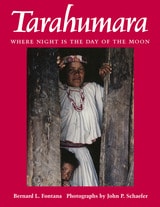
Tarahumara
Where Night is the Day of the MoonBernard L. Fontana; Photographs by John P. Schaefer
University of Arizona Press, 1997
The subtitle of the book derives from the Tarahumara's belief that the soul works at night while the body sleeps and that during this "day of the moon" both the spirits of the dead and the souls of the living move about in their mysterious ways.
As the authors observe, the fact that "so many men, women, and children persist in distinctive, centuries-old cultural traditions in spite of their nearness to all the complexities and attractions of modern industrial society is an importatn part of the story." Their book tells that story and brings readers closer to understanding the Tarahumara world and way of life.

The Silver of the Sierra Madre
John Robinson, Boss Shepherd, and the People of the CanyonsJohn Mason Hart
University of Arizona Press, 2008
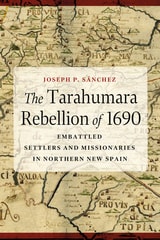
The Tarahumara Rebellion of 1690
Embattled Settlers and Missionaries in Northern New SpainJoseph P. Sánchez
University of Arizona Press, 2025
Previous histories have interpreted this revolt, and other borderlands uprisings, as localized and spontaneous events aimed at rectifying specific grievances. Historian Joseph P. Sánchez argues that the revolts of the Tepehuanes and the Tarahumaras in northern New Spain, or Nueva Vizcaya, were well-planned, inspired by outside events, and drew in multiple communities and ethnicities. Drawing on a wealth of primary sources, including Jesuit accounts and archival documents, Sánchez offers a comprehensive narrative that challenges conventional interpretations of colonial Mexican uprisings.
Far from localized, the Indigenous rebellions in the northern Mexican borderlands during the colonial period were part of the overall Indigenous struggle for defense of homeland throughout the Americas. The Tarahumara Rebellion of 1690 brings together a rich history of localized events and broader historical trends and offers a compelling narrative that enriches our understanding of the colonial experience in northern New Spain.