Results by title
6 books match the query 'Tasker, Yvonne'
Gender Meets Genre in Postwar Cinemas
Edited by Christine Gledhill
University of Illinois Press, 2012
This remarkable collection uses genre as a fresh way to analyze the issues of gender representation in film theory, film production, spectatorship, and the contexts of reception. With a uniquely global perspective, these essays examine the intersection of gender and genre in not only Hollywood films but also in independent, European, Indian, and Hong Kong cinemas. Working in the area of postcolonial cinema, contributors raise issues dealing with indigenous and global cinemas and argue that contemporary genres have shifted considerably as both notions of gender and forms of genre have changed. The volume addresses topics such as the history of feminist approaches to the study of genre in film, issues of female agency in postmodernity, changes taking place in supposedly male-dominated genres, concepts of genre and its use of gender in global cinema, and the relationship between gender and sexuality in film.
Gendering the Recession
Media and Culture in an Age of AusterityDiane Negra and Yvonne Tasker, eds.
Duke University Press, 2014
Contributors. Sarah Banet-Weiser, Hamilton Carroll, Hannah Hamad, Anikó Imre, Suzanne Leonard, Isabel Molina-Guzmán, Sinéad Molony, Elizabeth Nathanson, Diane Negra, Tim Snelson, Yvonne Tasker, Pamela Thoma
Interrogating Postfeminism
Gender and the Politics of Popular CultureYvonne Tasker and Diane Negra, eds.
Duke University Press, 2007
Essays by feminist film, media, and literature scholars based in the United States and United Kingdom provide an array of perspectives on the social and political implications of post-feminism. Examining magazines, mainstream and independent cinema, popular music, and broadcast genres from primetime drama to reality television, contributors consider how postfeminism informs self-fashioning through makeovers and cosmetic surgery, the “metrosexual” male, the “black chick flick,” and more. Interrogating Postfeminism demonstrates not only the viability of, but also the necessity for, a powerful feminist critique of contemporary popular culture.
Contributors. Sarah Banet-Weiser, Steven Cohan, Lisa Coulthard, Anna Feigenbaum, Suzanne Leonard, Angela McRobbie, Diane Negra, Sarah Projansky, Martin Roberts, Hannah E. Sanders, Kimberly Springer, Yvonne Tasker, Sadie Wearing
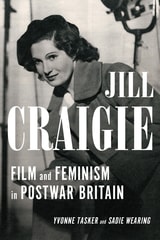
Jill Craigie
Film and Feminism in Postwar BritainYvonne Tasker and Sadie Wearing
University of Illinois Press, 2026
Tasker and Wearing reconsider Craigie’s place and reputation in the history of British Cinema. Craigie created work that showed a strong critical voice and at the same time challenged contemporary modes of filmmaking with both documentary and drama. Tasker and Wearing examine her feminist and working-class influences and also emphasize the democratic impulse that drove Craigie to include her subjects’ participation, and her commitment to representing them on screen. Throughout, Tasker and Wearing analyze Craigie’s work against the backdrop of postwar concerns and preoccupations.
Distinctive and nuanced, Jill Craigie reconsiders the career of a groundbreaking woman director.
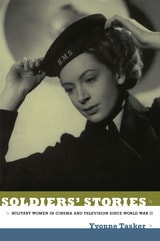
Soldiers' Stories
Military Women in Cinema and Television since World War IIYvonne Tasker
Duke University Press, 2011
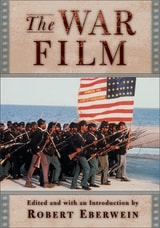
The War Film
Eberwein, Robert
Rutgers University Press, 2004
War has had a powerful impact on the film industry. But it is not only wars that affect films; films influence war-time behavior and incisively shape the way we think about the battles that have been waged.
In The War Film, Robert Eberwein brings together essays by scholars using a variety of critical approaches to explore this enduringly popular film genre. Contributors examine the narrative and aesthetic elements of war films from four perspectives: consideration of generic conventions in works such as All Quiet on the Western Front, Bataan, and The Thin Red Line; treatment of race in various war films, including Glory, Home of the Brave, Platoon,and Hamburger Hill; aspects of gender, masculinity and feminism in The Red Badge of Courage, Rambo, Dogfight, and Courage under Fire; and analysis of the impact of contemporary history on the production and reception of films such as The Life and Times of Rosie the Riveter, Saving Private Ryan, and We Were Soldiers.
Drawing attention to the dynamic interrelationships among politics, nationalism, history, gender, and film, this comprehensive anthology is bound to become a classroom favorite.