Results by title

19 books match the query 'Tax Policy'
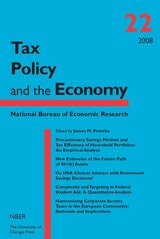
cover of Tax Policy and the Economy, Volume 22

Tax Policy and the Economy, Volume 22

Edited by James M. Poterba

University of Chicago Press Journals, 2008
Tax Policy and the Economy publishes current academic research findings on taxation and government spending that have both immediate bearing on policy debates and longer-term interest. Volume 22 includes issues related to savings through tax-deferred retirement programs, consumer choice on high-deductible health plans, financial aid applications and the tax filing process, and recent developments in corporate income tax reform in the European Union and possible implications for the United States.
[more]
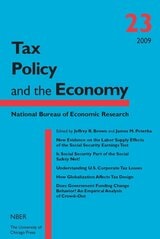
cover of Tax Policy and the Economy, Volume 23

Tax Policy and the Economy, Volume 23

Edited by James M. Poterba

University of Chicago Press Journals, 2009

Tax Policy and the Economy publishes current academic research findings on taxation and government spending that have both immediate bearing on policy debates and longer-term interest. The articles in Volume 23 address a range of topics, including Social Security, understanding corporate tax losses, the influence of globalization on the design of a tax system, and the question of whether federal provision of goods and services crowds out their provision by lower levels of government or the private sector.
[more]
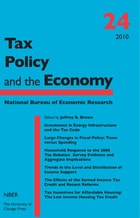
cover of Tax Policy and the Economy, Volume 24

Tax Policy and the Economy, Volume 24

Edited by Jefferey R. Brown

University of Chicago Press Journals, 2010

Tax Policy and the Economy publishes current academic research findings on taxation and government spending that have both immediate bearing on policy debates and longer-term interest. The papers in this volume range from topics as broad as the relative efficacy of tax cuts versus spending increases as a form of economic stimulus to a targeted analysis of the Low Income Housing Tax Credit. Also included are two papers at that examine different aspects of policies designed to provide fiscal stimulus, as well as an examination of the effects of recent reforms in the Earned Income Tax Credit.
[more]
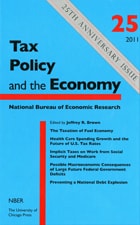
cover of Tax Policy and the Economy, Volume 25

Tax Policy and the Economy, Volume 25

Edited by Jeffrey R. Brown

University of Chicago Press Journals, 2011
In light of the very public debate on the federal budget this year between Democrats and Republicans, the economic ramifications of tax policy are now more than ever a focus of national attention. Tax Policy and the Economy, Volume 25 is thus an invaluable tool, publishing current academic research findings on taxation and government spending, which informs important policy debates with rigorous economic analysis. The papers in Volume 25 include a review of current fuel economy taxation; research on implicit taxes on work from Social Security and Medicare; an analysis on how future increases in aggregate health care expenditures will impact future tax rates required to support Medicare and Medicaid; and two papers that analyze the implications of large and sustained budget deficits on the economy.
[more]
cover of Tax Policy and the Economy, Volume 26

Tax Policy and the Economy, Volume 26

Edited by Jeffrey R. Brown

University of Chicago Press Journals, 2012
There is no question that the US is facing significant fiscal challenges. Tax Policy and the Economy research papers make valuable contributions to our understanding of the economic effects of alternative approaches. The papers collected in Volume 26 include a study of an important determinant of the labor supply effects of Social Security; an examination of the budgetary and economic impact of changing how employer health insurance is treated in the tax code; an analysis of how US investment in Europe might be impacted by proposed corporate tax reform in the European Union; a look at the term “tax expenditures,” often used to describe governmental policies that show as reduction in taxes rather than as an increase in spending. The final paper in the volume shows how uncertainty about the restoration of US fiscal balance imposes additional efficiency costs on the economy in consumption, saving, labor supply and portfolio decisions, and how it reduces individual welfare.
[more]
cover of Tax Policy and the Economy, Volume 27

Tax Policy and the Economy, Volume 27

Edited by Jeffrey R. Brown

University of Chicago Press Journals, 2013
Taxation policy was a central part of the policy debates over the “fiscal cliff.” Given the importance of fiscal issues, it is vital for rigorous empirical research to inform the policy dialogue.  In keeping with the NBER’s tradition of carrying out rigorous but policy-relevant research, Volume 27 of Tax Policy and the Economy offers insights on a number of key tax policy questions.  This year's volume features six papers by leading scholars who examine the tax treatment of tuition at private K-12 schools, the potential streamlining of the federal rules for post-secondary financial aid and the use of tax return information in this process, the effect of tax and benefit programs on incentives to work, the macroeconomic effects of fiscal adjustments, and the set of factors that contributed to the weakening US fiscal outlook in the last decade.
[more]
cover of Tax Policy and the Economy, Volume 28

Tax Policy and the Economy, Volume 28

Edited by Jeffrey R. Brown

University of Chicago Press Journals, 2014
The papers in Volume 28 of Tax Policy and the Economy illustrate the depth and breadth of the research by NBER research associates who study taxation and government spending programs.  The first paper explores whether closely held firms are used as tax shelters. The second examines the taxation of multinational corporations. The third discusses the taxation of housing, focusing on the ways in which current income tax rules may affect location and consumption decisions and lead to economic inefficiencies. The fourth paper offers an historical perspective on the political economy of gasoline taxes, with a particular focus on the response to the oil shocks of the early 1970s. The fifth and final paper uses the tools of financial economics to estimate the unfunded liabilities of the Pension Benefit Guaranty Corporation.
[more]
cover of Tax Policy and the Economy, Volume 29

Tax Policy and the Economy, Volume 29

Edited by Jeffrey R. Brown

University of Chicago Press Journals, 2016
The papers in Volume 29 of Tax Policy and the Economy illustrate the depth and breadth of the taxation-related research by NBER research associates, both in terms of methodological approach and in terms of topics.  In the first paper, former NBER President Martin Feldstein estimates how much revenue the federal government could raise by limiting tax expenditures in various ways, such as capping deductions and exclusions. The second paper, by George Bulman and Caroline Hoxby, makes use of a substantial expansion in the availability of education tax credits in 2009 to study whether tax credits have a significant causal effect on college attendance and related outcomes. In the third paper, Casey Mulligan discusses how the Affordable Care Act (ACA) introduces or expands taxes on income and on full-time employment. In the fourth paper, Bradley Heim, Ithai Lurie, and Kosali Simon focus on the “young adult” provision of the ACA that allows young adults to be covered by their parents’ insurance policies. They find no meaningful effects of this provision on labor market outcomes.  The fifth paper, by Louis Kaplow, identifies some of the key conceptual challenges to analyzing social insurance policies, such as Social Security, in a context where shortsighted individuals fail to save adequately for their retirement. 
[more]
cover of Tax Policy and the Economy, Volume 30

Tax Policy and the Economy, Volume 30

Edited by Jeffrey R. Brown

University of Chicago Press Journals, 2016
The research papers in Volume 30 of Tax Policy and the Economy make significant contributions to the academic literature in public finance and provide important conceptual and empirical input to policy design. In the first paper, Gerald Carlino and Robert Inman consider whether state-level fiscal policies create spillovers for neighboring states and how federal stimulus can internalize these externalities. The second paper, by Nathan Hendren, presents a new framework for evaluating the welfare consequences of tax policy changes and explains how the key parameters needed to implement this framework can be estimated. The third paper, a collaborative effort by several academic and US Treasury economists, documents the dramatic increase in pass-through businesses, including partnerships and S-corporations, over the last thirty years.  It notes that these entities now generate more than half of all US business income. The fourth paper examines property tax compliance using a pseudo-randomized experiment in Philadelphia, in which those who owed taxes received supplemental letters regarding their tax delinquency. The research explores what types of communication lead to higher rates of tax payment. In the fifth paper, Jeffrey Clemens discusses cross-program budgetary spillovers of minimum wage regulations. Severin Borenstein and Lucas Davis, the authors of the sixth paper, study the distributional effects of income tax credits for clean energy.
[more]
cover of Tax Policy and the Economy, Volume 31

Tax Policy and the Economy, Volume 31

Edited by Robert A. Moffitt

University of Chicago Press Journals, 2017
The papers in Tax Policy and the Economy Volume 31 are all directly related to important and often long-standing issues, often including how transfer programs affect tax rates and behavior. In the first paper, Alan Auerbach, Laurence Kotlikoff, Darryl Koehler, and Manni Yu take a lifetime perspective on the marginal tax rates facing older individuals and families arising from a comprehensive set of sources. In the second, Gizem Kosar and Robert A. Moffitt provide new estimates of the cumulative marginal tax rates facing low-income families over the period 1997-2007. In the third paper, Emmanuel Saez presents evidence on the elasticity of taxable income with respect to tax rates, drawing on data from the 2013 federal income tax reform.  In the fourth, Conor Clarke and Wojciech Kopczuk survey the treatment of business income taxation in the United States since the 1950s, providing new data on how business income and its taxation have evolved over time.  In the fifth paper, Louis Kaplow argues that the reduction in statutory tax rates from base-broadening may not reduce effective marginal tax rates on households. 
 
[more]
cover of Tax Policy and the Economy, Volume 33

Tax Policy and the Economy, Volume 33

Edited by Robert A. Moffitt

University of Chicago Press Journals, 2019
This volume presents five new studies on taxation and government transfer programs.  Alexander Blocker, Laurence Kotlikoff, Stephen Ross, and Sergio Villar Vallenas show how asset pricing can be used to value implicit fiscal debts, which are currently rarely measured or adjusted for risk, while accounting for risk properties.  They apply their methodology to study Social Security.  Michelle Hanson, Jeffrey Hoopes, and Joel Slemrod examine the effects of the Tax Cuts and Jobs Act on corporation behavior and on firms’ statements about their behavior.  They focus on for four outcomes: bonuses, investment, share repurchases, and dividends. Scott Baker, Lorenz Kueng, Leslie McGranahan, and Brian Melzer explore whether “unconventional” fiscal policy in the form of pre-announced consumption tax changes can shift durables purchases intertemporally, how it such shifts are affected by consumer credit.  Alan Auerbach discusses “tax equivalences,” disparate sets of policies that have the same economic effects, and also illustrates when these equivalences break down.  Jeffrey Liebman and Daniel Ramsey use data from NBER’s TAXSIM model to investigate the equity implications of a switch from joint to independent taxation that could occur in conjunction with adoption of return-free tax filing.
[more]
cover of Tax Policy and the Economy, Volume 34

Tax Policy and the Economy, Volume 34

Edited by Robert A. Moffitt

University of Chicago Press Journals, 2020
This volume presents five new studies on current topics in taxation and government spending.  Mark Shepard, Katherine Baicker, and Jonathan Skinner explore implementation aspects of a Medicare-for-All program, which provides a uniform health insurance benefit to everyone, and contrast it with a program providing a basic benefit that can be supplemented voluntarily. John Beshears, James Choi, Mark Iwry, David John, David Laibson, and Brigitte Madrian examine the design and feasibility of firm-sponsored “rainy day funds,” short-term savings accounts for employees that can be used when faced with temporary periods of high expenditure. Robert Barro and Brian Wheaton investigate the impact of taxation on choice of corporate form, on the formation and legal structure of new businesses, and indirectly on productivity in the economy. Jonathan Meer and Benjamin Priday examine the impact of the 2017 federal income tax reform, which reduced marginal tax rates and the incentive for charitable giving, on such giving. Finally, Casey Mulligan analyzes the impact of the Affordable Care Act on whether firms employ fewer than 50 employees, the employment threshold below which they are exempt from the requirement to provide health insurance to their employees.
[more]
cover of Tax Policy and the Economy, Volume 35

Tax Policy and the Economy, Volume 35

Edited by Robert A. Moffitt

University of Chicago Press Journals, 2021
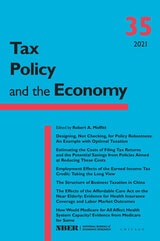
This volume presents six new studies on current topics in taxation and government spending. The first study looks at the costs of income tax filing, which have risen over time because of the numerous tax forms families have to fill out when filing their taxes and because of increased costs of itemizing deductions, and explores ways to simplify filing and reduce those costs. The second study investigates the design of income tax schedules when there is uncertainty about the way taxation affects household behavior. The third study provides new and comprehensive estimates of the impact of the US Earned Income Tax Credit on the employment of low-income men and women, finding that the large majority of the various expansions of that credit over the last forty years have increased employment of single mothers. The fourth study reviews the structure of business taxation in China and describes a number of tax distortions and potential inefficiencies in the system. The next paper considers how the Affordable Care Act has affected the health insurance and labor market choices of individuals who are between the ages of 60 and 64, and it finds increases in insurance coverage and reductions in employment for some groups. The last study considers how reimbursement rates for health care providers under various government insurance programs affect providers’ willingness to take on new patients and expand their patient capacity.
 
[more]
cover of Tax Policy and the Economy, Volume 36

Tax Policy and the Economy, Volume 36

Edited by Robert A. Moffitt

University of Chicago Press Journals, 2022

This volume presents five new studies on current topics in taxation and government spending.  
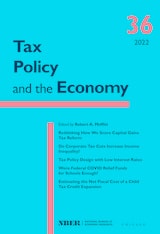
Natasha Sarin, Lawrence Summers, Owen Zidar, and Eric Zwick study how investors respond to taxes on capital gains, whether their incentives to invest are affected by those taxes, and whether that responsiveness has changed over time. Ethan Rouen, Suresh Nallareddy, and Juan Carlos Suárez Serrato revisit the question of whether cuts to corporate taxes increase income inequality, bringing new data and new statistical techniques to generate fresh findings. Alan Auerbach and William Gale investigate whether the advantages and disadvantages of different types of taxation are affected when interest rates stay low for long periods, as has been the case in the U.S. for many years. Nora Gordon and Sarah Reber study the distributional impact of emergency subsidies to schools made by the federal government during the recent COVID pandemic and whether those subsidies were sufficient to cover the increased school costs induced by the pandemic. Jacob Goldin, Elaine Maag, and Katherine Michelmore investigate the fiscal cost of an expansion of the U.S. child tax credit, which has been discussed extensively in policy circles recently. They take into account not only the direct expenditure on the allowance but how cost is affected by the existence of work incentives and by possible beneficial effects on childrens’ adult earnings.
[more]
cover of Tax Policy and the Economy, Volume 37

Tax Policy and the Economy, Volume 37

Edited by Robert A. Moffitt

University of Chicago Press Journals, 2023

Timely and authoritative research on the latest issues in tax policy.

Tax Policy and the Economy publishes current academic research on taxation and government spending with both immediate bearing on policy debates and longer-term interest.

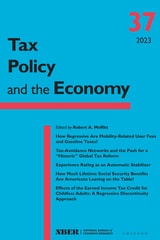
This volume of Tax Policy and the Economy presents new research on important issues concerning US taxation and transfers. First, Edward L. Glaeser, Caitlin S. Gorback, and James M. Poterba examine the distribution of burdens associated with taxes on transportation. Replacing the gasoline tax with a vehicle-miles-traveled (VMT) tax would increase the burden on higher-income households, who drive more fuel-efficient cars and are more likely to own electric vehicles. User charges for airports, subways, and commuter rail are progressive, while the burden of bus fees is larger for lower-income households than for their higher-income counterparts. Next, Katarzyna Bilicka, Michael Devereux, and Irem Güçeri investigate tax shifting by multinational companies (MNCs) and the implications of a potential Global Minimum Tax (GMT). They find that MNCs shift intellectual property to tax havens, and that a large share of patenting activity takes place in tax havens where little or no R&D occurs. Tax havens are particularly important for MNCs with large subsidiary networks; such firms would likely be subject to a GMT. Mark Duggan, Audrey Guo, and Andrew C. Johnston study the role of experience rating in the Unemployment Insurance (UI) system and find that the current structure stabilizes the labor market because it penalizes firms with high rates of UI-eligible layoffs. In the fourth paper, David Altig, Laurence J. Kotlikoff, and Victor Yifan Ye calculate how retiring at different ages will affect Social Security benefit amounts, taking into account taxation and other benefits. They find that virtually all individuals aged 45 to 62 should wait until age 65 or later to maximize their Social Security benefits. Indeed, 90 percent would benefit from waiting until age 70, but only 10 percent do so. Finally, Jonathan Meer and Joshua Witter examine the potential impact of the Earned Income Tax Credit on the labor force decisions of childless adults who are eligible for a small credit after they reach age 25. Comparing labor force attachment changes just before and after this age suggests that the EITC has little impact on the labor force participation of this group.
[more]
cover of Tax Policy and the Economy, Volume 38

Tax Policy and the Economy, Volume 38

Edited by Robert A. Moffitt

University of Chicago Press Journals, 2024

Timely and authoritative research on the latest issues in tax policy.

Tax Policy and the Economy publishes current academic research on taxation and government spending with both immediate bearing on policy debates and longer-term interest.

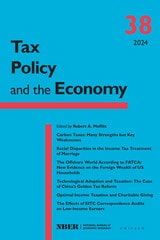
This volume presents new research on taxation and public expenditure programs, with particular focus on how they affect economic behavior. John Guyton, Kara Leibel, Dayanand Manoli, Ankur Patel, Mark Payne, and Brenda Schafer study the disallowance of Earned Income Tax Credit (EITC) benefits as a result of IRS audits, and find that in post-audit years, audited taxpayers are less likely than similar non-audited taxpayers to claim EITC benefits. Janet Holtzblatt, Swati Joshi, Nora Cahill, and William Gale provide new empirical evidence on racial differences in the income tax penalty, or bonus, associated with a couple being married. Haichao Fan, Yu Liu, Nancy Qian, and Jaya Wen evaluate how computerizing value-added tax transactions in China affected the tax revenue collected from large manufacturing firms. Niels Johannesen, Daniel Reck, Max Risch, Joel Slemrod, John Guyton, and Patrick Langetieg study data on the ownership of foreign bank accounts and other financial accounts as reported on income tax returns. They find that many of these accounts are in tax havens, and they discuss the impact of the Foreign Account Tax Compliance Act on tax compliance and government revenue. Louis Kaplow integrates charitable giving into an optimal income tax framework, and shows that the externalities associated with such giving are key to determining its optimal tax treatment. Finally, Roger Gordon compares caps or quantity targets on emissions with carbon taxes and points out that which one dominates can be situation-specific and depend on a number of features of the economy.
[more]
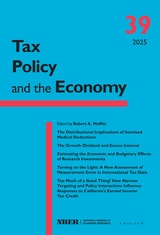
cover of Tax Policy and the Economy, Volume 39

Tax Policy and the Economy, Volume 39

Edited by Robert A. Moffitt

University of Chicago Press Journals, 2025

Timely and authoritative research on the latest issues in tax policy.

Tax Policy and the Economy publishes current academic research on taxation and government spending with both immediate bearing on policy debates and longer-term interest. This volume highlights new insights on taxation, transfer programs, and related issues. First, analyzing the itemized medical deduction in the US federal income tax, Gopi Shah Goda, Ithai Lurie, Priyanka Parikh, and Chelsea Swete find that this provision disproportionately benefits higher-income taxpayers, particularly after the passage of the 2017 Tax Cuts and Jobs Act. They also consider alternative structures, such as a tax credit, that could make the distribution of the tax benefits for those with high medical outlays more equal. Next, Danny Yagan analyzes factors influencing the US federal budget deficit and the debt-to-GDP ratio. He describes the "growth dividend," the impact of GDP growth on the debt ratio, and warns about the potential costs of high debt-to-GDP ratios, especially when interest rates rise. In the third paper, Theresa Gullo, Benjamin Page, David Weiner, and Heidi Williams synthesize the economic evidence on the economic and budgetary effects of R&D investment and examine how this evidence could be incorporated into the standard projections generated by various federal agencies. Fourth, Rosanne Altshuler, Lysle Boller, and Juan Carlos Suárez Serrato investigate profit shifting by US multinational corporations and evaluate the importance of aggregation errors in reported foreign earnings and on estimates of profit shifting elasticities based on these data. Finally, David Neumark and Zeyu Li find no employment effect of California’s Earned Income Tax Credit on less-skilled single mothers, in contrast with the effects of federal and other states' programs. They suggest that structural differences and interactions with minimum wage laws explain this result.
[more]
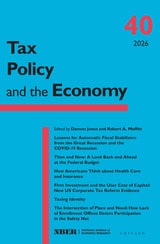
cover of Tax Policy and the Economy, Volume 40

Tax Policy and the Economy, Volume 40

Edited by Damon Jones and Robert A. Moffitt

University of Chicago Press Journals, 2026

Timely and authoritative research on the latest issues in tax policy.

Tax Policy and the Economy publishes current academic research on taxation and government spending with both immediate bearing on policy debates and longer-term interest.

This volume presents new research on taxation, transfer programs, and related issues. Karen Dynan and Douglas Elmendorf examine the potential impact of automatic fiscal stabilizers on fiscal policy and economic activity. They find that a stabilizer providing direct payments could have produced faster unemployment decline after the Great Recession without raising inflation and much lower inflation after COVID-19 at the cost of a slower unemployment reduction. Alan J. Auerbach and William Gale review federal budget history and project the US debt-to-GDP ratio over the next 30 years, arguing that high projected debt could constrain future policy actions. They also explore possible fiscal consolidation policies. Beatrice Ferrario and Stefanie Stantcheva survey Americans’ views of health care and insurance, finding broad agreement regarding costs, access, and efficiency but partisan gaps in policy preferences stemming from fundamentally different views of government scope rather than contrasting efficiency or fairness beliefs. Jonathan S. Hartley, Kevin A. Hassett, and Joshua D. Rauh analyze the corporate investment response to the Tax Cut and Jobs Act of 2017, finding a larger response than a number of earlier studies of investment sensitivity would have suggested. Joel Slemrod reviews historical taxation based on racial, religious, and gender identity and examines how tax policies that are not conditioned on any of these attributes can nevertheless differentially impact families as a result of systemic differences in their economic circumstances. Finally, Marianne Bitler, Jason Cook, Chloe N. East, Sonya R. Porter, and Laura Tiehen analyze geographic proximity effects on Supplemental Nutrition Assistance Program (SNAP) participation, finding that when a SNAP office opens, participation increases by about 20%. When an office closes, they find that participation drops by about 8% in the next two years.
[more]
cover of Tax Policy and the Economy: Volume 32

Tax Policy and the Economy

Volume 32

Edited by Robert A. Moffitt

University of Chicago Press Journals, 2018

The six research studies in Volume 32 of Tax Policy and the Economy analyze the U.S. tax and transfer system, in particular its effects on revenues, expenditures, and economic behavior. First, James Andreoni examines donor advised funds, which are financial vehicles offered by investment houses to provide savings accounts for tax-free charitable giving, and weighs their effects on donations against their tax cost. Second, Caroline Hoxby analyzes the use of tax credits by students enrolled in online post-secondary education. Third, Alex Rees-Jones and Dmitry Taubinsky explore taxpayers’ psychological biases that lead to incorrect perceptions and understanding of tax incentives. Fourth, Jeffrey Clemens and Benedic Ippolito investigate the implications of block grant reforms of Medicaid for receipt of federal support by different states. Fifth, Andrew Samwick examines means-testing of Medicare and federal health benefits under the Affordable Care Act. Sixth, Bruce Meyer and Wallace Mok study the incidence and effects of disability among U.S. women from 1968 to 2015, examining the impacts of disability on income, consumption, and public transfers.
[more]