Results by title

11 books match the query 'Teacher'
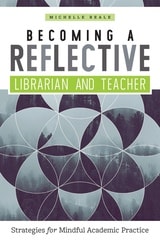
cover of Becoming a Reflective Librarian and Teacher: Strategies for Mindful Academic Practice

Becoming a Reflective Librarian and Teacher

Strategies for Mindful Academic Practice

Michelle Reale

American Library Association, 2016

[more]
cover of From Socrates to Software: The Teacher as Text and the Text as Teacher

From Socrates to Software

The Teacher as Text and the Text as Teacher

Edited by Philip W. Jackson and Sophie Haroutunian-Gordon

University of Chicago Press, 1989
[more]
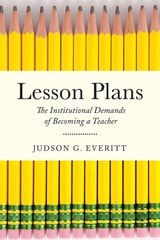
cover of Lesson Plans: The Institutional Demands of Becoming a Teacher

Lesson Plans

The Institutional Demands of Becoming a Teacher

Everitt, Judson G.

Rutgers University Press, 2017

Winner of the 2019-20 Distinguished Book Award - Midwest Sociological Society

In Lesson Plans, Judson G. Everitt takes readers into the everyday worlds of teacher training, and reveals the complexities and dilemmas teacher candidates confront as they learn how to perform a job that many people assume anybody can do. Using rich qualitative data, Everitt analyzes how people make sense of their prospective jobs as teachers, and how their introduction to this profession is shaped by the institutionalized rules and practices of higher education, K-12 education, and gender. Trained to constantly adapt to various contingencies that routinely arise in schools and classrooms, teacher candidates learn that they must continually try to reconcile the competing expectations of their jobs to meet students’ needs in an era of accountability. Lesson Plans reveals how institutions shape the ways we produce teachers, and how new teachers make sense of the multiple and complicated demands they face in their efforts to educate students.   
[more]
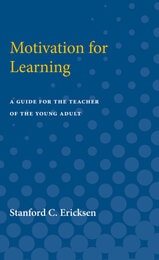
cover of Motivation for Learning: A Guide for the Teacher of the Young Adult

Motivation for Learning

A Guide for the Teacher of the Young Adult

Stanford C. Ericksen

University of Michigan Press, 1974
Motivation for Learning is a book for teachers—but not only for teachers: parents and administrators will also find it of value. Ultimately, too, it is a book for students—for their independence and growth and against their boredom in the classroom.Stanford C. Ericksen writes out of years of experience, both as a teacher and as director of the Center for Research on Learning and Teaching at the University of Michigan. In a practical fashion, he brings together the significant applications from research and theory about learning, motivation, personality, and group dynamics. The book says more about the conditions for learning than about the techniques of teaching: projecting one's voice to the back of the room is judged to be less important than is the instructor's ability to make sense to young adults and to challenge their curiosity. Throughout, the primary focus is on the stimulation and encouragement of the individual student's motivation to acquire new knowledge and new attitudes and values.Only a person of Ericksen's special experience could have written such a book. Equally important, only a person who likes and respects students as much as he does could have given the book its special quality of human warmth and understanding.
[more]
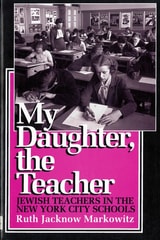
cover of My Daughter, the Teacher: Jewish Teachers in the New York City Schools

My Daughter, the Teacher

Jewish Teachers in the New York City Schools

Markowitz, Ruth Jacknow

Rutgers University Press, 1993
'My son, the doctor' and 'my daughter, the teacher' were among the most cherished phrases of Jewish immigrant parents," writes Ruth Markowitz in recounting this story of Jewish women who taught school in New York. Teaching was an attractive profession to the daughters of immigrants. It provided status, security, was compatible with marriage, and licenses did not require expensive training. In the interwar years, Jewish women in New York entered teaching in large and unprecedented numbers. In fact, by 1960 the majority of all New York teachers were Jewish women. By interviewing sixty-one retired teachers, Ruth Markowitz re-created their lives and the far-reaching influence they had on public education.These women faced many barriers--from lack of parental and financial support to discrimination--as they pursued their educations. Those women who completed their training still had difficulty finding teaching positions, especially during the Depression. Once hired, the teachers' days were filled with overcrowded classes, improperly maintained facilities, enormous amounts of paperwork, few free periods, and countless extracurricular obligations. They also found themselves providing social services; Markowitz finds a large number of teachers who took a special interest in minority children.The teachers Markowitz interviewed often agree with the assessment others have made that the 1930s were in their own way a golden age in the schools. The retired teachers remember the difficult times, but also their love of teaching and the difference they made in the classrooms. Their energy, initiative, and drive will help inspire teachers today, who face the serious problems of drugs, teenage pregnancy, and violence in their classrooms.
[more]
cover of Tales Out of School: Gender, Longing, and the Teacher in Fiction and Film

Tales Out of School

Gender, Longing, and the Teacher in Fiction and Film

Jo Keroes

Southern Illinois University Press, 1999

Jo Keroes's scope is wide: she examines the teacher as represented in fiction and film in works ranging from the twelfth-century letters of Abelard and Heloise to contemporary films such as Dangerous Minds and Educating Rita. And from the twelfth through the twentieth century, Keroes shows, the teaching encounter is essentially erotic.

Tracing the roots of eros from cultural as well as psychological perspectives, Keroes defines erotic in terms broader than the merely sexual. She analyzes ways in which teachers serve as convenient figures on whom to map conflicts about gender, power, and desire. To show how portrayals of men and women differ, she examines pairs of texts, using a film or a novel with a woman protagonist (Up the Down Staircase, for example) as counterpoint to one featuring a male teacher (Blackboard Jungle) or The Prime of Miss Jean Brodie balanced against Dead Poets Society.

The portrayals of teachers, like all images a culture presents of itself, reveal much about our private and social selves. Keroes points out authentic accounts of authoritative women teachers who are admired and respected by colleagues and students alike. Real teachers differ from the stereotypes we see in fiction and film, however. Male teachers are often portrayed as heroes in film and fallibly human in fiction, whereas women in either genre are likely to be monstrous or muddled and are virtually never women of color. Among other things, Keroes demonstrates, the tension between reality and representation reveals society's ambivalence about power in the hands of women.
[more]
cover of Teacher of the Logos: Essays on Origen's Rediscovered Last Work

Teacher of the Logos

Essays on Origen's Rediscovered Last Work

Joseph W. Trigg

Catholic University of America Press, 2025
In 2012 Marina Molin Pradel, an archivist at the Bavarian State Library discovered that CMG 314, a long-neglected Byzantine manuscript , contained twenty-nine homilies by Origen, the most important and most talented genius of early Christianity. He delivered these homilies around 259 CE, shortly before arrest and torture during the Decian persecution would put an end to his work. Thus, along with the Contra Celsum, Origen’s lengthy defense of Christianity, written after 248, when that persecution was clearly impending, they enable readers to appreciate Origen’s fully-developed thought. Except for the four of these homilies that had been translated into Latin in the fifth century, scholars of Origen thought that all the homilies on the Psalms had been lost. In 2015 Lorenzo Perrone of the University of Bologna, an eminent Origen scholar, assisted by a team including Dr. Pradel, produced a magnificent critical edition of the text. In 2017 the editors of this volume organized a colloquium in Washington, DC, generously hosted by the program in Early Christian Studies. The authors of this volume, a group of American and Canadian scholars, invited Professor Perrone to address the discovery of the homilies and his edition, and to join their discussion of their interpretation. This volume represents the group’s energetic investigations and discussion over the two days of the conference. The essays address Origen’s use of language, his philosophical interests, his relationship with Judaism, and his scholarly patrimony in the next century.
[more]
cover of The Adeodatus Handbook on Catholic Education and Culture: Volume 1: From Jesus the Teacher to St. John Henry Newman

The Adeodatus Handbook on Catholic Education and Culture

Volume 1: From Jesus the Teacher to St. John Henry Newman

Alex E. Lessard

Catholic University of America Press, 2025
Catholic education stands in need of renewal, for it too has experienced the consequences of the rupture of faith and reason in the modern period. Secularism affects Catholic schools as well as public ones when faith remains confined solely to a religion class or the celebration of the Mass. Our past provides a model of integration: the unity of divine revelations and the liberal arts and a life of wisdom that pursues what is truly highest. Modern people too often settle for less—little comforts and distractions—while the theologians, philosophers, and educators of the past spur us on to stop at nothing less than God’s invitation to enter his divine life. This first volume of the Adeodatus Handbook seeks to provide inspiration to return to the central vision of Catholic education: an integrated approach to the liberal arts that flows from God’s initiative toward us and is ordered toward eternal union with him. The essays of this volume unfold the narrative offered in this introduction in more detail. We consider them to be the most essential figures who have established the Catholic approach to education. Two of them, Plato and Aristotle, were pagan authors who formed the philosophical basis of the Catholic approach. The others, flowing from the Incarnation of the Son of God, appropriated the truths of nature contemplated by philosophy and drew them into a sacramental synthesis with the truths of divine revelation. There can be no genuine Christian education that does help the student to contemplate the whole of reality and to live a life of wisdom, rooted in the virtues that perfect human nature while ultimately receptive of the gifts and fruits of the Holy Spirit. The majority of the figures addressed in this volume are canonized saints, pointing us to the priority of holiness in Catholic education. Education serves the ultimate aim of human life: our perfect happiness in the beatific vision. To reach this, we need the support of mentors and friends. This requires the concrete embodiment of Christian community within the home and school. It can also, however, flow from our communion with the great sainted educators of our heritage. We have inherited their legacy, and with their prayers and support, we have been tasked with continuing in our own age. We will not be able to replicate their efforts, but with the grace and inspiration of the Holy Spirit, we can make our contribution in educating the youth, young adults, seminarians, and lay people of the Church of God.
[more]
cover of The Concubine, the Princess, and the Teacher: Voices from the Ottoman Harem

The Concubine, the Princess, and the Teacher

Voices from the Ottoman Harem

Translated and edited by Douglas Scott Brookes

University of Texas Press, 2008

In the Western imagination, the Middle Eastern harem was a place of sex, debauchery, slavery, miscegenation, power, riches, and sheer abandon. But for the women and children who actually inhabited this realm of the imperial palace, the reality was vastly different. In this collection of translated memoirs, three women who lived in the Ottoman imperial harem in Istanbul between 1876 and 1924 offer a fascinating glimpse "behind the veil" into the lives of Muslim palace women of the late nineteenth and early twentieth centuries.

The memoirists are Filizten, concubine to Sultan Murad V; Princess Ayse, daughter of Sultan Abdulhamid II; and Safiye, a schoolteacher who instructed the grandchildren and harem ladies of Sultan Mehmed V. Their recollections of the Ottoman harem reveal the rigid protocol and hierarchy that governed the lives of the imperial family and concubines, as well as the hundreds of slave women and black eunuchs in service to them. The memoirists show that, far from being a place of debauchery, the harem was a family home in which polite and refined behavior prevailed. Douglas Brookes explains the social structure of the nineteenth-century Ottoman palace harem in his introduction.

These three memoirs, written across a half century and by women of differing social classes, offer a fuller and richer portrait of the Ottoman imperial harem than has ever before been available in English.
[more]
cover of The Teacher; The Free Choice of the Will; Grace and Free Will

The Teacher; The Free Choice of the Will; Grace and Free Will

Saint Augustine

Catholic University of America Press, 1968
No description available
[more]
cover of The Vocation of a Teacher: Rhetorical Occasions, 1967-1988

The Vocation of a Teacher

Rhetorical Occasions, 1967-1988

Wayne C. Booth

University of Chicago Press, 1989

This critically acclaimed collection is both a passionate celebration of teaching as a vocation and an argument for rhetoric as the center of liberal education. While Booth provides an eloquent personal account of the pleasures of teaching, he also vigorously exposes the political and economic scandals that frustrate even the most dedicated educators.

"[Booth] is unusually adept at addressing a wide variety of audiences. From deep in the heart of this academic jungle, he shows a clear eye and a firm step."—Alison Friesinger Hill, New York Times Book Review

"A cause for celebration. . . . What an uncommon man is Wayne Booth. What an uncommon book he has provided for our reflection."—James Squire, Educational Leadership

"This book stands as a vigorous reminder of the traditional virtues of the scholar-teacher."—Brian Cox, Times Literary Supplement
 
[more]